Machine Music's Albums of the Decade: An Interview with Afterbirth
This is the 55th installment of the Albums of the Decade series of interviews. For the rest of the series go HERE.]
Artist: Afterbirth
Album: The Time Traveller's Dilemma
Year: 2017
Label: Unique Leader Records
Favorite Song: "Maggots in Her Smile"

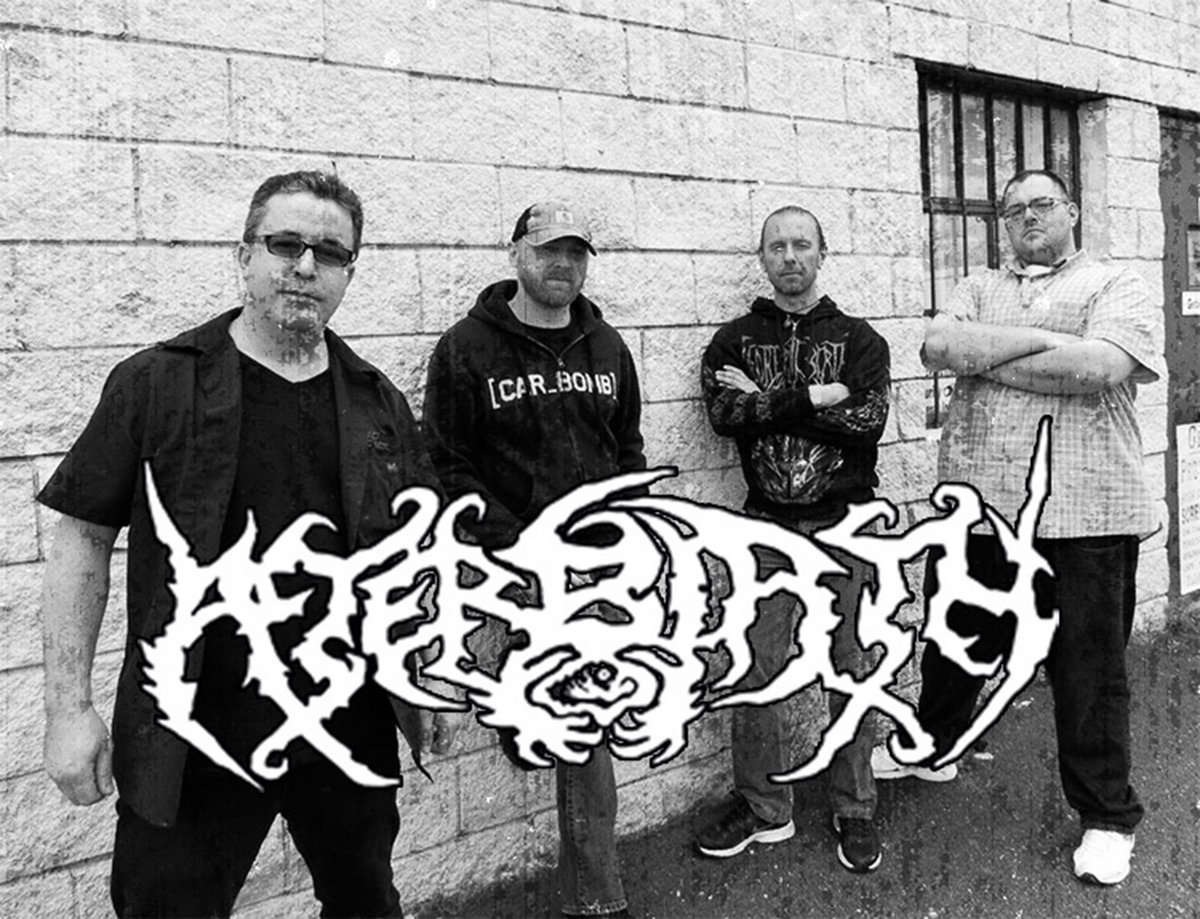
The Bare Bones: The Time Traveller's Dilemma is the debut album from Long Island death metal band, coming 24 years after its formation in 1993. The album features Cody Drasser (guitars), Keith Harris (drums), David Case (bass), and Will Smith (vocals).
The Beating Heart: The Time Traveller's Dilemma is an album that really shouldn't exist. It shouldn't exist because the band that recorded it had both formed 24 years prior, as well as spent the vast majority of that time, around 20 years, broken up. It shouldn't exist simply on those terms. Teenagers recording a demo together and calling it quits isn't your usually ticket to the death metal hall of fame. That was my thinking also when I first found out, quite randomly, about the album, and then proceeded to freak out about it in a special emergency post way back in January of 2019, six years ago, almost to the day. That post was not only triggered by the novelty of a band coming back from the dead to record their debut album – that would not have been enough. It was about that too, of course, and about the fact that this good of an album could fly so deeply under the radar.
But what tipped me over the edge, and what tips me over the edge still when it comes to The Time Traveller's Dilemma, is that a "brutal" band rarely sounds this creative, damn-near progressive, and beautiful, let alone a brutal band who didn't play together for almost two decades. This isn't kids growing up and attempting to recapture some youthful idiocy, this is grown ups, mature artists, making that rare, wonderful leap from a dirty sketchbook to a masterpiece.
Naturally, since 2019 a lot has changed for Afterbirth. They have continued to grow and evolve, and, as importantly, have gained a whole new audience, especially with the release of their amazing 2020 sophomore album, Four Dimensional Flesh. (which was also very high on my best of 2020 list). But Time Traveller's Dilemma is still the one closest to my heart. You might say it's the result of that all-too-known intimacy we share with albums we "found" randomly, but I think as time goes by both TTD and Four Dimensional will go down as two of the best death metal albums of this era. Which is why I decided to FINALLY sit down with Cody Drasser and talk about the band, that album, and just creativity overall.
On a personal note: These interviews take a whole while to work on (this conversation with Cody was originally held around October 2024), and so the patience of all involved is greatly appreciated. I might add that the video of the interview was available to Patreon supporters already in October, and a good opportunity as any to thank those who support my work there.
As always, you check out my various interview projects and other cool shit. And if you'd like to keep abreast of the latest, most pressing developments follow us wherever I may roam (FALSE!) (Twitter, Facebook, Instagram, Spotify and now also a tape-per-day series on TIK TOK!), and listen to my, I guess, active (?) podcast (YouTube, Spotify, Apple), and to check out our amazing compilation albums. You can support my unholy work here (Patreon), if you feel like it. Early access to our bigger projects, weekly exclusive recommendations and playlists, and that wonderful feeling that you're encouraging a life-consuming habit. On to Cody and Afterbirth:
Do you remember a moment you had with a song or an album or a performance that really kind of shook you or shocked you or surprised you in that “I didn't know music could be that” kind of way? And adding the caveat I always have to add that obviously that might have happened last week, but I guess an earlier version of that when you were a younger person. Can you think of anything like that?
I often think back on when I was younger, teenage years, when I was first getting into heavy metal and death metal in particular,I had this moment where my best friend Dave, who's the bass player in Afterbirth, we had gone to a local music store and I had bought Suffocation’s Effigy of the Forgotten, just based on the cover art I hadn't heard the band yet, and I was just like: “How can I not buy this?” you know? “I have to hear what this sounds like.” Which was a big gamble back in like 1991 or something like that, when I didn't have a job and this was weeks of allowance money from my parents.
So, I bought that. I believe Dave actually bought Nevermind by Nirvana, and so we both came home and went to our respective houses. And I assume Dave was also listening to the album he bought, and I put it on and I wasn't quite prepared for the hammer dropping on me and my CD player I played it. I was just, you know, mouth agape. I just had no idea that music could be like that. Obviously I liked heavy metal and some heavy thrash and some even cursory forays into death metal at that point, but I didn't know it could be like that. And so, I listened to the album in its entirety, just spellbound. And then immediately after or shortly thereafter, I called him and I said “Dave, you have to come over here and listen to this.” I couldn't even formulate the words. I'm like: “I don't know how to tell you what I just listened to, but you have to come over and listen to this.” And he actually said the same thing about Nirvana's Nevermind. So, I probably went over to his house because his parents weren't around as much, so we had a little bit less supervision over there. So, that was a moment that's never really left me and I'm always sort of chasing the tail of that sort of experience, whether it's music that I'm purchasing, I'm always sort of looking for that. I don't want to be flippant about this, but almost like a junkie looking for that very specific fix. I don't find it that often.
Have you gotten closer as you've gotten older to understanding what it was about that that kind of did that for you? Or have you accumulated more examples of similar experiences that you are kind of getting closer to understanding?
I don't know if I'm getting closer to understanding that thing we're talking about, there's an essence there that I can't quite pinpoint, and don't necessarily feel the need to pinpoint. I like mystery – there's so little mystery in music nowadays that if I never find out, then I'm alright with that. I don't know what caused it. I've had some similar moments here and there, I can’t remember exactly what band or album did it, but I’ll get it. It might just be for a small moment. Like: “Wow, whatever this band and group is doing in this part of the song is just a microscopic view of what I might have experienced when I was younger.” I think part of it is novelty. So, I was young. I hadn't heard anything like that. My mind wasn't inundated and basically trashed [laughs] by the constant flow of albums nowadays. I didn't have that growing up. For better or for worse, you know, so a lot of it is novelty.
It's funny because when you think of the frequency of albums coming out today, it makes you think of the younger me as kind of a poser, because really, how many albums are we talking about that changed my life back then? Four Carcass albums, four Megadeth albums, a couple of Death albums you got into black metal, maybe a nice little couple of albums. It’s not a huge amount of music, and it was always kind of very limited by budget, right?
Absolutely.
And by what you had access to, what you know about.
Geographical location.
Yeah, there was a proximity thing with Suffocation too, right?
Yeah, at the time at least they were mostly based out of a town called Coram, which was like 20 minutes from me.
So when you listened to that, did you know that?
I can't recall if I knew that at the time, I'm going to go ahead and say “no,” I didn't know that initially and then I think I found out that they were locals not too long after that. I just couldn't believe it, like: “Wow, these dudes are only four or five years older than me, that’s insane” I didn’t think of myself as being a good guitarist then. I was rough and not as good as I am now, I'm not saying I'm very good at all, but back then I was not anywhere near. I'm a little bit more fluent with the guitar right now [laughs]. But it was such a singular moment for me. It was almost like being born, it’s crazy. I felt like “I'm home,” or: “This is my sound” or “These are my people.” And it was hard not to want to be a Suffocation clone at that time because, you know, you're young, you can't really formulate too many of your own ideas, so you try to take others’ ideas and pretend they're yours. So I did that for a while. But that was the moment for me.
I mean, that's a very interesting experience. Because at least part of what you describe is awe and fear or shock or a lack of comprehension – unintentionally quoting Chuck Schuldiner there
[Laughs] Yeah.
So there's this entire field of emotions based on not really understanding what's going on, but at the same time we're talking about, you know, “birth,” and finding your people and feeling at home. That's a very strange combination.
Yeah. It's almost like I hadn't known what it felt like for my DNA to vibrate in unison with anything else at that point, you know. I hadn't yet had sex, I hadn't dabbled in drugs. I didn't have any connection or intimacy that you might describe, maybe in relation to drugs or sexual contact. So, music was the only place I got it. So it was almost like out of a science fiction film – as if you could zoom in on my DNA it would just stand up and start to vibrate [laughs]. And I still can feel exactly like that.
The older I get, the more I think about my favorite heavy album ever …And Justice for All by Metallica. When I think about how much time I've spent inside of that album. I just think that is also a very similar experience. Not quite the same experience I had with Effigy of the Forgotten, it was a little more subtle. I actually didn't realize it was creeping into my life the way it did, it was more insidious compared with the immediacy of what Suffocation did to me.
Insidious how?
I just didn't realize how slowly it had its hooks into me. How even still…. Like, if I go out for a run or I just decide to go for a drive and I put it on – as soon as I hear that feedback and Kirk Hammett's backward solo before “Blackened”…. Just talking about it, my hair is standing up. That album is really deeply embedded in my DNA, and that is definitely on par with the Suffocation thing. I just didn't realize where that album would take me, I guess, when I was first hearing it, I kind of had more of a spiritual vision, when I first heard Suffocation. It was like I saw life and the universe all spread out before me in something like a weird, condensed nanosecond. I didn't really feel that way with Metallica. It was like some God giving me a gift and turning around and snickering and walking away, not realizing that this would change my life.
It's interesting because I think I had that moment with the inverted intro into “Blackened.” I'm a bit younger than you, so I think I got to that album in the early 90s, when, for some strange reason the “One”video was getting crazy airplay, even though the album came out a few years before. This was the height of Nirvana insanity. And so I thought to myself that I really liked that song, and so I got the album. So I got the CD and at the time I had this habit…. I had a shitty stereo system, so when I got a new CD I would first listen to it on my Discman, because then I could really listen with my earphones and all that.
So you could pay attention to it and take it in.
Yeah. So, a 13-year-old me or a 12-year old me is really focusing on this new album, right? Just like opening the lyrics sheet and getting ready. And this creeping kind of thing comes in, and then that “Blackened” riff begins, and I remember being shocked because it wasn't like “One” at all. That had a really slow buildup. It obviously has the solo and the double bass machine-gun thing, but really it was a very slow build.
It takes a long time for “One” to get where it's going.
Yeah, and “Blackened” is like warp 10, immediately. And not only is it warp 10 immediately, it's such an eerie beginning. It's such a strange, alien beginning. Like, what am I listening to? A guitar? Is this a violin? What's going on here? And then it just bapa into you
Yep.
And I remember being physically afraid, which I still love. I love that feeling of being freaked out by something. A relatively recent example of this would be like Lingua Ignota. I remember listening to Caligula for the first time and thinking, for the entire duration: “What the hell is going on with my body?”
Oh yeah.
“Something strange is going on.” So, I get that completely about “Blackened” and I think that's why …And Justice is such an interesting album in their catalog, in general, because it gets a lot of shit for being kind of lifeless. But really it's power is that it's lifeless, that it's this surgical evil thing.
Yeah, it's very precise. It's very surgical. And I just came of age at a time where I wasn't like a disenchanted Metallica fan. I guess you could say when … And Justice for All came out. I was not only a new Metallica fan, I didn't even know I was a Metallica fan. I was barely a heavy metal fan. I was just dabbling with it, and I was actually afraid in a sense of metal, and didn't understand my attraction to it, because it seemed like something that older, less reputable teenagers did. And here I am, on the cusp of my teen years – I was very preppy when I was 12 or 13, and this was when I was getting into it. And I was thinking of myself, my future self, as being one way and then I'm like: “I can listen to this music and be attracted to it” and know that my life is not going to go where I thought it was going to go [yeah].
But in a kind of exciting way. I mean, there is a freakish enjoyment about, say, listening to – I don’t know – say, an Afterbirth album – blaring in your headphones, just going on the bus. There is something. about that jarring experience that to me kind of feels like a bit of what you're saying. I look like a normal person, and we're doing the same thing – I'm going on the bus like you. But I'm listening to the world fall apart.
Yes [laughs].
And shrieking and dissonant drifts are going on in my mind. And that's just who I am. I mean it's like the secrets about me that you might not know about me, that I find very appealing. But I guess I wanted to know how soon after that….. For instance, with the Suffocation thing. So how quick was it a transition between you saying? “Holy shit, the cosmos is unfolding” and “I want to be in a band”?
Well, I was already sort of jamming with Dave – he played bass, I played guitar. We would noodle around on occasion with Dave's older brother, who played drums. Sometimes I would play – poorly [laughs] some Metallica riffs with him. He just needed someone to keep rhythm with. He didn't want to play drums by himself. It didn't matter how crappy the guitar was. He was like: “Cody, come over here, I need someone to play drums with.” So, though I wasn't in a band with like two, three, four, five individuals, I would play with Dave and that felt like a band to me…. Or I would jam with his brother Matt. That felt like a band then. Or we would casually get together with some kid I didn't even know around the block who played guitar with some other kid, who I knew even less, who played drums in some stranger's house, and we would try to write songs. Actually, there was a lot of that going on. There were these very short lived bands I was in. We would get together and be in a band for a weekend.
Did those bands have names?
One of them did. Torture Chamber was one of those lands [laughs].
Good name.
Yeah. None of the other bands really had names, but I would come up with names on my own and I would draw their logos and everything, and I would have these fantasies of putting out an album or playing a gig, or just being better [laughs], being a better guitarist. Everything has its own way of unfolding, and it was unfolding even then that I would eventually be in a band like Afterbirth. I just had to….. You know that old aphorism: “Just trust the process.” I didn't realize that life is just a process ,and you can't really rush it. Before long I was in a band. Not too many years later, I met Matt who was the vocalist for Afterbirth, and then we searched for a drummer and we found a bass player and we went through a few early incarnations of the band. It was only like a few years later, I think, from I heard Suffocation. I was maybe 15 or 14. And then, when Afterbirth formed, even though it wasn't really a full band yet, I was only 17, barely 18. It was only like 3 or 4 years later.
I mean, you said everything was a process. So I guess my question is: How do you feel about the years during which Afterbirth wasn't a band? [meaning the break until 2013] Was that part of the process as well?
Yeah.
Looking back, What part was that of the process? I mean other than other than, I guess, maturing as a person or as a musician or whatever. What took place when you weren't the band that helped you become a band or when you became a band?
Well, that time period, whether you want to call it – a hiatus or a pregnant pause – it has to be part of the process, whether I realized it or not at that time. I had given up on Afterbirth. When Afterbirth first broke up, I didn't think about Afterbirth at all. It didn't make me sad, it didn't make me angry, it didn't make me happy. I just didn't even think about it. I was like: “OK, what's the next thing?” And I was in a bunch of bands after that that didn't go anywhere. Sometimes we played shows, sometimes we made demos, sometimes we didn't do anything – we would jam in someone’s back room, and wrote some songs. During a large part of that time period before we got back together I wasn't even playing guitar. Not traditionally – I wasn't playing guitar in a death metal band, I was just making drone noise music with my guitar, because I could do it on my own and I didn't need to ask for anybody's input. And I didn't need to bother with anybody, I didn't need to rent a jam space.
So, all of that did contribute somehow to the process. I don't purport to understand how, but it must have. I know I grew as a musician. If you have any self-awareness, I guess you can't help but notice that you mature and grow as a person and you grow and mature in regards to the things that you have a tendency to gravitate towards. So, I was maturing as a guitar player, maybe not in the ways that I had thought – I wasn't a Steven Vai or Paul Gilbert type guitar player, but I was definitely becoming more locked in on what I felt comfortable with and creating music that felt at least unique to me. It was not that childhood dream of a few years back of wanting to be Terrence Hobbs, you know, or Doug Cerrito from Suffocation. I got to a point in that process where I'm like: “This is Cody. This is what Cody does, and I'm cool with that.”
So the fact that you did the whole drone thing, which is still something you do.
Oh yeah, I just put out something today. On my Bandcamp.
I think I saw a notification from Peacock Records as I was logging onto my computer. So you still do that, and you did do that before the band got back together. And so what that makes me kind of wonder is: When the death metal thing came back, and Cody is doing drone. He is not insisting on using his instrument in a flashy way, right? Almost like a deconstructed, abstracted way of just thinking about song structures and not just the pulses that have to be there the entire time, much less ADHD. Right?
Yeah.
So when the band comes back, is that in sync with the band? You as an abstract musical artist, does it make sense? Do you say to yourself: “Aha, this is the piece that I've been missing all those years!” Do you say: “What the fuck, I thought I was done with this bullshit? How did the two tracks align for you as a musician?
I don't know if they aligned at all then, or even now. When there was the opportunity to get back together, and I discussed it with Dave and the other guys, we just sort of came to this conclusion of: “Well, why not try? Why not experiment with the band again?” So I was like: “OK. I have nothing to lose. Nothing's gonna hurt me if I go back into a jam room with you guys, nothing.” But during some of those creative sessions I would introduce riffs to them that I was like working on by myself, at home. Not necessarily writing songs, but I still just wrote riffs, and I would piece riffs together and I thought maybe that could be a song and I would show them. And there were definitely some riffs in some songs where I even said I said before I showed them to them: “Look, I'm going to show you this riff or this section, and I don't know if it's Afterbirth, but this is what's coming out of me now. So it doesn't make sense to not show you, because I can't force myself to play like I did on the demo,” which was the only reference point I had for the band. So it was: “I can't make music like this anymore. I literally can't, and so here's what I'm writing now and hopefully it'll be good and hopefully you'll like it.” And no one ever vetoed me on it, so…
What was the reaction to that?
I don't know if it was anything major, it wasn't fireworks going off. It was just, actually, a very casual acceptance of what I was writing. No one ever said “I don't like that.” It was just like: “OK, cool. So that's the next riff. Great. I got it. What's the riff after that?” So I was like: “OK, moving on.” We didn't even spend a lot of time on it. It wasn't like we had to have think tanks on the future of Afterbirth, like: “Is this Afterbirth? And what does Afterbirth look like?”
“The future of the brand”
No one even thought about the future of the band. We didn't care if we were, say, betraying the “brand,” betraying the demo, you know? We weren't around long enough to really create a brand, so it was like: “This is the brand now. This is what we're doing and if people are into it, that's cool. And if they're not, well then that's cool too.” We weren’t going to force anyone to like us.
I've never written music and I think the world should thank me for that. But I have written, and I think that one of the things that happens – I’m not sure if the word “fun” is adequate – but challenging and interesting and what really makes you want to kind of do it, is a feeling that you did good work. That you've cleansed a clogged pore, that something good was rinsed out of you, right? That kind of thing.
Yeah.
And often when that happens, the process isn't really: “Well, I'm going to write something great today!”, right? The process is more like: “Let's see what comes out, and if I like what comes out then that's that's OK.” But that presents a new problem because now this exists, and now how do you put something after it?
Yeah. And that's a very creative thing. And I deal with that with my visual art as well. So, both visually and musically. That when you have something good it creates another set of problems, like you just said. They're creative problems. It's not like the problem of my tire blowing out on the side of a snow bank, it's not that sort of problem. It's not a life-and-death problem, but it is a problem of “What's next?” And a part of me lets out a sigh and I roll my eyes a little bit, because I'm like: “Where am I going to find the energy now to deal with this problem? I have to go forward.” Well, actually, I don't have to. I don't have to do anything. But I choose to go forward. So, how are we going to deal with this? And I feel like, like right now Afterbirth is writing our next album, and we're like, I don't know, maybe a third or maybe half done. We've got a bunch of stuff, some tracks are finished, some are in the works and. We deal with that like all the time, like even sometimes just physically taking myself to practice is a creative problem. I have to find the energy to get out of bed, to take care of my children, to make my coffee, to go to the bank, to go to practice, and all that stuff. Those are creative problems too. Sometimes I just don't want to do it, but I do it anyway.

A collage by Cody Drasser
Right. I guess I wonder because one of the things that I thought about…. So, if I was in Afterbirth in 1993, which of course I was, as you well know, is documented, and I deserve my part and royalties and such and such.
Yes. The world. Will finally hear about it now.
Finally, finally. The expose that no one has been waiting for. Anyway, so if I were an Afterbirth in 1993, as a kid, basically as a kid, and then then I came back to that band 20 years later and started to kind of feel around. So, you saying: “This is who I am now,” right? The band saying: “Yeah, no problem,” that's a big thing.
Yeah.
That's a big experience of welcoming and accepting, and all that good stuff. But I can't help but think – and this is going back to the question of what happened to the process in the 20 years you worked together – that that’s an adult decision. I'm not sure kids can make that decision as readily. I'm not sure kids can say: “Well, I respect this different vision, let's insert it into the timeline and see what comes next.” You see what I'm saying?
I do. I think I do, at least, you know, I'm taking in what you're saying.
That maybe the way you guys gelled later in life happened the way it did because it was you guys being older and maybe already carrying different ideas about what creativity is, even, and how you construct art? That you had to get to that point separately, and when you were all ready to get back in the band you did?
Yeah. I can't disagree, because it is an adult thing to get into a space with two, three other adults and be OK with what's happening, even if maybe you have a little bit of resistance to what's happening. The mature thing to say or do is “OK, I'm listening. I'm willing to entertain this for a little bit and see where it takes me.”
Yeah.
And then you keep doing that. And then of course you get to some points where you're like: “No, I really dislike that. Can we make this work without it?” or: “Can we make this work and will you accept my input on changing it?” That's a very adult thing to do, which wasn't happening when we were first in the band. The whole reason the band split up was because of that very reason. You're young, you're full of ideas, but you don't know how to communicate very well, and you're very emotional and we were still young men. We weren't very mature young men, at that. We were 20 or something like that. You know, my frontal lobe isn’t formed.
[Laughs] It’s not! So I guess part of the process in our breakup – our long-term breakup or hiatus prior to getting back together – was, at least for me, just being a person and growing up and experiencing things – joyful and heartbreaking – and just going through the motions of day-to-day life and seeing what it has to offer you and trying to claim some joy in this life. Whatever that means. Something like that.
Yeah. I think I wonder to what extent it also involves – not trying to get too spiritual here – a kind of letting go, maybe. on the musical level of the band, you’re letting go of the riffs you would have liked to write and kind of accepting the riffs you are writing
Yeah.
But also letting go of what it means to make stuff. That you don't really understand the process, you don't really know what feels good. You just know that it feels good, and so you do it.
Yeah. I don't know any other way to live, and that's just me. I've always been driven to do something creative, whether it's visual art or making music, that's primarily what I do. I'm not much of a writer, even though I'd love to write a book or something, I'm just not much of a writer. So, this is how life is for me. And it is that way for my other bandmates as well, to whatever extent it is for them. I don't really know what else to do with life. I'm doing what's expected: I have a job, I have a family, and I'm paying bills, and I'm dismayed at the current events of the world and I wish it wasn't like that. But that can't be it for me.
Same.
It is for some people. For some people it is it. And whether they've been broken down by the system and have been brought to that state and have given up on their dreams, or they never had dreams to begin with and they were just always in that place…
I actually think there's another option there. I think that dreams are badly advertised. I think that if people knew that to live your dream, or to create a dream, not even live your dream, that to touch that process, you don't have to be good at anything. you don't have to be knowledgeable about anything. All you have to do is feel around if what it is that's happening is to your liking or not. And if it isn't, to search a bit until you find it. And I think if people knew that it was really that simple. t's not a difficult thing. I mean, obviously it's difficult to make it amazing, but it's not a difficult thing to do just in general. It's putting shit together, right? Like your collages, slapping stuff on top of stuff. That's all it takes. And I think if people knew that they wouldn't be so intimidated by what they think is involved in doing something like that, then you would have more people doing it instead of being, like you said, broken down.
Yeah, I agree with that. And also people before they have a dream, or before they dream, they'll see someone else's dream, and that other person's dream seems big. It's evolved, and it's complex, and it's desirable. And they’ll think: “I want that.” But you can't just have that. To have that you have to wake up every day and work at a dream. That's the whole thing. Dreaming is work. Everything is work. Making a collage is work. Making a song is work. Making music with your partner, having a relationship is work. Most days you don't see the results of that, but you have to keep at it, and every now and again you'll feel it, or you'll see it, or you'll get feedback from a person, or from the universe somehow, that you've been doing the work and someone notices.
Yeah. I wouldn't say enough feedback, but yeah, some feedback. I agree with you, but I think I want to kind of lay a little layer of empathy on it, because when people see your complex, realized vision, there is a reason they think that if they try something for a bit and it isn't really that what they wanted that they failed. And the reason is that there's an ideal of what art is. That it’s this wellspring of inspiration that things just pop out of people’s minds fully formed, and there's really not that much discussion of the daily grind that really involves, sometimes not getting anything done or getting very little done. That it accumulates over time.
That’s right.
I think more people need to know this. This is my idea of what art education is, breaking down art to what it really is on a daily basis. Yes, geniuses exist, but we don't have to be a genius….. Did we talk about this online or something – that I online or whatever I did a Howls of Ebb interview a whole ago?
Well, I'm a huge fan of that band, so I don't….
I think we did talk about it. Maybe you haven't read it yet, but anyway, one of the things that came up in that interview was that as I was preparing for the interview, and one of the things that came up in my mind a lot was Howls of Ebb sounds like them and them alone. How it feels so organic and stretched and almost surrealist. And I had this errant thought in my head, I was like: “I think about this music as “That's Patrick Brown's mind”. That's how it works. “But I wonder” – and this was on my mind as I was just editing my book – “I wonder if what I'm listening to is the result of Patrick Brown just being Patrick Brown, or whatever that shit means, or is it Patrick Brown going over his drafts over and over again until they feel like they fit? And I was like, “OK, I wonder.” And I asked him that question. And I said: “Is it just how you write music or is it the product of relentless editing?” And he said: “Relentless editing.” And I was like, holy fucking shit”….
Yeah, I can totally relate to that. I totally can relate to that.
So there's a gap that I'm talking about, the gap between the listener who says: “Oh my God, who would even attempt anything like this,” and the method through which the artist achieves it, which is a very human, everyday, nerdy thing.
Oh yeah, it's available to everybody. That's just how you know, it turns out for Howls of Ebb, or for Mr. Brown. Like, that's what it sounds like. So even though it's relentless editing, when you get to the distillation of it all, it is his mind, it is him. But it does take editing to get there, you know, because not every idea is great. There are dead ends in creativity. There are sometimes too many avenues in creativity, and you have to choose one, because you can't bifurcate yourself and go down two paths at the same time, you can only go down one path, then you have the option of following that path to its logical end, and then returning back and going to another path – you can do that. So, it has to be relentless editing, you know, and I don't see anything wrong with that.
I think it's great. I think people need to know that that's real life. Because I think if they knew that that was real life, they would not be broken.
Yeah, they would see that it's available to them and that this is what everybody does. But it does take time. It takes time every day. Even if it's only five minutes today and 10 minutes tomorrow, an hour on Wednesday, and then no minutes for the next two days, that's just how it is. It's the accumulation of time and your efforts.
So, one aspect about Time Traveller’s Dilemma that relates to this topic. I mean, we could talk about the album and how it came to be and all that. I mean, we can get to that, if you'd like. But…. OK, let's start with a listening journal. Every time I listen to Time Traveller’s Dilemma I then go: “Ah! Look! So many riffs! Everything is happening!” It's great. I'm enjoying myself. It's a fantastic death metal album. I'm having a great time. And then very soon thereafter, somewhere mid “Maggots in Hers Smile” It turns to: “This is not a normal album.”
[Laughs]
I swear, it's like that every single time. And what does that to me is the melody. There's this melodic break in the middle of that song where the guitar is kind of open, and the bass comes through and it's all very kind of open, almost happy.
Yeah!
It's almost a happy moment, a happy, proggy moment in the middle of a very heavy song. And that seems to me like one of the biggest things that are different about Time Traveller’s Dilemma, that may have not necessarily been there in the demo, and it feels like it's one of the stands on which you builded on when you moved ahead.
So I guess the question would be: When did you find out it was OK to have melody, pretty, beautiful parts, somber beautiful parts, sometimes happy in the middle of very aggressive music. Is that something that was always kind of very clear to you that those things fit together?
It wasn't like I had any realization. I wasn't, like, struck over the head. It was just…. I know the part you're talking about, and there's a bunch of riffs like that on that album.
Oh, I have a list. You want to hear my list?
[Laughs] Sure.
OK, My list is “Maggots in her Smile,” in the middle “Multiverse Dementia” toward the end, “Sifting through the Sands of Unholy” toward the end, and the beginning of “Timeless Formless,” of which I wrote almost “Hum-like.”
And there's a couple more like there's a riff right in the middle of “Eternal Return” that sort of does that. And that actually was like the riff I presented to the band, going: “OK, we could go down this road or not.” But there was never any realization like: “Oh, I can meld these two worlds together.” To me, it was just one world. Because I'm one person. I'm not two people. I'm not three. I mean….
Yeah. I can see just one.
[Laughs] It's just strange to think [about it]. It was never a thought, I never had a struggle, or a dilemma. Maybe once or twice before the band got together I would question, more rhetorically, not even like I had to sit down and answer, but I would just think: “Is this riff for Afterbirth?” And then just after a couple of times of writing these riffs, I was like: “Well, yeah. This is a riff for Afterbirth. And maybe this is not a typical 90s Long Island, brutal death metal riff, but it's still, it's coming from me, so it exists in that world. And this is the riff that's currently coming out of me. So, it either makes sense in the song or it's gonna make sense in another song. But I'm gonna put it in here somehow.” Obviously there are times where riffs don't work at all, so I'm not talking about forcing a riff.
I just think it's necessary to do that, to blend styles, to give the listener. More to latch on to than just 240 BPMs for three minutes, jack hammering away at your brain. And that's fine too if bands want to do that – I love Hate Eternal, I love Brodequin. It's fine if you want to do that. I love those early Deeds of Flesh records, there's a reason why I like that stuff. But, for me, this is just what's coming out. It's not even a struggle. It's just that this is who I am. And if you like it, then it's great, and if you don't, then that's fine too. Someone else will gravitate toward it. So, yeah. I can't really pinpoint where it comes from or anything like that.
That’s my next question. Obviously those things work in the simple way of “Oh, I heard that album, I want to put that in my music. But in retrospect do you think – shall we say – “non metal” music had a role in this accepting those kinds of segments in your music?
I mean, probably, unbeknownst to me. I was always into death metal and heavy metal, but I listen to plenty of stuff that isn't that. I might listen to something really heavy and grinding one moment, and then I'll put on something that’s the antithesis to that the next.
And that influenced the palette? Not necessarily the decision to insert said section in said song, but that you had a wide spectrum of influences that might have contributed to you thinking: “Yeah, this might work”?
Without a doubt. Early on, after Afterbirth disbanded, I got into a lot of different kinds of music. Still heavy but not heavy metal, not death metal necessarily. Bands like Om, or Failure. And especially from New York, Long Island, a lot of post-hardcore sort of stuff where it was heavy, but there was more of a melodic sense to it. Big Spacey chords, these really very cool sounding chords. Or parts that sound like what’s coming is a hardcore beatdown and then it just opens up into this almost happy, nostalgic riff that evokes something from my childhood. I don't know why it does that, just the way the riffs sound. I really grew up on riffs like that, I guess.
In those kinds of moments, and also the fact that the bass on Time Travelers Dilemma sounds almost like…. Do you ever listen to ISIS?
Absolutely. I was obsessed with ISIS for a good three or four years. I had a hard, heavy ISIS period, yeah [laughs].
So, throughout the album, but especially when it comes out in those kinds of melodic moments, the bass almost has a kind of very clear Wavering Radiant kind of sound, feeling like more of a melodic musical instrument, the way Tool albums would use it, or ISIS, or Hum, Failure. Of that ilk. Quicksand. Whatever.
Absolutely, yeah.
I listened to the album repeatedly to figure out what it is I wanted to talk to you about, and the parts that kind of I always liked, I was like: “OK, why do I like those parts?” And there’s almost an alt-metal feel to some of them. And those are two of my biggest loves. You know, I grew up in the 90s. Those bands are huge for me and ISIS was huge for me and still is, by the way. Wavering Radiant is part of this series because I forced it in, despite being released in 2009.
So that alt metal kind of sensibility, with the brutal thing was really, I think what made that album so special, I think. It makes it very special and very listenable and dynamic because you never get bored. Everything keeps changing in unexpected ways. Not in like Mr. Bungle ways, but more melodic ways. I’m not sure I’m making any sense here.
Well, it works for me. You know alternative metal, 90's rock. I grew up on that stuff, at the same time as death metal. So, to me, when you look at it just from a perspective of just being alive in that decade, being a musician in that decade, it just makes total sense. Obviously, death metal was hugely important to me, it was my lifeblood. But then, you know, I would put on an album from Hum or The Smashing Pumpkins or Depeche Mode. Some of the things that like Martin Gore does on his guitar throughout those albums, it's just phenomenal. How could I not be inspired by that? And then as a result, how can you not produce your version of that, if you're being true to yourself.
I agree. But, again, I think this has to be somehow attributed to being an adult and making those decisions. Because I think it's very difficult to be 16….. I mean those people do exist. When I did the diSEMBOLWELEMT interview, that's basically what Renato said when I asked about the clean guitar parts in that album, that he was into bands like Chameleons and so on. But most people aren't like that as teenagers.
They're not.
Most people have pretty firm ideas as to what music needs to sound like.
Well, yeah, you're more concrete, and you're thinking is slightly illogical, you know, because you're trying to make sense of the world. You still don't even understand yourself, and you're trying to make sense of the world. So you sort of hardline yourself into certain ways of being in order to not be as fearful of the world. If you can control something when you're young. And I guess if you're a musician, maybe controlling the music, you're right, is the only thing you can control. So of course you're going to box yourself in.
Yeah. OK. Last question. Is there anything when you think about The Time Traveler’s Dilemma that you're still very proud of?
'm proud that we did it. Occasionally I'll revisit that album, and I don't know how we did it. I'm a little bit bowled over with the fact that it exists and I contributed to it. I don't even know how to play…. There's one or two songs on that album that I don't even know how to play anymore, and I don't even know how I wrote that. I mean, if I sat down with it, I would figure it out again. But the fact that I did write it with three other guys and it came out the way it did. it sort of snuck up in the death metal world and became somewhat respected. I'm not saying we're the most popular band ever, but, internationally, it's become something of a hidden gem of brutal progressive death metal. And I'm very proud of that. And more than being proud, I like to say that I'm grateful I was given the opportunity to reform the band and that I said “yes” and that those three other guys also said “yes.” And that we stuck to it and we wrote it. And even though there were a lot of ups and downs, in the beginning, especially, it's just amazing. AndI'm very proud of the fact that people love it and it gives me reason to continue, to keep writing music.

