This isn't an interesting post, don't read it
At times writing this blog/zine/website/house-of-horrors is therapeutic. I would say it's mostly that, especially since 2020-ish when my life, your life, swiveled into "a documentary about the early twentieth century" territory. It's only gotten worse, and I guess the existence of this "space" as well as the readership that came with it was a big reason that I have yet to become a corpse. I mean, I'm not a corpse, not yet, but surrounded by more and more of them, and they're stacking high. My middle child, my beautiful, clever boy, is seven years old now, which means all of his life, at least the part he remembers, has been lived during either a pandemic or a war. I love him very much, and it burns my liver to think of that. I don't remember where I was going with this. Oh, right. Therapeutic. It isn't always that, though, at times it feels like stabbing myself in the guise of taking medicine but the syringe is empty. That happens when it gets mechanical, I think. Because I love writing, I love it a whole lot, but never as much as I love music, and the enduring gap between those two modes is at times a solace but often a nagging frustration.
So, as another horrible day dawns on the many dead of this war and these times and the burning/flooded houses, and my soon-to-be dead laptop, I thought I might pay homage to a kind of musical moment that I've been tracking for a long time. I actually don't know what to call it. Maybe it's a key change, maybe it's an octave change, I don't know because I'm not a music person that way. The best way I can describe it is the sense that while two levels exist in a song the bottom one switches into something else. The classic example of this thing I don't know how to name is the Smashing Pumpkins masterpiece "Starla." It's one of the most "jammy" SP tracks, and feels almost like a psychy, proggy exploration of time and space. But, more specifically, what happens in the 06:40 mark. It's the same song, the same "vibe," but the riff under the winding solo becomes suddenly more aggressive, less meandering and more direct. It has the effect of switching dimensions, as if you're eating from the with the same plate and utensils, but someone switched out the table cloth and the room.
Another example, somewhat more obscure, comes from the 2003 album Linshom Ba'maim ("Breathing in the Water") by Israeli artist Jango. A very strange song, again, especially for him. Maybe like the Smashing Pumpkins the heart of the matter is the sense of an unstable foundation – loose melodies, a kind of general lethargy, that then takes on shape. Maybe what I'm talking about isn't a key change, maybe it's just shifting from open plucking or whatever to power chords, whatever. There's also the sense of the song, the album's title track, and the almost droning repetition of "You have to learn to breath in the water," which sounds very true to living here. That you need to acquire the skill of breathing where no oxygen exists. The change begins at around 03:25, where the drumming gets kind of weird and the guitar turns into what feels like a loose, not-quite-there power chord. But 03:52 is where it really erupts. I say "erupts," but not really an eruption. It's still melancholy, and lethargic, but that sudden emergence of a stable base under the repeating mantra of an almost ironic acceptance of fate is amazing. It fills me with life.
There's a great section in Jacques Derrida's Monolingualism that kind of gets at this, I think, at the heart of the magic of these moments. That there's a shift, a desire to break through that isn't expressed aboveground but underground. It's in his discussion of "tone." Obviously there is no discussion of tone there, that's just how I read it. He talks about the inability – not fake, real – to breakthrough and reveal something about yourself since you are so embedded in a way of being. I'll quote it here:
I have never ceased learning. especially when teaching, to speak softly, a difficult task for a "pied noir," and especially from within my family, but to ensure that this softspokenness reveal the reserve of what is thus held in reserve, with difficulty, and with great difficulty, contained by the floodgate, a precarious floodgate that allows one to apprehend the catastrophe. The worst can happen at every turn.
I say "floodgate," a floodgate of the verb and of the voice. I have spoken a great deal about this elsewhere, as if a clever maneuverer, a cybernetics expert of the tone, still kept the illusion of governing a mechanism and of watching over a gauge for the time of a turn. I could have spoken of a boom for waters that are not very navigable. This boom is always threatening to give way. I was the first to be afraid of my own voice, as if it were not mine, and to contest it, even to detest it.
If I have always trembled before what I could say, it was fundamentally [au fond] because of the tone, and not the substance [non du fond]. And what, obscurely, I seek to impart as if in spite of myself, to give or lend to others as well as to myself, to myself as well as to the other, is perhaps a tone. Everything is summoned from an intonation.
So, what the riff is doing by changing ever so slightly is indicating the raging floodgates. It's obviously not an easy quote to unpack here, but I think the bottom line is that certain information isn't and can't be transferred through speech – so, through the melody or the solo – but through a shift in tone, in the foundational music of the message. What he calls here "intonation."
I had another example in mind, might have been from Tool. Don't remember. Though a related example that I was have in mind, while not really the same, is Abyssal's "Veil of Transcendence." I've written about that song a lot, and have even talked with Greg about it when we discussed the album, but to me it's such a special moment that it somehow elevates an already perfect album into all-time status. Again, the recurring theme is lack of stability, achieved brilliantly here via a chaotic riffing sequence that is made to feel all that more chaotic as a result of the shocking and very disorienting appearance of melody. Like a toy piano playing in the middle of a tornado. The line appears first at around 6:23, and the juxtaposition of its light, beautiful melody with the void-spreading undertow is jarring and amazing. But when the "intonation," the raging floodgates, are made to cohere with that line much later, in 9:36, it just overpowers your soul.
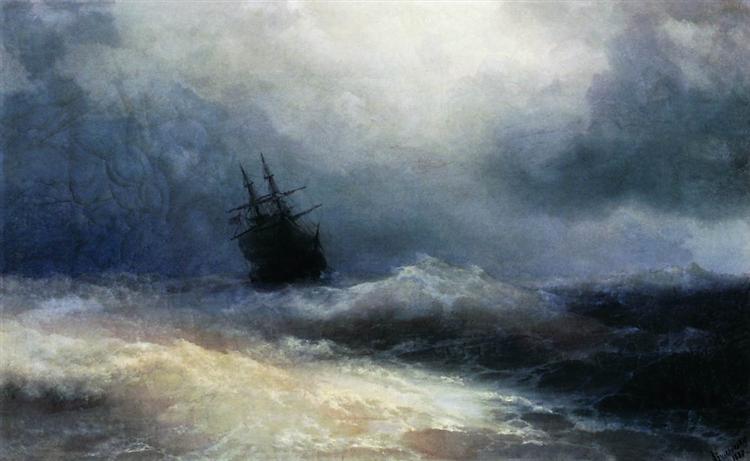
The last piece is another favorite track of all time for me, probably for a lot of people, and that's Isis' "The Beginning and the End." This one kind of brings together a lot of the previous themes. On the one hand this too is a moment of lethargy and melancholy shifting into aggression without really losing the hesitant, soft touch of its beginning. But, like Abyssal, it's also a moment of suddenly being hurled into lock-step, where the unstable melody becomes the center of cohesion. The motif that kind of sets up that shift begins lightly around 4:30-ish. But it stays unstable and "weak" way longer that you'd expect. And in 05:00 it forms this tidal wave (keeping the Oceanic theme here) if energy, while the unstable boat still rides on. Until it crashes about 30 seconds later.
It should be said that I don't take these moments of underground movement as a point of power, of creating power, or of projecting confidence. Maybe it's the other way around, that the shifting riff demonstrates something about whatever power, unseen and dark, is waiting to erupt and take you over. As if being moved by a force of nature. Maybe.
I wish words written in blogs could end wars. If they did, I would be very happy if mine was the one. End the fucking war. We've had enough.
Keep safe.

