Machine Music's Albums of the Decade: An Interview with Esoteric
[This is the 57th installment of the Albums of the Decade series of interviews. For the rest of the series go HERE.]
Artist: Esoteric
Album: A Pyrrhic Existence
Year: 2019
Label: Season of Mist
Favorite Song: "Descent"
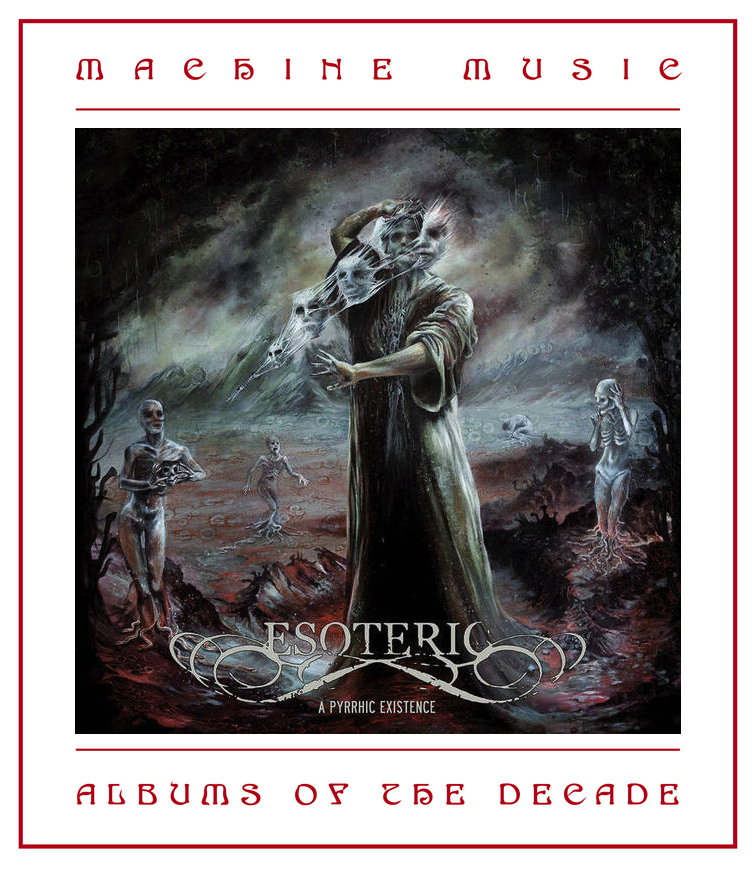
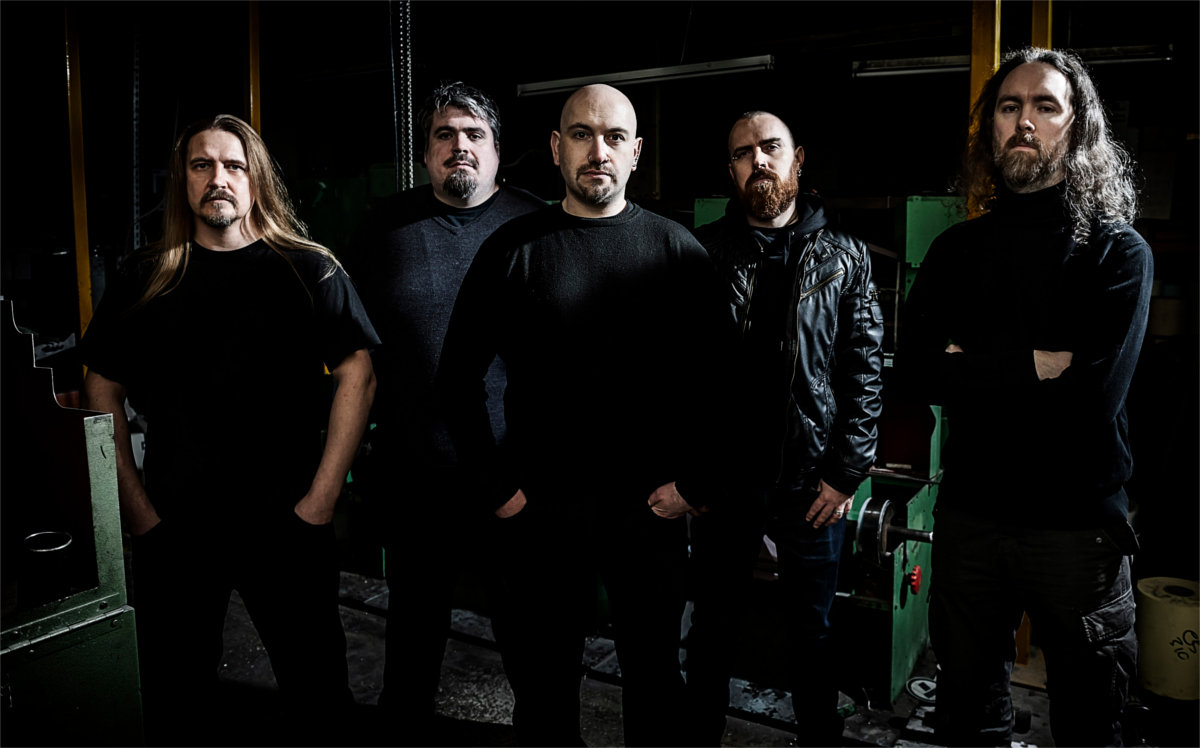
The Bare Bones: A Pyrrhic Existence is the seventh full-length release by English extreme doom band Esoteric, recorded by Greg Chandler (vocals, guitar), Mark Bodossian (bass), Gordon Bicknell (guitar, keyboards), Joe Fletcher (drums), and Jim Nolan (guitar).
The Beating Heart: If Esoteric's songs tend to elongate and bleed one into the other, then that sense of glacial blurring is also a distinct feature of their singular discography. Never shifting away from their core funeral-doom sound, the Birmingham pioneers of radical melancholy and self-expression have nonetheless managed to create a body of work that both builds on that foundation while stretching it to its seeming breaking point. Following their 2011 consensus modern-classic of doom, Paragon of Dissonance, Esoteric returned with an even greater emphasis on atmosphere and depth of sound, creating compositions as profound and "wide" as they were lengthy. The end result isn't just another hallmark release in an already spotless, exemplary back catalog, but one of the most stirring metal compositions in recent decades, which maneuvers what could have been the weak point of this sombre genre – its length and pace – into a new world of emotional and artistic expression.
It is for that reason and many more that I was delighted to be able to discuss the band's take on extreme music with Greg Chandler, who many might know not only as an integral part of Esoteric but as one of the most prominent recording engineers in metal today.
As always, you check out my various interview projects and other cool shit. And if you'd like to keep abreast of the latest, most pressing developments follow us wherever I may roam (FALSE!) (Twitter, Facebook, Instagram, Spotify and now also a tape-per-day series on TIK TOK!), and listen to my, I guess, active (?) podcast (YouTube, Spotify, Apple), and to check out our amazing compilation albums. You can support my unholy work here (Patreon), if you feel like it. Early access to our bigger projects, weekly exclusive recommendations and playlists, and that wonderful feeling that you're encouraging a life-consuming habit. On to my chat with Greg.
Do you remember a moment you had with a song or an album, an album cover, a live show, whatever, that changed what you thought music could do? Often I feel about this in terms of being scared because I feel like there's a very common early experience with extreme music, something frightening you, in a good way. But it doesn't have to be that.
Yeah. I would say probably it was when I was a teenager, a long time ago, back in 1989 at the local record store, which were quite abundant in those days, when I picked up a copy of Death’s Scream Bloody Gore. I remember listening to this back at home after buying it. I mean, basically I had been listening to a lot of heavy metal and thrash and got into heavy metal initially listening to Maiden, Priest, Motörhead and then wanted something a bit heavier, found Slayer, Megadeth, and then I was always looking for that next level. And I think when I heard Death when I first put on that album, the level of extremity was a coin-drop moment. I found this kind of level of extremity that I didn't know existed, but I'm glad that I've found it now. I think that was probably the moment for me.
How did you know to buy it?
I mean, back then at the local record stores, you couldn't really listen to anything, so you were guided by the artwork and by the people working in the stores as, when you go somewhere regularly, they kind of know what you're kind of into and what you're looking for.
And when you say “extremity,” that includes holding the artwork, looking at the artwork and then the music?
Yeah, the music.
In what way? I mean, we say “extreme” a lot, we don't necessarily always explain what we mean by that. So what about it did you feel was extreme?
Well, at the time, everything. Because it was the next level beyond Slayer, with less intelligible guitars, less intelligible vocals, everything was more aggressive. Everything was harsh. Everything was darker. The music itself was darker, the feel of it. And just more unusual.
And did you ever feel like they're one of the things that happens when people listen to metal, that there's this perpetual search for the more extreme thing? Or do you reach a point in life that Scream Bloody Gore is the Goldilocks Zone, right? It's perfect for you, and you don't want to go further?
Yeah, I think you carry on that journey once you've found what you believe is the pinnacle. But for me that was the defining moment: “I've found something that I consider very extreme now.” Obviously I considered Slayer extreme, particularly for a thrash band, and heavy metal was obviously not in the mainstream at the time either. So they were extreme compared to popular music, but they still had a more accessible format to them, a more accessible sound, whereas I think early death metal really kind of pushed the boundaries further.
Do you think that whatever it was that excited you about that first encounter is something that…. I mean obviously we already talked about always seeking out as a music lover, right? That you always look for that thrill. But is that an experience that you hope to invoke in your listeners when you make music? That you hope to kind of…. I don't want to say "scared the shit out of them," but that there's something about what you felt as a kid that you want to make other people feel?
Yeah. I think, certainly in the early days, maybe it's less conscious nowadays, but I think certainly in the early days, we really wanted to push boundaries with the music that we were creating. We wanted to do something very extreme. Not just extreme for extreme’s sake, but because it was something that we weren't hearing in the style of music that we were doing at the time.
Not to counter what you're saying, but some would say that, you know, glacial-moving doom music that often clips at around almost two hours an album is a kind of extreme experience, right? It's not extreme in the sense that it’s violent, but it's a form of extreme experience, isn't it? It’s not every day that you experience that.
No. But I think for us, at the time, anything that was considered doom was a lot more melodic, mostly with melodic vocals. There wasn't much, if anything, in the very early 90s that was considered extreme doom. It was also because a lot of doom back then was very melancholic and very melodic, whereas I think our music tends to be a little bit more on the aggressive and dark side.
On the subject of doom – one of the things that I've been thinking about is that often generic categories are interesting for someone when they dissect a piece of music, but it's not necessarily always interesting for the person making the music.
Yeah.
The most prominent example for me would be someone like Patrick Walker. When I interviewed him it felt like what he was saying wasn’t just “I want to be a doom musician,” it just so happened that that brand of music fit what he wanted to express. That what you want to express comes out as what other people call "doom music." Is that something you can relate to?
Oh yeah. Definitely. I mean, I said we wanted to be extreme, but the main aim was actually to write music that we felt we could express emotions, experiences, and so on, of our own and to create our own kind of unique style. Not just to aim to be a doom band, because there's certainly the genre of extreme doom…. I mean, it's called funeral doom now, but that name didn't exist for many years until all the bands of that era started.
Does that bother you at all, that there’s that gap between “I'm doing this for me,” or “the band is doing it for itself” and then it comes out into the world and people would say something like: “Oh, that’s extreme progressive funeral doom,” or whatever?
No, no. I mean, for me genres and classification, it's just a way to neatly and succinctly describe something to someone. It's not something that you need to be obsessive over or pour over too much. It's a very short way to describe something. It's not something that I think is that important.
So, after decades of making what, we will now for the sake of argument call doom music, do you have a better sense of why that is your preferred mode of expression? Do you have a better grip on, say, why you’re not Dave Mustaine?
Oh yeah, for sure. I mean basically the style of music that is more personal to me and to the guys we started the band with is just more fitting to that kind of expression, that kind of very depressive and oppressive sound. And certainly with trippy, psychedelic influences. I think that's something that we always put a lot of time into.
I recognize that it's what you guys felt like was the best way to express you, but do you know why? What is it about the pace, what is it about the themes, what is it about like the atmospheres that you think clicks with how you think on a basic level?
I guess in the simplest form, we were just kind of making music that we wanted to hear, that we weren't hearing in other music quite to the same degree. Particularly in the very early 90s, when we started. Most of the bands were trying to get faster and faster. And we were listening to a lot of different styles of metal and various other styles as well, psychedelic music and so on, and we wanted to incorporate something a little different into what we were doing. And I suppose it comes from our musical background and also our environment or environmental influences.
Environmental influences, as in other bands or other people in your group?
No, as in life, daily life influences and emotional influences. Our own kind of mindset.
So, one of the things I wanted to ask that’s kind about A Pyrrhic Existence but basically it runs through I guess most of your catalog, at least running back all the way back to like 2008-ish, or before, this idea that, because the songs are as long and extended as they are, and because the albums as a whole take up so much space and time, there's this tendency that your music comes out not so much like songs but a series of movements, right?
Yeah.
So you have this chapter that morphs into a different chapter that morphs into a different chapter, and they’re connected or there's kind of a relationship between them. So I have two questions about that. The first would be whether the music is written in that way in these pieces that fit together and are always in order or do you have to switch them around? That's one question and the second question would be how did the band end up with that really long form of music?
I don't think it was particularly conscious. I mean, one of the things that we wanted to avoid when we started out as a band was to follow any kind of set, choreographed or popular way of structuring music. So we weren't really interested in just doing intro, verse, chorus, verse, bridge, chorus. We weren't really interested in doing something like that. There are parts in some of our songs where a section will repeat later on, but it is quite rare. But I think, yeah, it was more because our music is very slow, and it's kind of based on emotions. I think that's why it kind of comes off more as movements.
Because there might be a certain part of the song where the emotion is going in a certain way and then, rather than repeat that later or go into something else, it’ll ebb and flow, light and shade. For example, it might go from something quite melodic into something very dark or an ambient kind of feeling. And so I'm really just…. It's just a way of writing where we go by feel rather than trying to make something fit within a certain thing, if that makes sense.
That makes a lot of sense. But when you say “go by feel,” does that mean that whatever it is, you just go into the rehearsal room, you feel it out and then you have the completed skeleton or at least the movement, or does that get revised later?
They always get revised to some degree, and basically there are different ways that we write. Sometimes a song might be written by one of the band members on their own, like writing the skeleton of the song and then bringing it to rehearsal, and we'll work on it together and flesh it out and embellish it together and experiment with the arrangements. Sometimes it can be a couple of us working together on something, pushing ideas backwards and forwards. And then other times it can be like a collaboration of everyone in the rehearsal room. So there's not really a fixed way of writing, as such, but whichever idea is sown from the initial ideas, once we have a basis of a song or kind of like ideas, we'll work on it together as a band and rehearse them together for quite a long time before we consider recording.
The point of rehearsing it for quite a long time is what? To nail every detail or to make sure everyone's happy?
It's to nail every detail, but also because we experiment so much with sounds that if we were to just come into the studio to record with just music, without any of the sounds prepared, tried and tested together in a room, then it would take forever. Because we work on the effects as part of the actual songwriting. So for example, certain sounds and delays and synthesizers…. We use effects for crescendos and also to build intensity, for example. So doing that together in a room means we can feed off each other and bring it all together as something that works in terms of getting our volumes right. Because we rehearsed the same way that we play live really, it's just feeding off each other, being able to hear each other, adjusting what we're doing according to what someone else might be doing, and so on.
It's a strangely jazzy way to describe a doom performance, right?
Yeah.
This idea that you always have to be alert. It sounds like for music that is as slow and as intent, you're describing, it also is a very sensitive experience, right? There's no breaking out, also because there rarely is a breaking out moment, but you always have to be attentive to where you are and what the other person is doing. Can that result in performances that are at times dramatically different in feel?
It can, yeah. For example, it can certainly affect the intensity of the effects. If we're pushing levels more, because it can also depend a little bit on how well you hear each other. So if you can't really hear the effects as well on certain live performances, you might be a little bit more conservative or you might be more extreme with it. So it varies a little bit.
On the subject of effects. One of the things that I think is a stand-out feature of what you guys do is your vocals. I know you use an effect on the vocals, but even aside from that they’re very interesting. OK, so I'll say this stupid first part first, right? So the stupid part is that they're very varied: There's the low growl and there's that scream – I'm sorry, I don't have a technical term for that – and then there’s the higher scream. There's a spectrum of screaming, that when the music soars you can soar with it, or soar vocally even if the music isn’t soaring to create contrast.
But I would imagine that that variety could create a ton of problems, right? I mean, obviously you said you go by feel, so I assume that might be how that goes as well, but it's almost like you have four other instruments in your throat you could be using at any given time, even without the effects involved. So how do you know which comes when? How do you choose whether to go against the grain of the music, say when it’s low, to go high with the vocals? Is it just a question of shading, what's too light or illuminating what's too dark, kind of giving that extra contrast or color?
Yeah, it's contrast and it's also related to the lyrics. So, for example, if there's a lyric that I think should be a little more intense, even if the music's not necessarily moving more intensely at that time, we might want to perform it with more intensity, like with a higher scream instead of a lower growl.
So sometimes it's actually just thematic?
Yeah.
I mean obviously from what you say already I know feel is such a huge part in a band that's as feel-oriented as you are, also in the writing process. And I know you mentioned in the past that at least when you guys were younger, certain consciousness-altering substances were used in order to kind of mediate that transition.
Yeah.
And that in itself is a sub category I'm very interested in, because it came up. It came up when I interviewed Neurosis, that was pivotal for them, it also came up with Cobalt as well as being a very important part of their creative process. So on the one hand, I get it it kind of allows you to kind of introspect in a more radical way, talk about extremes, so you can be extremely attuned to how or what you are. But then I'm kind of still wondering how do you deal with the fact that you're not always in that state. You’ve emerged from that state and then you have to deal with the song that came from it. Do you always know to bridge that gap?
Yeah. Because it's an experience…. I think part of the reason that some bands might use these methods maybe by accident or just from from trying it out. But it's basically because when you're in altered states your perception of sound and intensity and emotions might be slightly different. And often will be different. And you can explore things a little more, certainly on an introspective level. Certainly with psychedelics, they tend to be very introspective experiences. And because the experiences are marked and they're not like something that you would experience in everyday life, or particularly frequently – they're not generally substances that people take regularly – I think that it stays with you, the feeling, the experience and the sense of what you felt very much stays with you. It's not something that you easily forget. So you can kind of tap back into it, I would say.
So when you're in, say, the rehearsal or editing portion of the song, or even recording, you still have something to lean on.
Yeah.
You're not lost in space. You're not like: “What the fuck was Greg thinking two months ago?”
[Laughs] Maybe. No, I mean, basically you’re using it as a kind of tool in the writing process. I mean, you could almost say the same…. I've written music when I've been sleep deprived as well. Extremely sleep deprived. And that's a different state of mind as well. I think it's one of those things where once you've actually got the ideas and the feel and the vibe and the music's there, then you can just do it in any normal state of mind.
What you just said, the music's there, right? So you don't have to have a crystal-clear connection to whatever it is your mind was when that happened because you have the music.
Yeah.
In whatever creative pursuits I have, which aren't music because I suck at music, sometimes the product becomes the feeling. I don't know if that makes sense to you.
Yeah.
That whatever it is you created under the influence of doesn't matter if it's psychotropic drugs or it could be being sad, right? Whatever it is you did under the influence of whatever emotion, extreme emotion, or not, becomes the emotion in the way that when you listen to the music or when you read the words, then it's right back into it. Does that make sense?
Yeah, definitely. It’s like people that have certain songs that trigger certain memories because they're a song they were listening to at a certain point in their life. It’s a similar process, I think.
Yeah. I guess my version is even more extreme because I'm not just saying “When I listen to 40 Watt Sun’s The Inside Room I remember when I used to work midnight shifts at the newspaper.” I guess what I'm saying is “When I listen to 40 Watt Sun’s The Inside Room I'm at the newspaper.” It’s not a memory, I'm teleported. It's not a faded copy. It's actually happening right now and you can then become sad because the things that made you sad then are making you sad now.
Yeah, it brings you back. Yeah.
It makes no sense.
But you're exactly right though.
When I write sometimes I deal with shit Everyone deals with shit all the time. I don't know if you have kids, I have kids so when you have kids, you deal with them. And as a result, deal with your parents, because that's how kids work, right? And it goes both ways. And so, let's say I deal with something that happened when my daughter when she was 4, which doesn't have to be very dramatic, just the fact that she was four and I was her dad and not realizing my place, not realizing what I needed to do. Whatever. And I wrote down “the music,” for the sake of argument, that came out of that experience.
But what happens to me is when I read that back, I’m there.
Yeah.
It doesn't create a memory, it's not a documentary film. It's a reenactment, in a weird, very weird, uncanny, sometimes troubling way. This is kind of a segue to a different question I would get for you on the one hand, on the writing level, cathartic and expressive and working shit out, but then when you receive it as a listener. Do you ever, by the way, listen to your own music?
Yeah, we do listen to our own music sometimes. Maybe not as often when we're playing it more regularly.
So it's for, it's for functional purposes. Just to remind yourself how to play it?
No. I mean, sometimes I'll listen to it because I want to. But what I'm saying, I suppose, is that when you're playing it often enough, you probably don't seek out to listen to it as well.
But, is there a sense where you're playing it live and getting zapped into all these moments in your life while you're being on stage in front of people in, I don’t know, Maryland?
Yeah, I think the best kind of feeling that you get when performing live is when you really kind of exist in the moment of the situation you're in: the environment, the venue, the audience, the traveling that goes with performing, because that's also something that’s a very good byproduct of of doing shows is that you get to see a lot of different places and meet a lot of different people. But if you can just get into the actual moment, the meaning and the feeling behind why you originally wrote the music, then that's a very good place to be.
I would also imagine a very confusing place to be when it's over. But yeah.
[Laughs]
Someone wants to hug you and take a picture and you’re like: “What the fuck is this?”
[Laughs]
So one other thing I wanted to ask, and this is kind of also influenced by A Pyrrhic Existence is this idea of repetition. I'm kind of fascinated by repetition. And there's a brand of repetition, which isn't Esoteric's brand of repetition, because you don't often repeat. I think one of the insights I had when I listened to a lot of your stuff before I came to talk to you was the music never feels like it's standing still. You're always in the story, there's always movement, even if the movement is just the keyboard moving the melody forward or just the remnant of the echo of a scream that you just screamed five minutes ago in the background.
Yeah.
It always feels like it's being propelled forward, which is a unique thing for a song that's 17 minutes long to always feel like it's moving along, but and so I guess that's kind of a roundabout way of saying you don't repeat in a very repetitious way, not in a droning way.
Yeah.
I had a conversation at the time with Oranssi Pazuzu about some how sometime along the road they realized the power of really fatiguing their listener. Just banging the same moment or the same riff over and over, almost like kind of a drug. It's almost like forcing you to let go and just succumb to the music, but that's not something Esoteric does very often.
No. There is repetition, but it modulates quite a lot, like you mentioned. I think it's basically similar to some of the musical influences. Because we do listen to music like classical music, for example, there's a lot of modulation and a lot having a similar theme, but then it constantly changes, and just finding different ways to make the same theme continue, but with little modulations in it. That's probably quite present in our music.
There's always this telescopic continuation of something into something else, and then that something moves into something else. Obviously it's very appealing, because it makes you stay in the song and in the narrative of the melody, but then you think about the context of doom music more generally – that's it's very rare thing. The choice to just go forward. I’ll just go ahead and say something that makes no sense and I’m already making fun of myself for saying this, but I love Megadeth with all my heart. Megadeth was my band when I was a kid. And I think that's one of the things Megadeth does. The famous example would be like the intro riff or the verse riff to “Holy Wars,” where there’s this ever-adding tone that makes it move. Kind of an ADD take on music, right?
Yeah.
I will not rest on any one thing. I will always embellish one other thing. I mean, you don't seem like an obsessive guy, but does it come from a sense of I can't have things just lying there like on the ground, I need something to move along with?
Yeah. I think it's just personal preference, really. It's just liking movement in music so you can have a familiar theme, but then it just changes slightly.
So you’re like a very slow Megadeth. I think we have the headline.
[Laughs]
So, when a band repeats in a droning way, let's use Oranssi Pazuzu here, it's almost like an obtuse gesture towards the audience, right? It's like saying to the audience: “You matter, but not that much. I can do things that are offensive to you. I can do things that are boring to you. I don't always care what you think.”
Yeah.
And so that your music doesn't make me feel that, at all. It makes me feel like you always care about me and you always care that I'm still interested. But funnily enough, in one of the kind of older interviews you mentioned, the fact that the music is just for you guys and if you know, if no one ever bought the album, you'd be fine.
Yeah.
That's funny. To me, because you write music that's so communicative.
The premise really is, though, that the most important thing to do when you create something is to be true to yourself. There will always be some people, no matter how small the audience is, there will always be some people that will enjoy it and appreciate it. You're not going to please everyone, certainly not playing extreme doom [laughs]. You're not going to please many people anyway, so you should do something that you can find legs in, longevity. I think that if you write music to try and please other people, then you will lose interest in it yourself sooner. Whereas if you write music that you feel like you can be interested in for a long time, you'll find an audience for it that will appreciate it, and you'll be able to continue what you do for a longer period. That's, I guess, the premise behind that idea.
Has that always been a frustration-free mindset for you? I mean obviously it is absolutely right to say: “I do what I do. This gets me out of bed in the morning. If I don't do it right, I won't get out of bed in the morning.” That's basically the consequence of losing yourself in this.
Right.
But has there ever been a moment where you said: “Well, I kind of wish that that thing that makes me get out of the bed in the morning had more people listening to it?” Or “I wish I had more feedback?” Was there ever a sense of frustration or a tension between those two things?
No. I think, actually, in terms of what we thought our music would be when we started as a band compared to where we are now, I think we've actually done a lot more as a band, or we've had a lot more appreciation. I mean, we're a small band, let's get that straight. But we've had more appreciation and interest than we ever thought we would. We didn't really think that our music had legs. I mean, particularly in the early 90s. Coming out and playing very slow, extreme doom, while every other band was, well, not every other band, but nearly every other band was trying to be faster and more death metal or black metal oriented. We had quite a lot of negativity about the band in the early years. And quite a lot of negative feedback – that we're too slow, or too boring, you know? I think we appreciate that people are interested at all, you know, because we know that what we do is not something that's going to appeal to that many people.
Yeah. This is apropos of nothing, but the time it took between Paragon of Dissonance of and A Pyrrhic Existence, is that the time you needed to do Lychgate, is that the only reason it took as long as it did?
No. There were various reasons. I think one of the big reasons is that when you're in a band for a stretch of over 30 years, the time between albums becomes something you notice less and less as time goes on. And as you get older, you tend to be a lot busier. Working a lot more. You have more responsibilities, you have less energy for other things than you used to, and the band for us has always been….. We try to do it as well as we can, but it's always been something that we do on top of our full-time jobs. I mean, some of us are running businesses, I run a recording studio. So I work a hell of a lot of hours and the actual free time that I have to work on my own music is a lot less than it was when I was in my teen years or in my early twenties where I had a lot of time. That's part of it.
And also, as we got older, it became harder to balance doing tours and shows alongside working on music. So, it's very hard to find the time to do everything, because we put a lot of time into the writing of the music and the creation of the sounds.
We've also had stable lineup for quite a while, but then in the last few years since the last album, we've had quite a few line-up changes, which has been a question of one step forwards, two steps back. So there's been people leaving, taking the time to find new members, getting new members in and then getting them up to speed so that we can go out and play some shows and work on new music. And then we've basically, since the last album, we've had four guitarists come and go, which has been quite an upheaval.
Do you think, just in terms of the time it took between those two albums, that it affected the process? And if it did, did it also produce a different album? Because I mean to me as a listener it did, but I'm curious to hear if you feel like, beyond just the progression where every album is different from the other, whether the nature of that elongated process, did it produce a different kind of thing?
Possibly. It's hard to say when you're closely involved in terms of how other people see you. I think for us, we've never been…. I mean, even when we were more regular with albums, we've never been particularly prolific in terms of writing and releasing music. And one of the reasons for that, I think, is if you write an album every year or every couple of years, you're kind of forcing it or pushing it, rather than letting it happen naturally, and there's a degree of just wanting to do it in our spare time rather than trying to force something out sooner than we're ready to do it. You know, for us, there's no rush because we want to do it and we will do it, but it's going to happen when it happens.
That's kind of been a recurring theme, interestingly in some of the entries that I did for this series, a lot of bands saying something, which really I would not have thought of artists saying, which is something like: “It can't be your day job.”
Yeah.
Because if it is your day job, there's a whole Pandora's box having to do with what you just said, right? Feeling pressure to record when it doesn't come naturally, feeling pressure to tour when it doesn't come naturally, and then you tour when you don't want to and you hate your bandmates, because it's a shitty experience. And so you don't want to write another album. And the money becomes a big issue, especially if your livelihood depends on how your album does or how your tour goes, then that doesn't really allow a lot of room for artistic expression, and so on. So you would agree with that, you would say that having the band be something on the side, not as a kind of belittling thing, right? It's still very important, but something on the side, is something that is important.
Yeah, yeah. That's definitely the case. Basically we have to earn money to live, and pay the bills, and the music for us is our escape from what we're doing day in, day out. It's something that we cherish and is important. I mean I think every band would be quite happy to earn a living doing their music, but the reality can be a little different. There is a pressure there, particularly in modern times….. The amount of albums you would need to sell would be quite substantial to have any kind of comfortable living.
I just want to ask one short question and then the last question. About your day job. You're one of – I mean, to me, this is subjective, right? – but you're one of very few people who are also very meaningful musicians but also have a very meaningful stamp on how music sounds when they’re not the musician on the album. So your work in the studio, mixing, mastering, I will listen to an album, love the way it sounds, and then read the liner notes and say: “Oh it's Greg Chandler, that makes sense.” The select group you be in that regard would have Steven Lockhart too, but a very small group. I would assume that if you chose a career in music it’s also because you love music, but also because you like how things sound, not just the melodies, not the not just the structure, but really care about how the sound comes through.
Yeah.
And so do you view that as part of the creative process, or is this just a technical thing?
It's a bit of both. Because when you're working with your own music, you already have a vision of how it should sound, and you work towards that during the whole preparation of the recording before you even go near a studio. But then when you're working on other people's music, it’s trying to get a vision out of them of how it should sound, and interpret that correctly and deliver it to them so that they're happy with how their album sounds. And being on both sides of the glass, so to speak, I find it's very important to be able to interpret what those musicians are after.
But there is also a creative process, in the sense that I have my own kind of tastes as to what I like. I tend to favor a bit more of an organic approach to sounds than a lot of modern production techniques used. So I do have my own kind of niche that I tend to attract, working with bands that are after a sound that is unique to them. I try not to work with any templates, and just approach each session with an open mind and kind of like try and understand the bands are after and deliver what they like.
Though I imagine a lot of bands at this point they come to you because they want, quote unquote, the “Greg Chandler sound,” so that's a weird situation, right? You're trying to interpret their vision and they want your vision.
I think it's a mixture, though, because I think it isn’t that many bands that come to me and say: “Can you make it sound like this album you've done?” Because most bands want to stand out from other bands. But there is an element of that.
So the last question is kind of a set question. We didn’t really get into the specifics of the album, as much, but that’s alright. But when you look back at A Pyrrhic Existence, which was already a good chunk of time ago, when you listen to it, when you think about it, when you play some of those songs….. Actually, I have a footnote here which is to tell you that at some part in “Descent” you sound like Icon-era Paradise Lost. So, there. I said it [laughs]. But when you look back at that album, is there anything you're especially happy with? A song, a production choice, the whole thing? Something you wouldn’t change.
There are always things in an album that you're happy with. I think one thing that we were happiest with in the last album was that we got a little more detail, time and focus on the effects and the psychedelic side of the music again, which was a little bit more stripped back in Paragon of Dissonance and we kind of missed that a little bit. So I think that was one of the things that we appreciated more from the last album…. Maybe the last album was a little bit too melodic in places, for my own taste anyway. Melodic is not necessarily the right word, but maybe a little bit consonant in terms of music. I tend to prefer the music a little darker, myself. I mean, basically the way I've always seen albums, whether it's our own album or an album that I'm working on for someone else, it's basically you do the best you can in the time that you have. There's always going to be something you would change, something that you think you might be able to improve on or do differently, but what that thing is six months later might be different to what I think it is two years later. So you have to draw a line in the sand at some point.
So, you don't torture yourself.
No.
I would agree that Paragon of Dissonance is kind of more stripped back, but I think what you're calling psychedelic elements and I would call I guess atmospheric elements, or all that in-between stuff, they’re not the same as they were on The Maniacal Vale. On The Maniacal Vale it felt – this is subjective, maybe my stupid point of view of nothing – those felt almost post-rocky. Like this jangling atmosphere, and A Pyrrhic Existence felt, I think, on a whole, much darker.
Yeah, yeah.
So the atmosphere that was pulling you along, apropos what we said before, the constant shift, feels a lot more cinematic, which might not be the word, but it feels darker, almost gothy.
I think that's partly because when we did The Maniacal Vale, for example, we had a full-time keyboard player in the band, and so the atmospheric elements from the keyboards were quite strong on that album, which tend to be a little less dark, I would say, than the atmospheric elements that come more directly from guitars and vocals. I mean, they're still there.
Oh, so you. You're saying that on A Pyrrhic Existence a lot of the atmospheric stuff is not what you would call post-production keyboards, whatever. It's from the instruments with effects.
Yeah, I mean. Actually, in real terms, there's very little post production on any of our albums, but it's mostly just performed with the instrument at the time of recording. So for example, the effects that you hear, they're running through the guitars and and the vocals, they're recorded at the time we're recording, they're not. They're not something that we do later on.
All right, so the switch from keyboard-based effects to guitar and vocal-based effects might explain the shift in tone?
Possibly. Yeah. Possibly. But I mean, it's not so much that there were keyboard-based effects on The Maniacal Vale and less guitar effects. There was still the same level and intensity of guitar effects and vocal effects. But there was just a soundscape with a lot of keyboards, while, in the majority of our albums the keyboards are quite sparse, or even nonexistent.

