Albums of the Decade: An Interview with Cleric
[This is the 58th installment of the Albums of the Decade series of interviews. For the rest of the series go HERE.]
Artist: Cleric
Album: Retrocausal + The Book Beri'ah Vol. 2 – Chokhma
Year: 2017 + 2019
Label: Web of Mimcry + Tzadik
Favorite Song: "Separ"
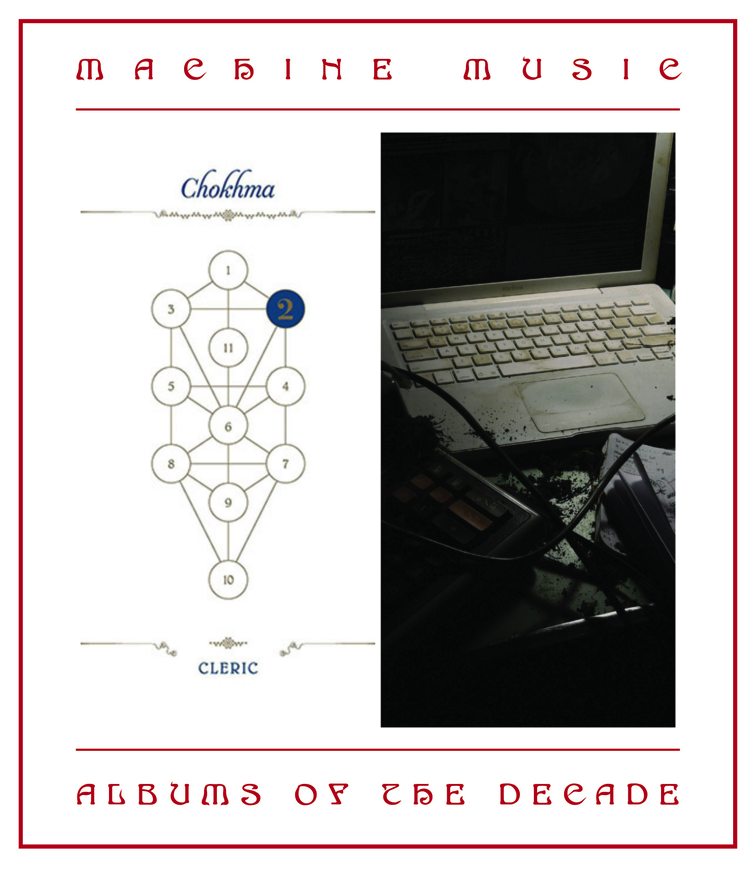
The Bare Bones: Retrocausal is the second full-length from American avant-garde/mathcore/crazy people playing guitars/jazz collective Cleric, comprised of Matt Hollenberg (guitar), Daniel Ephraim Kennedy (bass), Larry Kwartowitz (drums), and Nick Shellenberger (vocals). The Book of Beri'ah Vol. 2 – Chokhma is their third full length, part of the wider Masada songbook project envisioned, curated, and directed by American composer and label owner John Zorn.
The Beating Heart: Cleric's Retrocausal was a thunderbolt into my life. It may be the case that every time I tire of music or find it predictable some thing, some art comes along and plugs me back in. That was Retrocausal to me, another album I believe I had the honor of being exposed to via Doug Moore's GOATed columns. It serves as a high water mark of wacked-out, unabashedly creative and avant-garde metal. However, in many ways Retrocausal is only part of a wider story, one that involves Cleric's growing involvement in the wider web of Zorn-related projects, and thus also only part of their story of their evolution as artists. It is for that reason I felt any discussion of Retrocausal would be incomplete without a discussion of the album Cleric recorded as part of Zorn's Masada project which, to me, is from the wider view, is one of the most important musical endeavors of the past 50 years.
And so I had the distinct pleasure of talking to Matt Hollenberg, half-man, half-guitar about the artistic process that led into Retrocausal and ultimately into Masada. As you can tell from the very top line of this post, this series of interviews, stated seven years ago, is also becoming a place for me to better understand my own art. Thus, at times, less an interview and more of a conversation. I hope that's fine. If it isn't, well, that's too bad.
As always, you check out my various interview projects and other cool shit. And if you'd like to keep abreast of the latest, most pressing developments follow us wherever I may roam (FALSE!) (Twitter, Facebook, Instagram, Spotify and now also a tape-per-day series on TIK TOK!), and listen to my, I guess, active (?) podcast (YouTube, Spotify, Apple), and to check out our amazing compilation albums. You can support my unholy work here (Patreon), if you feel like it. Early access to our bigger projects, weekly exclusive recommendations and playlists, and that wonderful feeling that you're encouraging a life-consuming habit. On to my chat with Matt.
So basically the way these interviews work is it's kind of an archiving thing for me. And this is very much age-relevant because metal soured on me in the early 2000s—the specific kind of metal, not what we'd consider metal today, but heavy metal. I couldn't listen to it anymore.
Matt: That's exactly what happened to me at the same exact time. That's pretty interesting.
I kind of fell off around 2009-ish. Wavering Radiant and then backpedaling to find Jane Doe was earlier than that.
Matt: Maybe you fell off a little earlier than me. I fell off maybe around 2005 or 2006.
Could have been. There's a gap there—I'm two years older.
Matt: It's like a couple of years, but at a similar point in life. It's almost like a stage of life where you get bored of it.
When I came back—and this is very boring, won't make for good interview material—but I discovered I could only concentrate while studying if I had very loud music on. So I went back to the bands I liked: Isis, Cult of Luna, Dillinger Escape Plan, Botch, whatever. I'd listen to those albums again and my tolerance went up. I started needing to mainline Emperor albums just to concentrate. I became almost like teenager-levels of interested in music in the 2010s, which meant a lot to me.
Matt: That's really cool. It was like rediscovering it again.
Yeah, it was rediscovering it. I also discovered that a lot of bands coming up in the 2010s were informed by the music I liked in the 90s, but they were doing it smarter or different—things that fit the older me better.
Matt: Oh, that's great. That's really cool. Yeah, I'm happy to hear that. And you say Cleric fits within that?
Yes. Actually, when we begin the actual conversation—the one I'll be writing down—we'll get to Cleric and why it's a bit weird in these respects. But, usually I begin with a set question so there's a nice cross section. So that question is: was there a moment earlier in life, maybe as a child, when you encountered music in a way that made you rethink what you thought music could do? This could be the music, album cover, live show, video, whatever. Shocked you?
Matt: Did you want the first time that happened or just one is good?
First one is good.
Matt: Okay. Well, I was a really young boy. If you know the composer [Isaac] Albéniz, the Spanish composer.
Okay.
Matt: There's this piece, “Asturias.” My parents' friend had died of cancer, and their other friend played that piece on piano. Before I'd seen that piece played live as a single performance, I thought music was kind of cool. I liked some Beatles albums, but I was maybe five or six years old. It completely hypnotized me. I didn't really play piano or music yet, but I went home and figured it out by ear on our piano because I was so in the earworm loop. It was kind of the first earworm I'd ever had where I was obsessed with a piece of music and it hypnotized me. I eventually learned how to play it on piano. That was kind of my entry point into playing instruments.
So that's a very unique setting
Matt: Yeah. I mean, it's a funeral.
I'm a big death guy—not just the metal, but the life experience. I'm very interested by it.
Matt: Yeah.
Obviously this is a very young encounter. Sometimes you don't go to the funeral when you're that young.
Matt: Totally. Everyone's crying and you don't understand why—like, you're adults, why are you crying?
Yeah. Why are they?
Matt: Yeah.
So I'm wondering, looking back—obviously not as a five or six year old you, but thinking back now—do you think the hypnosis was an escape, or something reassuring, or were you curious about it? What was it?
Matt: It was literally all three for sure. It wasn't just one effect—it was all three. Maybe one was stronger than the other, but it's a hypnotizing effect that stretches time and condenses it. Time becomes vertical. Even as a young boy, I noticed that about music. I was like, time is a different thing now that I'm inside this piece.
Vertical how?
Matt: Vertical time.
Vertical as opposed to linear, you mean?
Matt: Yeah, as opposed to horizontal, like we're moving through. Each measure, if it's a perfect piece, is like a totem of meaning. So every measure is timeless—a cumulative effect. As an experience of listening, it's linear, but emotionally it's vertical. The way it affects time: if I'm really in a piece or playing and in a zone, it's that vertical sense of time. Even if it's three minutes—like, if a piece is looping too much and doesn't change the harmony, two minutes could feel like forty years. But if a piece is really well-constructed, it could still be under four minutes and feel like a full experience, like a movie. It's noticing that great composition affects the experience of time.
I think the vertical thing also works with how often you hear that piece now.
Matt: I never listen to it that often because I used to play it all the time, so I just don't listen to it anymore.
So maybe that's not a great example, but every time I listen to 40 Watt Sun, the Patrick Walker band—like, Warning, very sad, doom music.
Matt: Oh, cool.
Right. So—
Matt: No, but I do like stuff like that, which has a similar impact. The phrase is so long and the tempo is so slow that it feels shorter than the amount of time passing.
But that's the thing. The pieces that make you reconsider time or notice time—it's like that David Foster Wallace thing about water, right? Noticing time as a thing. The music that makes you notice time. Maybe I'm asking: is there a tendency, when you're listening to it at a different time, to remember other times you listened to it?
Matt: So yeah, definitely.
So you're both reconsidering time and also remembering different times. That works with the vertical theme too, right?
Matt: Yeah, right. And that's more evidence that that's what's happening. Because if I hear something I listened to all the time in sixth grade, but now as an adult I think it's cheesy—just hearing the song, like a 311 song or something—it's like, okay, that was middle school, one of the first things I heard, first rock. So it's trippy to hear certain 311 songs, not because they're great, but because of the association. It feels like I'm in sixth grade when it's on, because of the association. And that goes through the vertical thing—the meaning you're making when you're obsessed with music is that moment in time. So when you listen to it, you go back to that moment in time when it meant a lot to you.

So I wonder how different it is for you. Because you just mentioned what I was about to ask. How—because it's very easy for me, a person who is really definitely not a musician—if you've ever met someone who is the opposite of a musician, it's probably someone like me. It's very easy for me as a self-identified listener to go, "okay, this is the one" or "this is one of those" where I'm just spacing out, nothing else matters, the world melts away.
Matt: Right, you still hear that too, right?
No, but I'm asking: as you're not five anymore and haven't been five for a long time, and for a lot of that time you've been making music and maybe thinking intentionally about causing that effect.
Matt: Yes. Yes.
So is it that simple? How do you do that?
Matt: Because you don't identify with what you're doing. You do deep listening without identifying. It's both at the same time—intense focus, but when something good happens, you don't take ownership. You don't try to possess it. So if something happens in improv, it's like: “Here's this fish I caught.” Does the fish define you? No. It's just the fish swimming in the lake that day. Tomorrow, another fish will come around. And that applies to the good things and bad things you play.
Yeah, yeah.
Matt: Whether you think it's bad or good, I try to not identify. That's a big thing. Even if I write something, I'll say I wrote it if I composed it.
Yeah.
Matt: But I won't say past a certain point that it has anything to do with me.
It's a very T.S. Eliot take on music composition.
Matt: It's kind of like Buddhist sand paintings where they spend so long and then destroy it, over and over.
No, but let me clarify. T.S. Eliot was also a critic. He had this thing about how the individual artist doesn't matter that much.
Matt: Yeah, I agree with that 100%.
And the only thing that matters is what he or she is channeling.
Matt: Yeah, exactly. That's 100% true.
That's like an antenna kind of—they're up on the waves.
Matt: Right. And if I say this is mine, I did such a good job and that defines me, it's like you're already tensing your body. You're not in a 360 landscape. You need to control and possess. But you just caught a fish. It doesn't, you know? It's not that deep, but it also is, because it's only that moment in time. So there are these paradoxes stacked on top.
I'm going to go off reservation right now. The immediate context is that two or three weeks ago, I published a novel.
Matt: Oh, cool.
Yeah, I don't know about that. It's happened. It's an accomplishment. The novel itself—because I want to talk to you about improvisation, which seems to be a big important thing that you already mentioned. The act of writing as kind of glorified “figuring it out,” and active listening as you listen and catch things, then look at it later and say yeah, I like that thing.
Matt: Right. That's very well stated.
The reason I mentioned this is that the novels I write are not dissimilar to Cleric albums. They have a very specific audience. I don't know if I want to describe that audience, but it's specific and already in production, this isn't going to be a Billboard top 100 thing.
Matt: But you're doing it because you're curious. You're not doing it for commercial success.
Yeah, because I need to do it.
Matt: Yeah. Because you're curious like a kid is curious. That's what it's about.
But also because the finding means something.
Matt: Yeah, right.
There's something at stake. You need to find the good stuff, but to find it, you need to not think about it.
Matt: Yeah. You need to not be self-conscious and not get on an ego trip like “I'm important because I did a good thing.” That's equally bad as the flip side—”I'm bad because I did something bad.” Both are useless. There's no way, you know. Both of those things are useless.
Yes. But what I wanted to say: I had this conversation with someone who just finished reading the book. She spoke about a Taoist idea of void or nothingness and how she thought it related to my book. At the same time I'm having this profound conversation about my book—which is everyone's dream, right? You want meaningful conversations. But I'm very conscious that the book just came out and no one's writing about it. It's not part of any publicity. I made a point of saying, recommend it to your friends, even though I knew that's not the thing.
Matt: No, but that's fair to say if she liked it. I mean, you don't have to be so punk rock in every single interaction.
No, I'm just—yeah. And then she said, "I know all the love. I mean, I love the book, so I will. But just be mindful of the fact that whatever void we're talking about, it's not going to be fixed by me recommending it to someone else." And I appreciated her saying that.
Matt: Yeah.
But I still felt that pull, right? So it's one thing to say, I'm out here catching fish. I'm on my boat catching fish because I need sustenance. It's good for me. And the more I let go of it, the more good it does.
Matt: Yeah, that's very perfect.
But it's very difficult to not get excited about the fact that you think it's good.
Matt: I don't think there's anything wrong with that and it doesn't matter either way. That's my feeling.
I don't know. They feel conflicting.
Matt: Because you think it's bragging or something. And I would say it's not.
I don't know if it's bragging. I don't know.
Matt: Yeah, I don't think it is. I think it's just like I worked on something and I want you to know about it. I don't think that's wrong.
Yeah, it's something like that. Anyway, I want to ask about improvisation. How big of a part has improvisation always or with time played in your writing process?
Matt: Well, maybe it always played a role and I just didn't realize it until the last few years. But it might have always been happening. Even on the Regressions album, we were in a room trying stuff. We didn't even know how to write with the computer, so we had to name the parts with human names like Steven and Homer's Second Hair and just goofy stuff. We'd write them down on a notepad and play each little thing. It was jamming to find the thing. So even though it sounds like we wrote it on the computer—like a Meshuggah approach—that's not what happened. We kept tinkering with stuff. But we weren't just tinkering in a room together. I think it's always played a little bit of a role. Earlier on, from like 2003 to 2013 or so, things would pop in my head as earworms through the day. I'd literally sing it into my phone or just be—things just pop up. But now I take more of a strategy: I'll play 20, 30 minutes with a click track, or set up a drum fill and jam with it for a while, then get one thing out of there. Like the Masada Cleric album—did you check that out at all?
I did. I wanted to actually talk about it.
Matt: So you know the “Iyyun” track? Yeah. So we did that one specifically because it was C major, D-flat major the whole time. And we wanted it to be that because that doesn't fit Cleric at all. That's why we did it.
Yeah.
Matt: There's like one counterline in there that I'll probably never get personal credit for, but I wrote it. It's a counterline off of his main melody. It's this thing that goes like [demonstrates]. And it repeats like that. To find that, I played over C and D-flat major for like 35 minutes. I was just listening and thinking: “This is all garbage. Stupid, stupid, stupid.” And then that happened once. It was literally like all this garbage, and then you see a gold thing in the garbage and you're like: “What is that?” You pick it out. To me, that's like one of the most glorious melodies I've ever been part of. It's really intricately chromatic, beautiful, changes the harmony, has everything. And I didn't write it consciously. It was one moment in that 40-minute improv. Everything else in that session: garbage. Thrown out.
Okay, so this is very apropos.
Matt: Yeah.
I have a fascination with improvisation and its counterpart, which you just described very naturally without me bringing it out: editing, right?
Matt: Yeah.
One part is sending out feelers, right? Trying stuff out.
Matt: Right. And I think giving yourself the space to do that is so important. If you're too self-conscious or on an ego trip, you're not going to have that space.
Because okay, so I'm going to connect this dynamic with—I've seen older interviews where you talk about music that feels alive. In the context of music that meant a lot to you as a musician or person growing up—like We Are the Romans or—
Matt: Oh, yeah. Jane Doe, We Are the Romans, Through Silver and Blood [You can find interviews about the latter two albums here and here. Maybe I'll be able to do Jane Doe one day too, MM].
Yes.
Matt: I mean, Bread and Butter. Destroy, Erase, Improve, Chaosphere.
You know what I mean?
Matt: Oceanic.
Oceanic is, yeah.
Matt: Right.
“The End is the Beginning.”
Matt: And Celestial too. I love Celestial and Red Sea. Those were so heavy.
You're not going to find an argument against that from me.
Matt: But all those things together create this whole sound of metal that is the new metal. It's not the 80s. It's not even related to the 80s anymore.
When I went on a trip in my early 20s—this was the MP3 days—I said, I'm going on a long trip abroad. I need to hook myself up with hundreds of albums on MP3. I cataloged them by genre or by bands that feel related. I had one category where I threw all these weird bands together because I couldn't categorize them. It basically makes up the majority of my adult taste. It had Botch’s We Are the Romans, Calculating Infinity, Oceanic, Salvation, Cult of Luna. Did you know The Casket Lottery?
Matt: No, I don't really know that.
Oh, no one knows the Casket Lottery.
Matt: I'll check that out. Casket Lottery.
Oh, you will love me now. Yeah. They're like this screamo/emo band called The Casket Lottery with an album called Choose Bronze, which isn't really metal. Doesn't sound anything like any of those bands, but it's for a certain kind of brain. And I believe it's your brain because those bands are all perfection. Anyway, the reason I circled back is: if improvisation plays a big part of how you write and then you edit—you say “Garbage, garbage, garbage, boring boring boring”—you're a ruthless editor, right? So as ruthless as you are as a musician, as a writer, are you as ruthless on the counterattack?
Matt: Yeah, yeah, totally.
Is that how it works out?
Matt: That's fair.
Okay. And so what you're looking through to do is make music that sounds like a human being made it.
Matt: Yeah, I'm glad it comes across that way because that's my goal. I don't want it to sound like Archspire or Necrophagist or Cryptopsy. I'm looking for push and pull like Steve Albini—like it's in a room together. Everybody's in the room. You hear the people playing together. That's what I want.
And that includes the warts part, right? Because being human means you make mistakes, not just.
Matt: And you push and pull the tempo, which is actually better to me than quantized. I like that more.
I agree. I agree. My band from my youth—very unsexy band, not a great name. It's Megadeth.
Matt: Oh, yeah.
And Megadeth, for me as a young person and later in adulthood, made me realize I need kind of ADD music.
Matt: Yeah. You need really tightly arranged music. Yeah. That's how I feel. I'm the same way. Exactly the same way. So if I do a 40-minute jam, I'm not thinking of that as the thing. I'm exploring like an actor improvising—try this line, try all of it. I'm exploring. Oh, and then you get this little fragment. And then the arrangement starts. But that's not arrangement. Arrangement is a whole other conscious mind thing. But maybe getting the elements for the arrangement is anti-conscious mind. The conscious mind's not invited to the party. It's all subconscious.
So when you're looking out for the pieces—it's subconscious. You're blacking out.
Matt: Yeah, there's no thought. That's ideal. Usually the best pieces come because I wasn't thinking and was just interacting with the thing itself. So there's no control in the music. It's just free-flow. And then my control is in the maniacal arrangement and how far I take that. That's the conscious mind ego trip of arrangement. So it's really both.
Yeah, but the conscious mind is—
Matt: The evil arranger.
Yeah. Sounds like he's having a great time too.
Matt: Yeah. We're both having a great time because the conscious arranger is incapable of coming up with a part that viscerally appeals. Only the subconscious can offer that. Also, the subconscious is a time portal to any time and space. Music has the potential of creating an entire space—a chord or an interesting vibe where it's like we're inside something. Music can do that really. And that's because I've experienced that over and over, playing other people's music and my own music. When it's not happening, it's just garbage. And so if it's 98% garbage, it doesn't matter because that one melody that happened once, that took 40 minutes to find, is something I'll always be proud of.
And anytime it comes to my head, I'm like, that's so good. Like objectively. It's like great food or something. It speaks for itself. I don't need to justify anything. To me, I'll always think that's amazing. And I didn't cleverly come up with it because I'm the smart one. That comes from school. I call garbage on that approach because to me, that's school. I keep that away because it needs to be an open landscape. If I want an A-plus grade, now I'm in a tight ladder, not an open landscape. So that goes back to: don't identify. Even though I came up with that, it's like my fingers moved a certain way randomly at one point in 40 minutes.
Yeah.
Matt: It's like that defines me. I'm a genius. No. But I did write it. It's both.
Either way, I think I just thought of a way that makes sense to me, right? Because I'm very wedded to—I don't know. I have an ego. I have concerns about what I'm doing.
Matt: It exists. Yeah.
No, but I'm saying—this sounds like an idealized ego death. But what you're saying is a different way of saying it. It's not: "I don't take ownership because that thing wasn't me or wasn't in control." It's saying a different thing: “It would be less productive for me to take ownership.”
Matt: Yeah, it's not productive. Exactly.
Because I know that if I take ownership, I will then suck the next thing I do.
Matt: Yeah. Because now you're trying to accumulate more. It's all materialistic. And it's not what it is, though.
So it's more like a practical thing.
Matt: Yeah.
It's not like an ego death.
Matt: Yeah, it's practical. No, it's functional. It's utilitarian, what it is. Yeah, exactly.
It's like cleaning the mics. It's maintenance.
Matt: Right. And it's like, I'm always changing my pedals around depending on who I'm playing with: “Oh, I know this person's like that, so I'm going to bring this pedal. Oh, now I'm going to play differently because I decided that.” It's like cooking food. And then it's like: “Well, okay, I don't even remember what I did the last time I played with this person. Today I'm going to do this.”
Yeah.
Matt: It's just like a game. It's not like—once something's important, it's not important. If my conscious mind is like, this is really important and people need to think it's important, I'm literally defensive in my nervous system. Physically I'm already messed up. I can't search around because I'm literally psychically defensive.
Has that ever happened to you?
Matt: Of course. I mean, this is an idealized thing. I'm aware of what's ideal and have good days and bad days. If I look at someone on social media: “Oh, they're so ahead of me.” Just standard stuff everybody goes through. It's like, oh, now I'm in my ego place. So now maybe I can't access this subconscious oasis, Garden of Eden subconscious land.
Yeah.
Matt: Because all my rewards lie in the subconscious. All my greatest rewards have come from the subconscious. My conscious mind being: “Oh, I'm going to do this rhythm and everyone will see.” It's like: “No, I heard a thing in time at the moment.” It's like a flow. I capture it and then mold it into something.
Have you ever had the experience—maybe earlier when figuring out this system, or later—of being tense about it? Like the ego is taking over. But instead of finding a way to relax, punching it until it's dead? Going ultra violent?
Matt: Like going through it. Yeah.
Going through it.
Matt: Yeah. That's happened a few times on Zorn sessions. But I'm starting to see that force—at least in the last couple of years—I'm not seeing much value to physical force when it comes to what I do. It doesn't have a superior sonic result. It doesn't help.
It doesn't have to manifest as being loud or whatever.
Matt: Yeah.
That kind of—
Matt: Oh, the intensity. Right.
The intense frustration instead of finding a way to open yourself again.
Matt: Yeah.
You are that frustration.
Matt: Yeah, no, I think that's probably happened a fair amount in the past. I mean, “The treme” was a horrible experience to record. Horrible. And then later it was like the best song live. We do it really well, but when we recorded it, we weren't that good at it.
And by the way, that's a very interesting combination.
Matt: Yeah.
Horrible recording situation.
Matt: Yeah.
Great live reaction or one of the best live tracks.
Matt: Right. Probably like one of the best tracks we did, but literally made me want to quit music when we recorded it. I'm like: “I'm done with recording, dude. Fuck bands. I'm done. This sucks.” I hated it. Yeah. But later I listened to it and I'm like: “Oh, we did a good job.” It was just a pain because we weren't prepared and forced it. And now I wouldn't do that. That was at the time.
Many years ago I interviewed Devin Townsend, who for a while was a big person, at least earlier in his career.
Matt: Oh yeah, he's great. He's amazing.
And I talked to him about some of his earlier heavier stuff—like Ocean Machine and City, the Strapping Young Lad album.
Matt: Oh, yeah, I like that. Yeah.
And I talked to him about my perception of those albums—that at least in some parts where he's heavy, he's posturing as a death metal band, not because it's authentic death metal, but because he wants to feel like that feels. And he kind of approved that idea of what he did. And then when he described not doing it anymore, if memory serves, he doesn't eat meat. And he described it like not wanting these bad dead vibrations in your body anymore because it's poison, right? It's successful and feels good sometimes to play it and people want to buy that, but you feel like you're doing something bad for you and he didn't want to do it anymore.
Matt: Do you think you mean like playing the metal career game? Is that what he's talking about?
The way I meant it is that it's ironic.
Matt: Yeah.
He wanted to play heavy, but he felt cringy about it.
Matt: Yeah.
He was playing heavy as if it's cringy for him. And he said, yes, it was cringy for me.
Matt: Right, I understand. Because there's something about—if you have a real artistic mind and vision, obviously he does. He has a distinct vision. And if you look at a lot of metal bands, there's not a lot of people like that. It's mostly like we're gonna play tennis, we're gonna play basketball—black metal, tech death. It's already defined. People are just doing the styles. There's something about that if you're artistic, it's a bummer. It feels like: “Man, people just like hot dogs. Just make a fucking hot dog.” You know what I mean? It's kind of that idea of just like, give up on your vision. You can't challenge these people. They just want a heavy beat. Don't elevate this. Just market yourself and play the game. It's something super depressing about that. I call it LARPing and I think it's a real problem nowadays. You can just make a mixtape and your band could be a mixtape of all your favorite heavy bands. Here's the Gorguts part, here's the Nile part. There's no style or identity you can discern. It's very generic. And I feel like people do it to get a thing started. Oh, I want to play Download Festival, Avakin, Hellfest, so I'll reverse engineer my band to get on those festivals. I feel like that's not cynical. I really see it a lot. So to me, I'd rather have an artistic musician that's less commercially successful than another band that sounds like that. That's not going to be sustainable.
It actually made me feel kind of bad for bands I knew who painted themselves into a corner where they can't do anything creative anymore.
Matt: Yeah, that's what happens. Because when you pick a very marketable scene type style, it's second tier commercial music and people shouldn't kid themselves like you aren't really rebelling. This is laid out for you. It's the appearance of rebellion, but it's a simulacrum of rebellion. It's not real rebellion. You could get all this gear—the amp, all the Heavy Metal 2 stuff, all the patches in like two weeks on the internet. So no one knows who's a tourist. And when there's no style anymore, there's not individual voices and styles. It's just people saying I like this band. That's how their band sounds. It's them telling you, I like Gorguts, I like Nile, I like Morbid Angel. You can't discern any of it and none of it means anything. It almost turns into Comic-Con. Then these bands have an artistic approach and a real unique sound. It's not really going on, you know?
It kind of made me think about topics that come up in interviews: money. What happens when a band depends on money for its life? The album has to do well, the tour has to do well. Some examples of bands where commercial interest influences the creative side and it sours the whole experience. The band sucks and it's not fun anymore. But what you said about the ego pushing it, wanting an A, becoming very narrow—these are all versions of the same thing. Obviously no one's promising you that if you're an A student and you know the design logos up right now, you'll do well.
Matt: Because when everyone's doing that, it makes it meaningless.
Yeah. But you are promised that you won't be satisfied by what you do. That's almost 100%.
Matt: And even if you have enough fans to make it feel good for a second, you're not building your foundation on firm meaning. Like even if there's fewer people in my restaurant, I know I wanted to cook it that way. That's more what it is.
So this gets to, in a very roundabout way, where I wanted to get with Retrocausal. When you mentioned the Masada album, the Chochma album: I look at them as much more related to each other than Retrocausal might be related to Regressions.
Matt: Oh yeah, I totally see it the same way. Because with Retrocausal, it was like: “Okay, you've now done a bunch of records with Zorn and had to improvise in the studio as a final take without editing it. Which is an emotional gauntlet if you've never done that.” It's like: “Wait, what do you mean? Because I wasn't used to it.” But once you get used to it and it works out, you get better and better. And then it's like, okay, that gets infused into Retrocausal where there's—actually my two favorite songs on Retrocausal are definitely “Triskaidekaphobe” and “Grey Lodge.” And the reason is we ran out of a plan. So we did this insane—and this has taught me something with Larry in general. For the other six songs, it was very highly planned on Logic for years, like Meshuggah probably did it. We wrote the beats, didn't play it. It's designed in Logic and then we play it. And I think we've lost something doing it that way. I'm really glad we still executed it and I'm happy with all the songs, but there's a stiffness to those six. It kind of evaporates in the last two. Those last two are more free jazz metal—tighter but looser, more expressive—because there was no drumming plan. So Larry had to just go for it. He didn't have a standard beat he'd been planning forever. And the problem with doing that is that's not really what you're doing. Tomas Haake is a whole other thing. We love him, but that's not Larry. We've realized that. So now the newest stuff—cause we don't waste time doing it that way. I'll record Larry downstairs playing drums for 20 minutes: “Give me a 20minute improv.” I cut it up and make the best song ever. We didn't write anything. I just found the loops, put the riffs in, done. And yeah, I know he can play it because he played it already. It's based on his style. We're not trying to do so much sugar coating, you know?
So I'm glad because people always bring up Retrocausal. And to me it's like an 8.5 because—and I don't even like that stuff—but from an artist’s perspective, it's like almost there. It's definitely ridiculous. But in a weird way, from doing Masada and how that morphed into this other territory by the end of the album—more free jazz, ecstatic, spontaneous expression, which is almost an anti-metal drumming style. To me and Larry, we were like: “Whoa, ‘Grey Lodge’ is the best drumming. Holy fuck.” It's like: “Why are we planning things like this? Let's get away from that. We could write a beat here and there,” but we made too much of a plan. It was proven the moment we recorded “Grey Lodge” because we recorded it in 90 minutes, and he had no plan, and he could do the parts. And it's the best drumming by far because it's on the edge. It's like the drumming equivalent to the Kurt Cobain note in that Unplugged album, you know? Where you can't reach the note on “Where Did You Sleep Last Night.” It's the drumming equivalent of that, and it's powerful.
Because if it's stiff and he's like I did this a bunch of times the same way over and over, okay. Larry is actually shut down now. There's an aspect of Larry where we're losing expression, you know? And it's like, actually, Regressions is a little bit less expertly arranged. It's still cool obviously, but the drumming on Regressions is all more ecstatic expression. It's not like: “Oh, I'm thinking of the Logic beat.” It's like we got past doing that and I wouldn't say that to everybody, but like going past that point and doing a bunch of other stuff like the Bagatelles and Masada. It was like: “We're never doing that again.” That's the way Meshuggah approaches it. That's a whole other thing because Larry's not Tomas Haake. He's not George Kolias. He's Larry. Larry is more like Primus, like Tim Alexander or Matt Cameron or Hella. He’s not a metal guy. So we realized that from taking that approach too far and then realizing the unhinged style destroys the metal style because Meshuggah is stiff. He's playing to a pre-recorded drum track. With the guitar live to a click, I mean it's stiff music. It's still amazing, but that's not what we're doing. We had to understand that.
First of all, I just love the fact that by coupling those two albums together, you already answered the question I was about to ask about the difference. It just happened because of your experience with improvisation, or with a different approach to what's cool and not cool in writing music or not editing. Or whatever.
Matt: Yeah.
So, okay. Amazing, amazing. Because that was kind of my intuition listening to those albums.
Matt: And that's great because if that's how it comes across, that's really an accurate portrayal not just of our artistic realization, because that's emergent. It's not fixed. It's emerging as we write each song and you hear it in the album and that's what's exciting. And then you hear it break through into like now we're kind of playing like a jazz band but we just have these metal sounds. And that's a little more interesting because now we like—even if we play with metal bands, they're like: “What the fuck are you guys doing? They don't have any—it doesn't even relate to metal once you put those two things together.” It's violating too many rules of jazz and metal. So we're on a jazz show: “You guys are fucking dangerous. Jesus.” And on the metal show: You guys are fucking freaks. Holy fuck.”
Another important theme in this series is coming up.
Matt: Yes.
I'll give you an example.
Matt: Yeah.
Do you know Disembowelment, the band?
Matt: Yeah, I know them. Yeah. They're great. Great heavy metal.
So Disembowelment—I have another series about 90s albums. I have We Are the Romans, Calculating Infinity, and I have interviews with the guy from Disembowelment. Anyway, I told him that the best parts I love about that album is when there's this clean strumming guitar and you're just fucking growling all over it and it doesn't sound like a death metal album at all. It just sounds like: “What the fuck are these two elements doing together?” And they sound so good together and make it sound heavy but it isn't heavy. And he said that what prompted that was he was listening to a lot of post-punk. He was listening to Chameleons UK, whatever. And stuff that wasn't metal made its way into his writing because he felt like it.
Matt: Yeah.
Because curiosity felt like it.
Matt: Yeah, exactly.
And so this is a vertical moment. This is a vertical moment of how he composed the music. But importantly, it becomes vertical music for the genre. Because then people listen to Disembowelment and say, I want to play like that. People like Dillinger Escape Plan—I actually had a conversation with them and Megadeth.
Matt: Because they were touring, you mean?
No, because Ben loves Megadeth.
Matt: Oh, right, right.
And with this idea of being ADD and wanting a lot of stuff happening at the same time, or at least consecutively. And so the stuff that goes into what I like—other people might like that fine—but that consistency is what I define as human music. It has to do with this idea of almost like a pastiche of throwing things together that don't necessarily belong. Sometimes it's because of musical influences, sometimes because of drugs.
Matt: Right.
Sometimes people trip out and the show they choose to see when tripped out is Neurosis during the Through Silver with Blood tour [RIP Erik Wunder, MM]. That's it. You're not gonna play music the same ever again.
Matt: Yeah.
But what you're saying—and maybe not saying exactly what you're saying, I'm just simplifying it—sounds like you took John Zorn, the drug.
Matt: Yeah, it is. That's exactly what happened. And I love that you just hear it and don't need it told to you because it's codified in those pieces. You hear his personality creep into the band. Those first six are like Mr. Bungle. It's kind of like: “You guys are nailing your parts, cool.” And then those two songs it's like: “Whoa, what the fuck happened?” And it kind of reminds me of Disco Volante when "The Bends" hits and it's like: “What the fuck are you even doing now?” I love that. And I'm hoping that “Triskaidekaphobe” and “Grey Lodge” lead “Zorn Cleric” [laughs]. You know what I mean? Because that's pretty much what happened. And then the next album's Masada. And a bunch of people I've talked to about that are like: “You guys went so far with those arrangements.” Because everyone else – not Trey [Spruance], but a lot of people just kind of do “head, solo, head, solo.” And he's like “You guys took it so far it almost feels more like a Cleric album.” Like the Masada influence is like 40% and Cleric is 60%. Multiple people told me that. So I'm proud of how Retrocausal leads into that if you were just following it. Because it's a really clear story.
I think they're part of the same story.
Matt: Yeah.
Dark and light versions of the same story. But I will say that the way that story plays out on the Masada album, feels like this is what it's supposed to do.
Matt: Yeah, yeah, this is.
Like destiny.
Matt: Yeah, I like the sonics on the Masada album more than Retrocausal. The tones of the bass and guitar. The way it's more deliberate where we picked different sounds and it felt more like what you're saying sonically. These are the sounds. And Retrocausal was like: “Yeah, these are cool pieces.” The tones are hit or miss for me sometimes, to be honest. It's not clear enough or it's not thick enough. Because what happened is I had a bunch of my stuff stolen the day I was supposed to re-amp all the guitars. So I had to use the Kralis guitar tone, which is basically like a black metal sound. And that wasn't what I intended. So that doesn't ruin the album because Colin mixed it and he's a fucking genius and it hits perfect anyway. So I'm not gonna let that ruin the album because it's still great. But that wasn't my tone. It was more my tone on the Masada album. I totally agree with what you're saying. The sonics were like: “This is what we're doing.” Because we played live enough times with Retrocausal that we just had to record an album. It's 80 minutes and there's probably not enough time. There's some loose ends like that. But the Masada album, every tone on here is so fucking sick. It literally sounds like how we sound live.
As crazy as Retrocausal is sonically, it's kind of a “metal album.” I just re-listened to the Masada album a few days ago, and I did 10 times more stank faces to that album.”That's nasty—like what the fuck was that?” So to me, it's heavier in a weird way. It has a heavier bass tone, so it's objectively heavier. There's no question.
Okay, but since you've already answered all my questions, I have one question that is going to be weird and you might not be able to answer. So we described a process of figuring out not only what you like and want to write, but the process of doing that better. Being better at finding the good stuff and recording it.
Matt: Yeah.
That process,with other bands, is a result of sometimes growing up in a very specific scene, which I don't know if that was your experience. But sometimes a band like Botch in the Northwest hardcore scene or whatever, they start noticing—this came up in my interview with Brian—if you change the music a bit, the people are aggressive and they don't like you anymore.
Matt: Yeah, it's weird.
They kick you out of all the shows and don't want to play with you.
Matt: So fucking weird.
And so there's this slow realization that there has to be a separation between what you thought things were going to be and what they need to be for you to realize yourself. In those scenes, very defined scenes with very defined rules, even in a punk band, it's very easy to find out when you cross the line.
Matt: Yeah, right. It's not that subtle at all.
Because if you're a punk band that suddenly plays non-punk music, a famous example would be Neurosis. They were a post-hardcore band and then they started playing unhardcore music and people turned on them. So that's a very easy line to cross. But my perception of you guys wasn't that you came from a very specific scene. You seemed from inception like ultra-intellectualized, complex people doing idiosyncratic music.
Matt: Yeah, totally.
So when you were that person, when do you find out that a line's been crossed? Because you're not a punk musician.
Matt: You never got invited to the party, so you never lost anything. The only party I got invited to was the Mr. Bungle party and the Zorn party. So if there is a scene, that's the scene we got invited to. But we played with Nile, and Nate from Converge was like: “You guys are fucking nasty, bro. That was soulful. Holy shit!.” It wasn't: “You're weird.” So it depends. There's this festival in Philly called the Subterranean Dissonance Festival that goes on every year. It attracts people from all over the country. And it's kind of like the antifa leftist metal, whatever you want to say—the non-Blabbermouth scene of smarty-math metal and noise. It's not like all the bands are mathy, but it's not quite metal the same way. It's not January 6th metal [laughs]. It's punk metalcore, death metal, grind, crust. It's all one thing I guess. But anyway, those people are open-minded enough that if you're some standard metal band, none of those fans are interested. So there's a scene in metal now that maybe wasn't as pronounced a couple years ago that is straight up: “Yeah, we don't give a fuck about those Blabbermouth bands bro. That's terrible. That's boomer shit. Get it out of our face.” And it's more like this new punk, and it's definitely leftist [laughs]. So, I think Cleric in that context isn't weird at all. They're relieved by it. They're like: “Oh yes, we will follow you. This is the future.” That's the vibe I've gotten from that scene and from the Bungle people and from the Zorn people. I mean, Tyshawn Sorey told me Cleric influenced him. So that's already like, all right. I’m totally satisfied.
So I actually don't usually ask political questions, but I feel like asking a political question here. It's not necessarily directly political. To me, and I think not just to me, my perception of the Zorn project is a very diaspora project. And by “diaspora project,” what I mean is it's very anti-nationalist.
Matt: Yeah, I think that's true.
It's a project of culture. And what happens to culture.
Matt: Do you mean Simulacrum or the Masada project generally?
I'm talking about all Zorn.
Matt: All of it, yeah, I agree with you totally.
I think Zorn's project, to a large extent, is paying homage and respect to, among many other things, the Jewish notion of culture in the diaspora as a kind of intermingling of various things that result in cultural freedom. And it's very anti-nationalist.
Matt: I agree with that.
Nationalism is a space defined. So nationalism is more like the A-plus student we mentioned before that really needs everything to fit into literal borders.
Matt: Right, it's authoritarian and obedience-based.
Exactly. It has to be obedience-based. It's not free. It's not talking about intermingling of cultures. And so I know that Cleric kind of fits into the wider Zorn fictional universe on its own. Cleric is its own thing. You have your own stuff like Shardic. But I'm wondering whether you identify with that idea—not just compositionally and improvisationally, but ethically. That ethically you're interested in music that’s about freedom and kind of—because Zorn is interesting. He is saying: “This is very much a Jewish project, but at the same time, it's also a kind of free-ranging cultural project.
Matt: I'll just put my cards on the table. I don't support the Israeli government at all. I'm horrified by that. I'm horrified for the last few years. I hate all four actors: Iran, Hamas, Netanyahu, Trump. Like they should all be—like they're all the devil. Like it's fucking crazy. And that's kind of what I'm trying to allude to in Cruelty Bacchanel is that I'm demanded upon, even if I'm sympathetic to all parties, that I pick a side and start attacking. And that's the dynamic I really resent. And to Zorn's credit, he doesn't do that.
But even picking a side is so anti what we just said.
Matt: Exactly, right. And I'm more interested in articulating the psychic, philosophical, epistemological terrain that we all occupy. I'm not interested in giving you an answer and telling you I know the answer. That's the last thing I want my art to portray. I want my art to portray a landscape of action, of these symbols that have meaning. Maybe they don't mean anything. Maybe it's just noise. But it might, for some reason, mean everything to you to hear this part. That's what I'm after, which is more about—it means a lot of things. It means something different that day than the next day. Now, if I just write a song—Shardik played with this one band up in upstate and all their songs were about Trump from like the 2016 Trump era. So like Roger Stone and shit. And me and Danny are like: “This is so cringe, dude.” It just doesn't matter.
That's why you can't do that. You know? I can't write about what happened in Israel this week and make that the song I write this week because it's immediately out of date. It just makes no sense. Like what makes more sense is like, let's articulate this psychic terrain. Let's articulate this epistemological terrain, the ethical terrain. Like what's the venom in the way people talk to each other and the way people assume? Like the way people are entitled with what they think they're owed from others who are their enemy? What's going on there? That's what I'm interested in. Just in a broad picture, not like pick Israel, pick Palestine, pick Russia, pick U.S., pick Iran. It's like, fuck all of you. You know? Because I've never met someone in Germany—because I was over there. He's an Iranian. And it was just a great perspective. I mean, I agree mostly with the white leftist side, but they have a lot of blind spots because they're naive, right? And this woman was like: “I'm so fucking glad Trump killed that guy. Fuck Khamenei. He raped my friends with shotguns. He can fucking die.” And then she's like: “Also fuck Hamas, also fuck Netanyahu, also fuck Trump.” And then she said: "What a pity for everybody that we have to deal with the four of them." And it's like: “Yeah. That really sums it up for me.”
That goes to what you're saying. It's like that interaction of feeling so in line with her even though she's from Iran, she should hate me. I'm a Jew. I'm from America. But we had such a close—we were like the same person in that moment. Right? Because I don't care about America and I don't care about Israel and I don't care about Iran. So she's just like, the four of these people. I'm like, yeah. That's that. That's like that's my perspective. Like this is a giant waste of time. You know? And it's like I don't have the answer, but I resent the assumption that I have to fight with people in that way. I mean I would say that's like a productive thing to do and that's what I should do, or I'm a coward or something. You know? Like I reject that.
No, I think I mean I obviously agree with all of that, but I also like—I mean, that's all the negative aspect of it, right? The positive aspect is that if you insist on creating art informed by your epistemology, that isn't choosing—not necessarily because it's wrong to choose political interest or that—but just because the lack of choice is, as we said at the beginning, that's the modus operandi.
Matt: Yeah.
Open to whatever's happening. And the good stuff can come from there. And so the result is, I think, a much greater respect for what I consider to be the good parts or interesting parts of culture, specifically Jewish culture also. I think that's how both the wider Zorn project works, obviously much wider than I can even deal with, but also your part in that project. It's kind of like—I don't want to say it because it sounds weird and it's cringey itself—but Jewish metal. Not because Scott Ian was circumcised, but because the openness of the culture, the open-ended side of that culture could also be metal.
Matt: Yeah, totally.
Can also be something that's freaky and whatever.
Matt: And way more risk and danger in action than like click-based tech death bands, you know? It actually sounds like things exploding and all this action and things, tempos on top of each other. It's way more exciting than what metal bands can conjure up because they're not playing a musical game. They're playing an aesthetic game. And it's very nakedly that. And there's only certain exceptions to that, like certain bands where I'm like, they're fucking amazing. That guitarist has a thing he's doing, you know? You can always tell it's not even subtle. It's so obvious when it's the real thing. There's no need to state it to affirm it. I just want to say they have a vibe like, oh yeah.
No, this interview has really served its purpose, which is to make me feel good about my book [laughs].
Matt: Yeah, oh, that's great. I'm happy to help you do that.
I'm really happy we did it. Anyway, I'm sorry, I didn't mean to cut you off, but there's one last question I want to ask. It's back to the set questions—they're bookends to these interviews. You could feel free to skip it, but it goes something like this: when you look back now—I'm going to couple them together because that's what I'm gonna do from now on—Retrocausal and the Masada album together. When you look back at those, what is one thing, one choice, you're very happy about?
Matt: I really think we were so stoked to do Masada. I'll say one thing about each album. As far as the Masada album, everyone was so excited because – I don't feel bad saying this, you could read this in interviews—but Zorn wasn't gonna do the last 90 songs that way. But he was convinced of doing it after we had our performance at Town Hall. We took this 30-second thing he wrote and turned it into a nine-minute epic metal song with palindromes and polyrhythms and reharmonizations. And he said it was like the greatest arrangement of a song he'd seen in like 15 years. On the spot he's like: “Do the Masada album.”
So we were so stoked because we'd proved ourselves. We looked like just these scrappy kids. And then we played and had the full respect of everybody. So we really felt like we'd earned that album. And everyone just went all out on the arrangements. We divided all the songs up and everyone did different arrangements and everyone just killed it in my opinion. It's such a versatile album. There's so much variety and you can hear the sound of Cleric open up and become more dynamic in real time, which is very exciting.
Now, Retrocausal—I would say I'm proud that we made that happen because there was a lot of like, this is too hard, this isn't gonna work all through the session. So the fact that we did it anyway in the group sense—yeah, there were some Larry freakouts, like, I can't do this. So it was like we probably weren't ready to do it. So I think what I'm proud of is that we probably weren't ready to do it and we did it anyway. I'm really proud of how it came out. That's like triumphing over adversity. All my stuff gets stolen, we change the plan, we make it work anyway. Just make it happen. Retrocausal will always be that to me. I'm proud that we just made “Grey Lodge” almost two weeks before we recorded it, which is almost like a Zorn move. And I literally copied the way Zorn made his scores and his handwriting and wrote it out in JazzScript and everything and sent it to him. And he's like: “Ah, it looks like one of my scores.” Because he doesn't do that with anybody. So it was really cool to have him play on the album and then almost like I'd done like six Simulacrums at that point. So it was kind of like switching to where I was the band leader, needing him to do something. We recorded that in 90 minutes. So I think that “Grey Lodge” is the peak of that album because it's the least planned and most in the moment. Whereas those other things were like calcified plans for years, you know? Finally we're recording and there's a stiffness there. You realize when you do the song with no plan and it comes out more visceral—we shouldn't plan as much stuff. That's not smart. I think those two albums show very different things and they're very emergent in showing the range of the band, which is great.
I agree. I agree. I can't thank you enough, Matt. Really, I hope this didn't feel like a waste of your time.
Matt: It was not at all. Surely was not a waste of mine.
You're being nice. That's fine.
Matt: Oh, it wasn't. No, I'm happy to talk about this. I haven't been asked questions about this album in a long time. You asked about it, but I don't really haven't had an interview about it.
That's kind of one of the merits of the series—it's out of a promo cycle.
Matt: Yeah, that's cool. It's archival. I like that.


פינגבק: Machine Music's Albums of the Decade: An Interview with True Widow – Machine Music – מאשין מיוזיק