The Pace of the Heart: An Interview with Warning's Patrick Walker
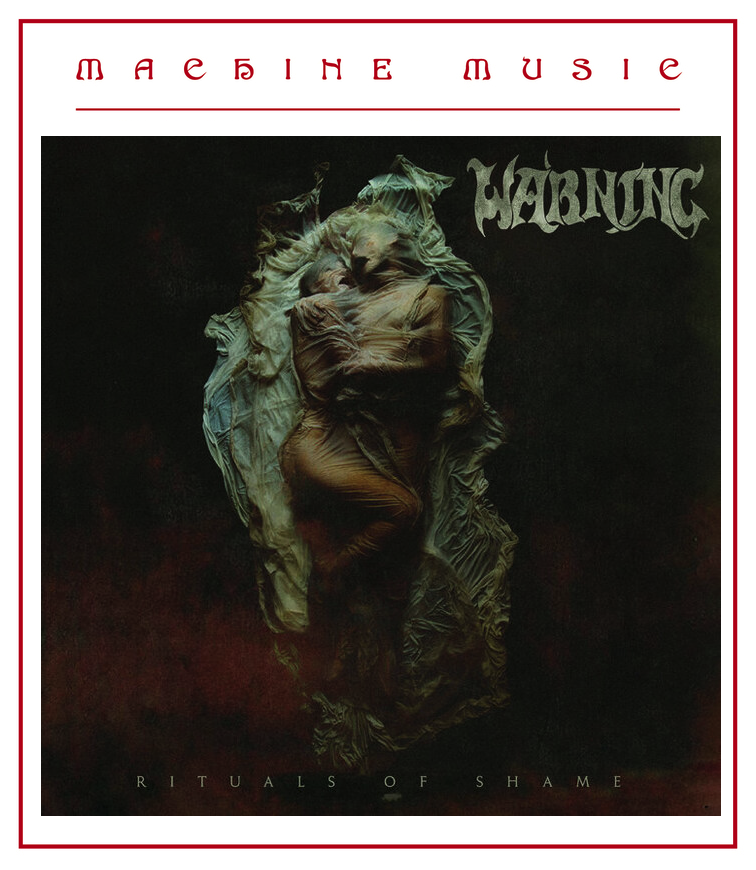
The gist of this, if you're a "gist" kind of person, is that this is a new, extended, wide-ranging conversation with Patrick Walker, conducted mostly under the influence of the recent release of Warning's incredible new album, Rituals of Shame (Relapse, get it). Another piece of context that feels important is that this is a kind of follow-up interview to the one I conducted with Patrick a few years ago, when we discussed 40 Watt Sun's The Inside Room as part of my Albums of the Decade series. That's the gist.
The less-than-gist, or more-than-gist is that I avoided treating this conversation as an interview as much as I possibly could. Also because I know Patrick is wary of them, and because of my own thoughts and feelings concerning my art that served as basically the context of this moment. If you've read interviews here before you will already recognize my tendency to, shall we say, paint with a somewhat abstract brush. And this, fair warning (pun alert), is the case here as well, perhaps even more so. If you're not a fan of that style, that's fine, I get it – it's even addressed in the conversation itself. But if you have a few minutes and feel like reading about music, art, human expression, pain, family history, and many of the other themes we address here, then I hope this will prove to be a rewarding read.
One short note: Since we recorded this interview a while back John Brenner of the band Revelation, who mattered a great deal to Patrick and whose work is mentioned in this interview, sadly passed away. This conversation is then dedicated to his memory.
If you're new to this metal blog of bones you can also check out the various interview projects I have going on as well as the weekly recommendation posts. And if you'd like to keep abreast of the latest, most pressing developments follow us wherever I may roam (Twitter, Facebook, Instagram, Spotify, Bluesky, TIKTOK etc), and listen to my, I guess, active? (no) podcast (YouTube, Spotify, Apple), and to check out our amazing compilation albums. You could also possibly support my unholy work here (Patreon), if you feel like it. Early access to our bigger projects, weekly exclusive recommendations and playlists, and that wonderful feeling that you're encouraging a life-consuming habit. It's probably a bad idea, but to each their own. On to Patrick and I.
Patrick: I'm a little nervous about this because last time we did this…
Yeah, let's get straight to it.
Patrick: Scott Walker died [laughs].
Oh, so you're saying, who might die today?
Patrick: Yeah. It has crossed my mind.
There was a death too—a bunch of people died yesterday.
Oh? Who died? Sam Neill died.
Sam Neill died, and the Mike Browning from Nocturnus. You know the death metal band?
Patrick: I know of them.
So he died.
Patrick: What happened to him?
I don't know. Who knows? Death, I think?
Patrick: [Laughs]
But anyway, last time we did this, Scott Walker died. And you're nervous. That's a good starting-off point. By the way did you see the name I gave to this session?
Patrick: No.
I called it "Ron and Patrick talk about the World Cup"
Patrick: [Laughs]
But, I am nervous too, Patrick. Not because of you—I love you, you're a good person—but because I know you were nervous.
Patrick: Go on.
We should set the record straight. Since you mentioned the first time we did this already. An event that had long-term repercussions. Some of which, I should say, were very positive, but the immediate repercussions were that you regretted the whole thing and wanted me to delete it and to commit suicide.
Patrick: [Laughs]. Did I say that at the time?
That you wanted me to die? No. But you were very apprehensive about the things you said and how you said them, and you felt it had gone horribly wrong. At the time, I think you were very averse to doing these kinds of interviews. It may even have been one of the first ones you did. Since then…
Patrick: Yeah.
…you've done quite a few more. So I wonder whether that makes you any less nervous about the situation.
Patrick: You know what my biggest fear about dying is? It's not being dead. It's that all the interviews I wanted scrapped would suddenly get released.
All the things you wanted scrapped?
Patrick: Yeah.
It's interesting because I've been thinking lately about writers who asked for their unpublished papers to be burned.
Patrick: Yeah, yeah.
And you seem to kind of jibe with that.
Patrick: Didn't Kafka ask that all his unpublished work be burned?
Yeah, but then it ended up in Israel, in the vault of the guy who was supposed to burn it.
Patrick: [Laughs].
Then his girlfriend—or whoever it was, I don't quite remember—got possession of it, and it became a huge debate about who owns it, what the author's wishes mean, and so on. But there's another author I've become very interested in lately. His nom de plume was Ka-Tzetnik. Have you ever heard of him?
Patrick: I don't think so. I'd have to see it written down.
He's not very famous. He survived Auschwitz, came to Israel, and changed his name because, essentially, "That's not me anymore." It was a very dramatic artistic gesture. On top of that, he adopted a literary pseudonym under which he published his memoirs and fiction about Auschwitz. He went one step further than you, me, and Kafka—our companions for this morning. He would go out into an orange grove to write alone. He would wear the Auschwitz prisoner uniform that he had kept. He reportedly often starved himself and deliberately put himself in very adverse physical conditions while writing. Then, before driving home to his wife and kids, he would often burn what he'd written.
Patrick: [Laughs].
My metaphor for it is re-entry into the atmosphere. You know what I mean? This thing I've made…
Patrick: Uh-huh. Yeah.
…cannot coexist with my domestic life. These two things can't go together. His wife was his champion. The books that were eventually published were either the very few he agreed not to burn, or the ones she managed to rescue before he could. Anyway, it gets back to you and your aversion to these interview situations. We've talked about one kind of aversion, which is: “I don't need this shit, I don't need this fodder, this PR-cycle bullshit. Whatever I'm forced into talking about—or whatever I end up saying that I later don't like—I don't want that to become part of my legacy when I'm gone.” Do you agree with that, generally?
Patrick: I think I do. Yeah.
And the second version would be: “Why would I be of fucking interest to anyone in the world, if there's anything I've wanted to say, I've already said it, painstakingly constructed. You can already hear it. So what's the point of me potentially ruining that painstaking process by babbling all over it.” Is that it?
Patrick: I think that's the primary reason. Your first example is really the secondary one. It's also partly that, when I'm writing…. I'm very careful about what I say and how I express myself. I take a lot of time—even down to the formatting of what I'm writing. And conversation just feels too… I can say something in an offhand way or lighthearted way, and I worry that I'll say something…. I think that words on the written page lack the context of a conversation. The words get edited. You don't get the hesitation or the tone of voice.
That's very interesting, because when we did that first interview, one of the things that bothered you was that you couldn't get your thoughts to where you wanted them. You couldn't express yourself in exactly the way you wanted, and you were afraid that, when it came out, it wasn't what you wanted it to be. I don't know if you remember this part, but I said “no.”
Patrick: [Laughs].
I still believe, by the way, that me saying “no” is a big part of why we're still friends.
Patrick: Yeah.
So I said “no,” and then it came out. I remember you telling me that one of your friends read it and said it was the first interview where they felt the real Patrick was there. So you might be wrong about that. Not as a blanket statement—you're right about most of it—but you might be wrong about this part.
I run a writing workshop. I've been doing it for the last two years, with the help of others—if I don't say that, they'll crucify me—so, with the aid of partners, I've been leading a writing workshop. The work I do as a scholar is about why people write during and after war. That's my main thing. One of the theories I've been working on—it's kind of my own, though it's related to other theories that exist along these lines—is that language gets broken after certain kinds of experiences. You can't communicate those experiences very well, and that inability spreads like a disease into the rest of your life until you find yourself unable to communicate anything particularly well. That inability to communicate has adverse effects on your well-being.
Patrick: Mm-hmm.
We've been living through a war for the last three years. It seemed funny to me—maybe "funny" isn't the right word—that I have all these thoughts and books published in English about how veterans of, say, the Falklands War communicate their experiences, and yet now I'm surrounded by a very large war and I'm not doing anything about it.
So the workshop grew out of that. I wanted to put my money where my mouth is and help people vent the immense pressure created by their inability to communicate, because I know that not being able to communicate is painful. It's hurtful. It's bad for you.
One of the things that happens in these workshops is that people—often people who've had catastrophic experiences— they write for ten minutes during the session. Afterwards they say, "Well, I've written something down, but it's really nothing. It's fragmentary. It doesn't make much sense. I don't know if I feel comfortable reading it." An important aspect of the workshop is that nobody is ever forced to read anything.
Patrick: Yeah.
But because we're already having this conversation, there's often an inclination to share it. So I cajole them a little. I say, "Just read it. Let's see what happens. If you don't want to, that's fine—but let's try." And Patrick, eleven times out of ten, it's the most powerful thing you've ever heard in your life.
Patrick: Yeah.
People are immediately drawn into the moment in which it was written. They identify with the person immediately. And what that person realizes is “Oh, shit. When I thought I wasn't communicating well, I was only communicating differently.”
I give this example not because you have trouble communicating. As an artist, you have fans. You don't need me for that. I'm simply saying that under certain conditions—if something is left unedited, if it's allowed to breathe as it was, which I think is what we did with that first interview—the real Patrick might come out.
Patrick: I think so. Sure.
Was that convincing? That's a "fuck you." I just worked my ass off while you sat there drinking tea.
Patrick: [Laughs]. No… I understand. Yeah.
That you experience as tripping over your tongue can actually be very instructive. Maybe later for you, but certainly for other people.
Patrick: Sure.
And this is where I want to get into the discussion of the new album. We're kind of going to talk about the new album—but we're not. Because I know you don't want to, so I have to maneuver my way into it.
Patrick: No, no—I don't not want to.
OK, fine. Let's go with the plan I have. Patrick, don't fuck this up.I have so much riding on this. If this interview goes well, I'm a millionaire.
Patrick: [Laughs].
So—I just published a book, and I'm in what I would consider the particular hell of having just published a book. I think that specific hell is somewhat different from the hell of writing and publishing music, but you can correct me. My assumption is that you have it easier than I do, because you've already spent years torturing yourself over the music, the lyrics, getting the band together, studio time, arguing with the drummer—that whole hell, which is also bliss. Then you release the music, and within forty minutes people are online saying, "Warning has never missed a step. This is the best album ever. Patrick Walker is our Shakespeare." Tag, tag, tag. Social media, music media…
Whereas I publish a book… Silence. And if anything does come my way, it isn't going to happen within forty minutes.
Patrick: No.
I should also clarify that I don't write the kind of books people finish in forty minutes. I write books that are difficult, I guess. Weird, I guess. They take time, even if they reach exactly the audience they're supposed to reach. Even if I hit pay dirt—win the lottery and find my reader—that still takes time. And that reader might be shy and doesn’t even think that there's an author somewhere waiting for feedback.
Is that a fair comparison between our two versions of hell?
Patrick: I think so. Music is easy in that respect because it relies on stimulation, whereas literature relies on concentration. You don't get an immediate….. You can't tickle somebody's funny bone or something with a novel [laughs].
I mean, you could, but I can't. I experience it as a continuous failure because it's very hard to know in that “in-abeyance” phase if the reason you're not getting anything back from the universe is because these things take time or because you're a bad writer, you don't know.
Patrick: Yes.
The reason I bring this up is that, despite the fact that you're Patrick Walker—our Shakespeare, the Emperor of Sad, whatever title people want to give you [laughs]—the reception history of your music is interesting. In that I'm not sure you'd describe yourself as someone who was an immediate success, or someone who found his audience instantly and completely. Would that be fair?
Patrick: I think so, yeah.
So, Patrick Walker seems to be the kind of artist people feel they've discovered for themselves—not because they saw you on the cover of some music magazine or because there was industry buzz telling them they had to hear you. More often it's someone finding your CD, or having a profound midnight conversation with a close friend at midnight, who says, "You know what? I think you'd like Watching from a Distance."
Patrick: Yeah. One hundred percent. I've said this before regarding bearing the weight of Watching from a Distance. You can't compete with that experience, with someone’s experience of feeling they've discovered something for themselves. The emotional experience of hearing a record like that —as you and I both know too—is that it feels like you're part of a secret club.
Was that secret club ruined when you released Rituals of Shame? Is the secret somehow gone now that you're public? Now that people are waiting for an album instead of discovering it piece by piece?
Patrick: I don't know. I haven't really thought about that. I just think that everything I've ever done has always been—and probably always will be—compared to Watching from a Distance. Because that record, and I think probably that record alone, garnered its reputation by people having that experience with it, that discovery.
You don't think people had the same experience with the 40 Watt Sun records?
Patrick: Possibly, but to a much lesser degree, I'd imagine. I don't know.
I think so….. Obviously I’m troubled by this because it's my experience right now. But there's also a fatalistic aspect to this. There are many fatalisms involved. One would be that I can't simply decide to write a different kind of book—just as you can't decide to make the kind of music that spreads like wildfire. This is what I make. I format the page, the font, everything has to be my way. It may simply be that my process or whatever it is that inspires me lends itself to produce works that are destined to be discovered piece by piece.
Patrick: Yeah.
So there's that fatalism: “This is the artist I am; I can't change what I do.” But there's also a kind of positive fatalism, which I wonder if you have and which I'm trying to invent for myself. It's the belief that this will happen, maybe even against rational thought. That even when there's no immediate gratification, no immediate response, it will come with time.
Patrick: Sure.
Do you have that? Or are you not as stressed as I am? Am I the only person who wants to throw up every day?
Patrick: Writing is such a lonely pursuit. Unless you're being published by a major publishing house that's sending advance proof copies to other writers to write puff pieces on the back cover, you're not going to see that kind of response straight away. I know that as well as you do. I didn’t have that. I don’t want to sound arrogant.
Please do.
Patrick: But I knew I'd made a great record. I knew I'd made the best record I could have made. I knew I'd made the record I'd set out to make. I also knew that even if the initial reaction was, "Oh, it's not as good as Watching from a Distance," in time people would probably come around [laughs]. I haven’t been troubled by that at all.
It's kind of like building a really good stool. I don't know whether you like that analogy, but imagine it's attractive enough that people want it in their house, and it's built so well that it doesn't fall apart. You can't predetermine how people are going to use your stool. If some creep came into my house and said, "I heard you bought my stool—that's not how you're supposed to use it," that would go against everything I believe artists do. They just sell stools. They don't tell people how to use them.
Josef Hoffmann, stool from the kitchen furnishings for Paul Wittgenstein’s “Bergerhöhe” cottage
If you want to have sex while listening to Warning, great. If you want to go to a funeral with Warning, that's fine. If you want to listen to Warning while you're in the bathroom, fantastic. Great shitting music.
Patrick: Yeah.
Whatever people do with it, it's yours. But the point is that, when you're making that stool in your workshop—sanding it down, making it as fetching, practical, and fit for human use as you possibly can—people will keep wanting to use it. They'll walk around the house saying, "I fucking love that stool. I wonder why they don't make them like this anymore."
I always transcribe these interviews, so when you nod it doesn't help me. Patrick, you have to say, "Yes, Ron, you're absolutely right."
Patrick: No, no—it's OK. I'm listening to you [laughs].
OK [laughs]. So you're completely confident that you made something people will use, want, and be helped by. I think art helps people. And it helped you to make it. That confidence isn't arrogance. It's knowing. It's saying, "My stool is better than that stool because it won't break." It's confidence in the work that went into making it what it is. That's not arrogance—that's knowledge.
Patrick: Hmm.
It's a kind of certainty. You know you did the best you could.
Patrick: Sure, OK.
OK, so now I have a question for you.
Patrick: Sure.
Do you have an album—or any work of art—that was that for you? You're wandering around your Patrick Walker™ life, and you stumble onto something and think, “Oh my God. This is mine. This speaks only to me.” Have you ever had that experience—as the finder rather than the creator?
[Here Patrick thinks]
Patrick: Perhaps not something I feel I discovered entirely by myself, but there have certainly been novels that I've read where I thought, "How has somebody written this? How does this person know? What could anybody else possibly get from this novel?" Because…. this is getting into difficult territory, I think.
No. Why difficult?
Patrick: I'm very cautious about… it doesn't matter.
Can you say the name of the book, or does that reveal too much? You don't have to if you don't want to.
Patrick: Well, there are a few. When I read The Heart of the Matter by Graham Greene…
Never read that.
Patrick: …and The End of the Affair, also by Graham Greene…
Never read that either.

Patrick: They're good examples to begin with.
OK. Without getting into anything you don't want to discuss. What was the feeling? Was it that these books knew something you thought only you knew?
Patrick: No…Oh, a bird just landed on my windowsill.
Maybe it's Scott Walker.
Patrick: [laughs]. No, it's not something that I know about. It's something that I feel about.
Yeah, that's what I meant.
Patrick: For sure.
And did you later meet other people for whom those books meant a great deal as well? Or was it just you?
Patrick: No.
That's pretty amazing.
Patrick: I mean, it did make me feel… I think it did what all great art should do. I've used this metaphor about my own work before, though in a different context of conversation, but it felt that the writer was standing next to me with an arm around my shoulders.
Yeah. For me, that feeling is that I’ve found family.
Patrick: Sure.
That obviously depends on what you mean by “family,” and whether family has been a good thing for you. But, for me, my family doesn't really know anything about me. I think that's safe to say. They know me in certain ways better than I know myself—they watched me grow up—but they don't know anything about what I actually care about. If I try to explain it to them, it's incredibly boring for them.
And so those people for whom the things I'm passionate about aren't boring—but, in fact, are what they’re passionate about—those are the people I think of as family. And sometimes those people materialize as works of art.
Patrick: Well, that's exactly how I felt when I first discovered the doom metal bands in the early '90s and went on to push me into the trajectory of the rest of my life, particularly in a creative sense. When I first discovered them, that felt like family.
In the same way as Graham Greene, or was it different?
Patrick: No, different. Because Graham Greene was about ideas, talking about feelings, thoughts, and emotions. This was different. This felt like discovering a family that I could belong to. And I still feel like I belong to it, but I also feel estranged from it now.
Why is that?
Patrick: Because that whole… I don't like using the term "genre." I'd rather call it a "field" as I would in literature. That field of music doesn't exist anymore. Over the last thirty years it's morphed into something else and lost the essence of its meaning
Do you think what it lost was vulnerability? Emotional depth? A certain attitude toward melody? What exactly did it lose? Because metal as a whole—and I know it's strange saying "metal" to you because I don't really think of you as a metal artist—but doom metal, as part of that wider field, went through a kind of arms race over those thirty years…
Patrick: Yeah.
… where everything became more extreme, more out there. Was that what caused it to lose what it was for you?
Patrick: It was a depth and breadth of emotion. It was a seriousness of purpose. It was a level of musicianship and a sense of songcraft. I believe that doesn’t exist anymore.
I mean, firstly that sounds very lonely.
Patrick: Yeah.
I think I'd feel very lonely if I were you. Except, obviously, when you're talking to me. That's when the weight is lifted.
Patrick: Sure.
But seriously—it feels lonely because it's as though you once belonged to something. I know that, in your case, you're talking about an international community. It's not as though you were hanging out with these people every weekend in the '90s. They weren't part of your immediate local world. They were part of a wider “I'm glad these people exist on Earth” family. Right?
Patrick: Well, I wrote to many, if not most of those bands at one point.
So those relationships became real?
Patrick: For sure, to some extent, yes. Some close personal friendships, some of which I still have today. But there isn't really a school of bands anymore that shares… It simply doesn't exist anymore.
That’s too bad.
Patrick: Yeah.
But aren't you in a strange position in the field? I think there are quite a few musicians like you—not necessarily your field—who end up being grouped into movements or genres by marketing departments, journalists, fan forums, and so on. They don't necessarily want to be grouped that way, but have to live with it because the marketing means better tours, better sales, so they end up living with a label that doesn't really fit them. Has that been your experience?
Patrick: I think so. I can't complain, I'm very lucky. Most of the musicians and artists who were my heroes in the '90s—and still are—aren't even talked about today. I think that's part of why I sometimes feel guilty, or undeserving, that Watching from a Distance is still heralded in the way that it is, because I still feel as though I'm standing on the shoulders of giants, to coin Isaac Newton's phrase.
So you have survivor's guilt.
Patrick: [Laughs] Yeah… possibly.
You're kind of like the Holocaust survivor.
Patrick: [Laughs]
Has anyone ever said that to you?
Patrick: [Laughs] You said that—not me.
[Laughs] I know. I'm fully aware of that. But you're the one laughing, Patrick, so, shame on you. You'll never wash this blemish off your legacy. Laughed after the word "Holocaust" was mentioned.
Patrick: [Laughs]
So, about three years ago, my family and I moved. I have three kids—we talked about my kids before, didn't we?
Patrick: Yeah, we did.
Right. They're 4, 8, and 12. We moved from what, in English terms, would be like moving from Shoreditch—a grimier, up-and-coming, gentrifying part of London, to a well-to-do but incredibly boring suburb. What's the equivalent? Not super rich, but upper middle class and very boring?
Patrick: I don't really know London's suburbs that well. Oh God… I don't know. Make something up.
Surrey, whatever.
Patrick: That’s a good one actually.
What makes it more complicated is that I grew up around here. So I hate it in exactly the same way I hated it when I was a teenager—walking around with dreadlocks, listening to Megadeth on my headphones, hating everyone, and finding the handful of friends I could connect with. None of them liked Megadeth, but some of them liked… whatever. The Exploited, maybe. It doesn't matter. We could at least agree that we hated everybody, even if we disagreed about the soundtrack.
Patrick: Yeah.
But now that I'm older, I don't have those friends anymore. I don’t dress…. I mean I guess I do, see I’m wearing a doom metal shirt just for you.
Patrick: Thank you.
It's Chrch.
Patrick: I think I played with them in San Francisco—at the show you were at.
Yeah, I think you did. Although that doesn't quite make sense because I bought the Warning shirt at that show. Maybe I bought both. Unintentional tie in. I still hate it here.
But there's nobody walking around saying, "I hate everyone," when you're an adult. So it's lonely. And I feel guilty because I came back to a place I hated, and I left a city I loved. Everything feels a bit like Robinson Crusoe, except I'm also a father, so I have to function.
Patrick: [Laughs].
Then I started noticing that there's a park near our house—a playground where I take my kids—that's named after said Holocaust-survivor writer. I thought “That's a very unusual name for a playground.” It’s not that there’s a death of morbidly named parks, but still. Then I found out that, before this neighborhood existed, it had been the orchard where he used to sit and write.
Patrick: OK.
I found that incredibly moving. Because, at another time, there was this tortured soul that couldn't find its place, and that had a profoundly conflicted relationship to his own art. He's known in Israel, but not really regarded as one of the great writers of his generation. Ironically, he's probably most famous for collapsing during the Eichmann trial.
Nobody knew that the man with his everyday name was the same person who had written all these Holocaust books under a pseudonym. Then, when he took the witness stand, those two identities suddenly collided into one person, and he couldn’t take it and he collapsed. And there’s a very famous piece of footage of policemen carrying him away because he simply couldn't continue. He's a fascinating figure if you're interested in trauma.
Patrick: Is that on film?
Yeah. Do you want me to show you?
Patrick: Sure.
Patrick: One second…
Patrick: This is the same trial Hannah Arendt was at?
Exactly the same one.
[Video of the testimony of Yehiel Di-Nur at the Eichmann Trial because that’s a very normal thing to do in an interview]
He's wearing this white suit, which is such an extraordinary fashion choice for the trial of the man responsible for the murder of millions of people, he looks like a Colombian drug lord.
Patrick: Yeah. For sure.
Anyway, as you know, the Eichmann trial was a watershed moment in the way the Holocaust came to be understood. Up until then, Holocaust survivors in Israel were often viewed with suspicion. Some people wondered whether they had collaborated. Women were accused of having slept with Nazis to survive. There was a great deal of cruelty and misunderstanding. That trial made people realize these people endured unimaginably horrific things. He's become one of the symbols of that shift because he simply broke down.
I don't write about the Holocaust as much, but I grew up in a Holocaust family. So it appears in my fiction, though mostly because my grandparents were so important to me. Because they mattered so much to me, their story became important to me. Years later, discovering that this man—who isolated himself in an orchard, writing in his concentration-camp uniform, burning his manuscripts before returning home…
It's such a performative thing to do, but he wasn't performing for anyone. That's what's so striking. We're used to these gestures as performance art, where there's an audience. He was completely alone. To know that he once sat writing in the very place where I now push my children on the swings…. It's fucked up. But it's also somehow my fucked. I find it deeply moving. That this isn’t just the empty space I thought it was. Or, more that it is still vapid upper-middle-class life built on the soil of other people's suffering. I could connect to that. That meant something to me.
Patrick: Yeah.
Anyway… The reason I mention all this is that I've become fascinated by this man, and by the idea of castaways. He's a castaway. I know—I'm dragging you back into Holocaust territory again, Patrick. I apologize. But you're a castaway from a different time, out of time, out of joint. Maybe that’s why you know Hamlet by heart, I don’t know.
Patrick: Time is out of joint. O cursed spite / That ever I was born to set it right!
Oh my God. I thought I'd be the only person to ever hear you quote that. Now it's on the record. Well… on the written record. So, castaways. Sometimes you find people who are out of their own time. Maybe Graham Greene was that for you. Maybe those doom metal bands in the early '90s were that as well—people who didn't quite fit their moment. Maybe part of what you connect with is simply the fact that they existed. Even in Graham Greene's case—they existed.
I'm reading this book now that I literally found in the street, written in 1950, a man writing about what a profoundly sad child he was. I don't know exactly how old he is in these stories—maybe eight to twelve—but he describes this overwhelming sadness in a very young boy. He walks through the world, and that sadness becomes a kind of projector through which he experiences everything. He absorbs the world through it. It's so beautiful So moving. The humanity with which he treats his own childhood—as something filled with sadness, love, despair, anger, and a sense of not fitting in… I'm simply glad he lived. I never knew him. He's actually a well-respected author; I'd only just discovered him. So it's not as though nobody knew who he was. Maybe it's a bit like Graham Greene. But what he means to me is personal.
Patrick: Of course.
That’s how people feel about you.
Patrick: I hope that's true.
I know it's true.
Patrick: Yeah… I hope it is.
Which is why I don't think your association with sadness isn't the right one. Yes, you've written some pretty fucking sad music.
Patrick: Sure.
And yes, when I put your music on, I reflect on my life in ways that aren't always comfortable.
Patrick: [Laughs]
But I don't experience that as sadness. In the same way that taking my children to play where that Holocaust survivor used to write might seem horrifying to someone else…. To me, it's inspiring. Because you, Patrick, exist.
Patrick: Yeah. It's not a reputation that I enjoy.
The sadness part?
Patrick: [Laughs] Yeah.
Why not?
Patrick: Because I think it's reductive. It's misleading. It's not truthful. I don't know if that’s down to a misreading of what I'm doing, or down to people not being articulate enough to express what really is that they think they’re feeling.
Maybe that’s true, though. Maybe what people call "sad" isn't what you consider sadness to be. If you died, Patrick, I would be sad. That would genuinely be a sad moment for me because you're my friend. I can message you in the middle of the day, and you'll reply by reciting Shakespeare. I think that's hilarious—in the best possible way.
Patrick: [Laughs]. Yeah.
So that would be sad. It's not what I feel when I listen to your music. I think, when people call your music "sad," it's exactly what you were talking about earlier. There's a reason they don't write Warning albums. They're not used to examining their emotions in that much detail.
In casual conversation—or in an online comment—they're not going to write a treatise about the complexity of human emotion. They're just going to say, "It's sad." I'm guilty of that too. Do I have one of your tote bags?
Patrick: Possibly.
I think I once wrote that walking around with my 40 Watt Sun tote bag felt like making other people cry out of spite.
Patrick: [Laughs].
But that crying isn't sadness to me. It's more like what happens when you read Graham Greene. You're not happy. You're not depressed. You're somewhere fascinating in between. You're inspired and crushed at the same time. It's an emotional state made up of every temperature at once.
Patrick: I tend to think that anything worth writing about—or perhaps, more specifically, anything I've written about—comes from feelings or experiences that are far more complex, far more interesting than a single emotion. I'm being very careful about how I say this.
I'm here, Patrick.
Patrick: This is very difficult for me. I don't normally express myself like this.
"Complex" is a perfectly good word.
Patrick: It is, but I don't want to sound as though I'm trying to elevate my own feelings or experiences.
Do you think calling them complex elevates them?
Patrick: I just worry it might sound as though I'm trying to…
It doesn't. "Complex" just means complicated, not elevated.
Patrick: I think of some of the most painful moments I've experienced have also contained a kind of beauty… or peace in there as well. But, above all that, this wonder at being alive.
You know what Wittgenstein calls that? The wonder at the existence of the world. He's not talking about some cheerful Instagram version of happiness.
Patrick: I don't place much value on happiness as it's commonly understood. It's not a priority I am particularly striving for. There are things that I would…. Peace, and I mean peace of mind, is a deeper, more elevated condition. Curiosity. Personal satisfaction. Those are things worth pursuing. But happiness, for me, isn’t worth striving for.
And do you feel that writing— I'll separate writing from performing for now, because they may be different things—but does writing, making music, contribute to that peace of mind? To satisfying that curiosity?
Patrick: Of course.
In a lasting way?
Patrick: No. Because once you've done something [Laughs]. Making a record is a bit like taking a shit.
OK, we're back in the bathroom.
Patrick: Right. You park what you need into the lavatory, you flush the chain, and then you have to wait for the tank to refill before you can do it again.
Right.
Patrick: It's just a cycle. Any true creative art, it’s the same. It's not unique to me.
No, probably not. But I wonder if it changes. Is it a cycle in which every circle is the same? Or is it more like a spiral—or, if I were Yeats, a gyre—where each revolution changes the shape of the next?
Right now I'm only at the beginning of my current cycle. So, I just shat, to use a beautiful Patrick Walker metaphor….
Patrick: [Laughs].
I flushed the chain. Now I feel this void. And at least at the moment—it may change—it feels like the worst its ever felt upon releases.
Each time I complete something, the void gets larger. Maybe the fix is bigger too. Maybe, to stay with your metaphor, the shit gets bigger as well. But the emptiness grows too. Does that make sense?
Patrick: I think so. I think I understand what you're saying.
Because that doesn't feel good.
Patrick: No.
It doesn't feel like I'm getting anywhere. It feels as though I'm simply back on the machine. On the cycle. It’s not really up to me.
Patrick: No. But it's just the way I express myself. I don't think it's related to anything more than that. Some people like to pick up the phone in the evening and have a conversation with someone.
Yeah—and that does it for them.
Patrick: Yeah. Some people want to go out and dance every weekend. This is just my way of having a conversation.
With whom?
Patrick: With anyone who's willing to listen, but I don’t know who that is.
So, a "The Rime of the Ancient Mariner" kind of conversation?
Patrick: [Laughs]
"There was a ship"… Or, "there was a shit," if you want to keep the gag rolling.
Patrick: [Laughs]. Yeah.
I want to tell you about something I've been thinking about lately. Do you know György Ligeti?
Patrick: I do. I've actually got some of his CDs behind me.
I grew up in a house where my father was a huge classical music enthusiast—which, of course, made me hate classical music for most of my life. But I ended up imitating him in a different way. My own children now live in a house full of music in physical media they don't understand. So I inherited the collecting instinct, even if not the music.
But through my love of certain kinds of extreme metal, though, I've gradually come to appreciate certain kinds of extreme classical music. I feel like they're touching the same nerves.
Patrick: Oh, it's certainly extreme.
Yeah. I started a Spotify playlist called "These Violins Kill Souls." I keep adding to it. Lately I've been listening to Ligeti constantly.
Patrick: Would you share that playlist with me?
Sure. So I started to dig about Ligeti. With some very avant-garde metal I can admire it, but I don't necessarily feel I understand where it's coming from. Sometimes it seems deliberately overwhelming. With Ligeti, though, I feel I can relate. He feels like family. He's wrestling with things I'm wrestling with.
Then, after spending a wonderfully depressing week watching documentaries about W. G. Sebald on YouTube, I decided my next obsession would be Ligeti. I found an extraordinary documentary from 1992. I can't recommend it highly enough.
It meant a lot to me for several reasons. First, he's a Hungarian Jew. That's where my own family comes from. Second, he's a Holocaust survivor. And Patrick… I really can't overstate this: He has my grandmother's face. He looks exactly like my grandmother. And like her brother. It's almost uncanny.
So I immediately loved his music even more simply because he looks like my grandmother. That's what I mean by “complexity.” A few years ago I interviewed an American band called Scarcity. They make this strange avant-garde black metal with strong modern classical influences. Great guys, really thoughtful people. Ligeti came up during the interview I brought him up.
I told them that what they were doing didn't feel like conventional melody writing. Instead, they were creating all these tiny musical events and layering them together. It reminded me of Ligeti.
Would it help if I played you a little? Are you ok with time?
Patrick: I'm not under any time pressure at all.
Great. Just to show how dumb I am, this album is called Aveilut. I originally assumed that was just another obscure black metal title. Eventually I realized it's Hebrew. It means “grief.”
[Playing Scarcity as if that’s a normal thing in an interview]
Anyway, I mentioned Ligeti because what Scarcity were doing reminded me of his music. Instead of writing melodies you simply follow, they're creating hundreds of tiny moments and layering them together. It's like those paintings made entirely of dots. Eventually your perception shifts. You stop looking at the individual dots and begin experiencing the larger image. You ride the wave created by all those tiny details.
Patrick: Right.
They loved Ligeti too, and we talked about it, great. Then, later, I watched that documentary, and Ligeti himself described his music in almost exactly those terms.
Patrick: Yeah.
It felt as though he had been sitting in the room with us. He talked about creating music that seems static—as though nothing is happening—even while tiny changes are constantly taking place beneath the surface. As someone who isn't a musician but simply listens to music, that struck me because so much of the music I love isn't really driven by melody. Something barely moving or changing slowly.
Then I suddenly started thinking about my own writing. This is probably going to sound incredibly boring…. Great, I sound like Patrick Walker now.
Patrick: [Laughs]. Go on.
There are a lot of different voices. Often whole sections belong to different characters. The narrative jumps between them, sometimes in disorienting ways, at times across thousands of years. There’s a sense that people report to me when they read that they gradually learn how to read the book. You don't open the first page already knowing the rules. It isn't like, Ah, here's the suspense plot. Now I'll wait for the resolution. It's more like what Ligeti described. You're bombarded by all these polyphonic voices. For most people that’s annoying.
I think, for most people, Ligeti is annoying. And I think, for most people, I'm annoying. The way I write about music is annoying. The way I write fiction is annoying. The way I do research is annoying. I genuinely don't think I'm most people's cup of tea.
Patrick: Hm mm.
But it made me wonder whether that is what I mean by complexity. You can reject this completely if you want, I enjoy being humiliated, but maybe complexity that’s a tension between something that is moving and something that isn’t moving.
Let me give you an example: My daughter was born. For sure a “moving” moment: The day before, not a father, the day after, cosmic horror, A lot of action. Buying things. Reimagining your life. When you zoom in on me, it looks wildly dynamic. Everything's happening at once. Crazy sounds.
But the difficulty and complexity of that is that it’s actually “happening again.” This has happened billions of times before. It will happen billions of times after me. It's what happened when I was born. And when my daughter arrives she looks like my father. How do I feel about that?
A brand-new human being who already resembles the person I most resemble. All of those realities exist simultaneously.
So asking whether Warning is sad or not, is like asking – “Do you like having a baby?” What kind of fucking question is that?
Patrick: [Laughs]. Yeah.
That's not a good question.
Patrick: No.
A better question is: “What is it like?” Now that I can answer. You may not like the answer.
Patrick: Hm mm.
You may think it's too long—like this entire section of our conversation.
Patrick: [Laughs].
That's fine. But the only way I know how to answer a question like that is by writing a book. Or making a piece of art. Those are the only forms capable of presenting the layered nature of an experience like that. And this is where I want to get back to you. There's this tension between something happening for the very first time— something utterly new— and simultaneously feeling, of nothing is changed.
“New album! Nothing's changed. A new morning! Nothing's changed. Someone wants to know me, to love me, to share my pain. Nothing's changed.” All these narratives appear to move forward, while reality itself seems to stand still.
Patrick: I think you've articulated it better than I ever could [laughs]. But you do that with everything.
No, but does that resonate with you?
Patrick: I don't know whether I'd say nothing changes…
There's a gap between what seems to happen and what actually happens. Can I tell you why I'm asking?
Patrick: Yes, please do.
The reason I ask is because, on the surface, your music and Ligeti's music have almost nothing in common.
Patrick: Yeah. For sure. I'll go with that for now.
But I think all the works of art we adopt into our lives— the works we create with all the sincerity we possess, the works we release into the world, and the works we discover and recognize as members of our own family— are ultimately concerned with the same thing. Not the same subject matter— not childbirth, or Holocaust survival, or grief— but with the complexity of being alive. And the particular question that seems to fascinate me is this.
I think the tradition—the field— is also a statement of that. Because when you write a “doom” song. Because when you write what people call a "doom" song…
Patrick: I’m wincing a little when you say that. It makes me feel that you’re suggesting that I’m following a recipe card.
Not at all.
Patrick: OK.
What I mean is that whatever first drew you toward that family of musicians— whatever made you feel that you belonged there— was that they were taking something extraordinarily seriously. Emotionally. Artistically. And, among other things, they were taking time seriously. They understood that some things have to be said slowly. That hearing chord changes unfold slowly matters. That letting words arrive slowly matters.
Patrick: I have two responses to that. One is that, and I’ve said this before, that whatever I'm singing, I like to think about what I'm singing, in exactly the same way that I like to feel what I’m playing. But… and I'm not being contrary… I don't feel that I play slow. I feel like I make music that exists at the same pace as if I went for a walk across the fields with somebody, and we were chatting and taking a saunter across the fields. Or had we spent the afternoon talking. Or the same rate as my heartbeat when I’m peaceful, or the same pace at which I eat. I don’t feel like what I do is slow.
And I think that’s interesting. I'm a big fan of pop music. I like very middle-of-the-road music, and my songs probably reflect that in a lot of ways. Nobody talks of a Billy Joel ballad as being “slow.”
They do
Patrick: I don’t think they do. No one talks of “Piano Man” as being slow.
They absolutely would. What do people dance to when "Piano Man" comes on? A slow dance.
Patrick: [Laughs] Oh no! But I think that’s something that’s unfairly applied to a lot of music, particularly mine. There are bands that play exessively slow to the point where it feels contrived.
Contrived to you. They could say, as you do, that that is what comes naturally to them.
Patrick: Of course. But to me it doesn't sound natural. In the same way that hearing speed metal wouldn’t sound natural.
It probably does to someone with ADD.
Patrick: [Laughs] Well that’s true.
I was only half joking.
Patrick: No, fair enough. What I mean to say is that I don’t write slow songs, in the same way that I don’t think I write long songs. People talk about my songs being long. And I think “How can you go to the Cineworld and watch a two-and-a-half-hour Marvel film and then leave…
[Laughs]
Patrick: …and then remark on the length of a ten-minute song!
But doesn’t that have to do just with convention? What people are used to? You spoke of pop songs, pop songs aren’t usually 10-minutes long.
Patrick: No, they’re not. Nonetheless, and I’m talking about my own music, I don’t mind conventional pop music, and I think it reflects my interest in it. I’m very interested in it.
As a listener, or as a musician?
Patrick: I think it’s a beautiful artform, I think it’s one of the great art forms of the last century.
Do you ever wish you were a pop musician?
Patrick: Sometimes, yeah. Probably all the time.
[Laughs]
Patrick: [Laughs] I do. I'd love to express myself in three or four minutes, and to make music that sounds celebratory, in a more accessible format. I mean, I can’t.I've never tried, it’s just not what I do.
Can I counter your counter? I don't actually think we're disagreeing, I think you just don’t like the word. I respect that. What you're saying is that the pace at which you naturally experience life, the pace at which you write, the pace at which you perform, it’s not fast for you, it’s not slow for you, it’s “Patrick Walker speed.” If I had a speedometer, it wouldn't read "slow." It would read “Patrick Walker.” Neither fast nor slow. Just your tempo.
Patrick: Sure.
In the same way, if I pointed my gauge at Ligeti and say “Hey, Ligeti, what’s with all the weird sounds?” He would say: “Weird? Why weird?” So there’s something coy about that answer. I obviously accept it, but there’s also you saying “I wish I could write those beautiful, shimmering three-minute songs about the human condition, but I can’t.” So, you know there's a difference between the way you work and the way many other people work. There’s an awareness that your slower than others.
Patrick: Yeah… there's a reason—beyond simply being a balding middle-aged man—that I don't appeal to a great number of people.
OK—but that's interesting, because the great number of people you're interested in, and the great number of people into pop music, go together, right? At its height, it's a Tears for Fears album: the masses love it, and it's a masterpiece. At its worst, it's some trash thing, and people love it.
What I'm trying to say is that no one says, to go back, "I remember the day I heard Michael Jackson for the first time—I felt like I found family." No one says that.
Patrick: No.
They might say it about a Tears for Fears album, even though it is a pop album, and I find that interesting. I think part of what's happening there is that good writing—what we, in our different fields and different tastes, might both agree is good writing—is when we find those people who seem to clutch our hearts and feel something about us.
Patrick: Mm-hmm.
Is an artwork, an artifact, a song, or a novel that shows something happening quickly and something happening slowly at the same time. That's why I think pace matters. For most people, you're slower than some, and I think that's part of your appeal.
They love it, I love it, when I can hear every word you sing, how you enunciate, how words ending with a "t" actually get their "t." There are other bands I hate for exactly that same reason, because I can hear what they're saying and it's horrible. But with you I can hear it, and it's beautiful because it's slow and deliberate, and because what you wrote matters.
So again, I'm going to force this comparison. You are not a Hungarian Holocaust survivor who fled Communist Hungary to participate in postwar avant-garde classical music. That's not you. But isn't it interesting that people listen to you, and to Ligeti, and read Graham Greene, and even read me sometimes, and say: “This is a real person going through real emotions in a beautiful way?”
I think part of what they experience as real is this friction, this discomfort, this feeling of not fitting.
Patrick: That's fair, yes.
That's all I wanted. Goodbye, Patrick.
Patrick: I'll accept that.
And I think that's also part, if I may, of your problem with what people call doom metal in general—as though you're following a recipe. Whatever doom metal has become – it's not longer real people expressing real emotions beautifully. It's going through the motions.
Patrick: Sure.
If I read a book like that, I drop it after a page. Much like you would stop listening after two seconds, because you immediately hear: “This isn't what I'm looking for.” And I'm guessing that's not metal anymore.
Patrick: What do you mean?
That it’s not what you’re looking for, to quote the great Bono.
Patrick: Do you know the story? It’s apocryphal. About Bono writing to Captain Beefheart to collaborate on a record. And Captain Beefheart wrote back: “Dear Bongo, no” [Laughs].
[Laughs]
Patrick: [Laughs]. Sorry, why don’t we just backpedal to what we were talking about….
I’m not backpedaling for you, Patrick, the moment is gone
Patrick: [Laughs] You wanted to talk about how today it isn’t metal?
That when you’re listening for what you’re looking for, that more often than not it’s probably not in a “metal band.”

Patrick: [Laughs] Yeah. Again, I don't know. Probably not, most of the time. But I don't even think in terms of metal or not anymore. I don’t think I do. Put it this way – the American black metal band you played for me, share, in many respects, far more qualities with Ligeti than they do with, say, Marduk. It would be easier to listen to that band and then move on to Ligeti than to listen to them and then Marduk. In that respect that’s why I try to avoid it, because "Metal" is a superficial connotation. It groups together things that don't necessarily belong together.
Yeah. The way I understand it is simpler. Do I need the loud thing or the quiet thing? And by "thing" I mean whatever stimulates me, whatever inspires me. There are many things in metal that belong to that circle, and many that don't. Just like every other genre. I don't want to listen to Mozart. Mozart doesn't resonate with me.
Patrick: It's like when I worked in a bookshop. People would come in and say, "I've read such and such. What should I read next?" A lazy bookseller would recommend maybe something of a similar genre, say someone came in and said “I read this novel by John le Carré, can you recommend something else?” and you recommend some other spy novel. But the more proper response would be: "What was it that you liked about it?" I feel that way about music.
Yeah, I do too. Which, by the way, is why I write about music.
Patrick: I know that you do, because I know the way you write and the way you think…
… I should say, that too limits my audience. Just as there are more lazy booksellers, there are also more lazy readers.
Patrick: Well, yes.
Some people don't want to answer the question, "What did I like about it?" They just want another book. They don't want to interrogate themselves. It’s not everyone that wants a thoughtful response. Most people don’t want to have that conversation. They don't have the experience and the vocabulary to express what they love to the bookseller – Patrick Walker, obviously – much the same way that most people who read music reviews aren't looking for me. They'll read a line I've written and think, "Fuck that. I don't need that in my life."
Which brings me back to what I asked you earlier. You said “some of the time, probably all the time”. I'm like that with everything I do. I probably could write about music in a more accessible way. I could write better books. Better articles. And from that point of view, I'm a failure at everything I do.
I once joked on Facebook that after years of writing music reviews nobody reads and books nobody reads, I had finally reached the only possible conclusion: everyone else is an idiot.
Patrick: [Laughs].
That was the joke. Because I didn't really believe that. I believed I was the idiot. And once the thing has finally been made—once the great achievement arrives, the book nobody wants to read—you have both realities at once: No one's reading it ,and you've already emptied yourself making it. So it feels, in that moment, like a lose-lose. Even though I know—from my workshops, from my own experience—that the cost of not writing is infinitely higher than the disappointment of writing and feeling you failed. The cost of not expressing things the way I need to express them, not following my curiosity—that cost is astronomically higher than the cost of doing it and being disappointed in how you did it. I know this. Do you know this?
Patrick: I know it.
But it still fucking sucks. I'm sorry about this. [Showing the cover of my book to the camera]. It has a very nice cover.
Patrick: It's a lovely cover. I love it.
It is a lovely cover for a book no one reads. But really, it represents my faith in the experiment. Because there's no choice. As you said, my pace is my pace. My shape is my shape. The way I express myself is the only way I know how. I can't dance this away. I can't talk it away. I can't go into nature and relax. Those things don't work for me. I have to interrogate.
Patrick: Hmm.
Do you like Defoe?
Patrick: Defoe? No, I can't say I'm a fan.
That's fine. Most of Defoe is unreadable. Moll Flanders is readable, but, yeah. His most unreadable book is The Storm. It's not really a novel—more like investigative journalism. He collects accounts from people who survived the hurricane of the early eighteenth century and tries to understand what happened. It's an important piece of journalism and in a way weather reporting, but it’s also the most tedious thing you'll ever read.
Patrick: [Laughs].
But I used a quotation from it as the epigraph to my book: “Two Men met in the Middle of a great Wood; One was searching for a Plant which grew in the Wood, the Other had lost himself in the Wood, and wanted to get out: The Latter rejoyc'd when thro' the Trees he saw the open Country: but the Other Man's Business was not to get out, but to find what he look'd for.”
I don’t get out of the forest. I stay until I feel like I’ve figured it out, even if it means circling the same drain over and over. Then I move on to the next plant.
Patrick: OK.
That produces art that not everyone likes. I hope it produces art that, when it reaches the right reader, feels as though it was written specifically for them.
Patrick: Yeah.
That they carry it in their blood. That it becomes family. I hope. I'm telling this to you because you've already completed one successful cycle of this process, and now you're beginning another. You've experienced people finding your work. You don't know whether they'll find the next one.
Patrick: No.
Unless you carry some confidence from what happened before.
Patrick: OK. What's your measure of success? In the context of what you've just described.
At my lowest? The thing I'm desperately holding onto? Or when I'm thinking clearly?
Patrick: I just mean, in the example you just gave me, what is your measure of success?
People telling me they found the book. That it mattered to them. That it became meaningful in their lives.
Patrick: Sure. That's why we make things, at all. I'm so wary of discussing what I do and trying to be objective about it.
You don't have to be objective. Do people come up to you, or write to you, and say, "Patrick, your music profoundly affected my life?"
Patrick: Yeah. It happens all the time.
And does that feel like success?
Patrick: I think it's a measure of success.
What would be another one?
Patrick: Well, financial success. I’m being objective, not necessarily one of mine.
So, what are yours?
Patrick: There’s critical success.
Critics, newspapers, magazines? That kind thing.
Patrick: Sure, it’s a measure of success.
If I made what I thought was a great record and had nothing but bad reviews, could I still call it successful?
What if nobody reviewed it at all? Did Watching from a Distance get reviews when it came out?
Patrick: [Laughs]. No, it did not.
So by that measure, it failed.
Patrick: Yes. I mean, I don’t know if you can say something that had no critical reception was a failure.
So, no reviews isn't the same as bad reviews.
Patrick: That’s true. But then, if I see a seven-and-a-half-out-of-ten review, I feel annoyed by that. I'd rather get one [laughs].
[:aughs] Would you?
Patrick: Yeah. Seven and a half is indifference, isn’t it? [laughs].
Didn’t care enough to look for a real number.
Patrick: There are different ways of measuring success: financial success, critical success, sales, audience feedback, knowing you've reached people…
And how you feel about the work.
Patrick: Personal succeess. That's the most important one. Like with Watching from a Distance, which I don’t necessarily think is a great record by any means, but I don’t want to argue with people about that [laughs]. If you make a great record at least I can sleep easy that you’ve done the best work I was capable of and that perhaps one day it may be heard the right way.
None of this is helping me very much. Thank you, Patrick. I'm struggling on all fronts. The feedback arrives slowly. Reviews, not really happening. I did a short interview, which was lovely, but it wasn't really a review….
Patrick: What did you expect, though? You’ve written…. What would you call it, “experimetal fiction”? With an independent, small-press publisher, I assume. I’m not sure if I’ve done the same what I would expect that would i be any different from what you’re experiencing.
There’s a gradual aspect to it. This is my third publication, and it’s been through increasingly larger publishers. So, this time it’s out not on “mainstream” mainstream publisher, but it’s the Relapse of publishers. One of the bigger smaller ones.
Patrick: I understand, it’s an independent publishing house…
That has a reputation, wouldn’t be the reason why your book disappeared. Or could potentially generate interest. And I think because of the gradation – first one tiny, no one noticed. The second one, a bit bigger, got a review in the paper. Which, to be honest, was the best review I could ever hope for. The person who needed to review the book did. I appreciate that.
But when I moved up again I anticipated more, and it’s less. Also because in the second time I was more hands-on because I had to finance the book myself – crowd funding. Which was a nightmare emotionally, but put me into direct contact with readers. More of a sense of who's reading and what they think.
Now it’s just me, chilling, talking to Patrick Walker, not really knowing what’s up. And, again, I realize through my coping via watching Ligeti documentaries and Sebald documentaries, and coping via talking to Patrick Walker. You're a friend, but you're also someone I can speak to while I'm trying to get through this. I'm trying to find small victories that keep me moving.
Patrick: Yeah.
The biggest one is writing itself. Which sometimes makes me feel like I'm trapped in a pyramid scheme. But I don't get to choose my mode of expression, or of the different ways to check all those boxes – curiosity, finding something out, my place in the tradition, rolling the ball forward. That's what interests me the most. It'll carry me through the next book. Then I'll end up back in the same place again. We'll have another conversation like this.
Patrick: Maybe it would be more helpful to think of each book as part of a larger body of work. As you add to that body grows, your backlist will be rediscoered or reappraised.
That way it works its way out is that the way it happened. My first book, Diamond Purse, tirggered by the birth of my daughter, the Holocaust, war, and how violence shaped my family. The title comes from the diamonds my great-grandmother hid in her vagina when she fled Hungary. One of the themse I was maybe thinking about was if she hand’t hidden those diamonds, I wouldn't exist. In a sense, I'm a diamond in her vagina.
The second book, Coal, because it made me think about what conditions something becomes a diamond. It broadens the story to my father's side of the family—who did not experience the Holocaust and who are obsessed with texts—and asks how I'm continuing something that began centuries before me.
The new book is called Dust. I keep moving toward smaller and smaller particles.
Patrick: Yeah.
And I think the next one is going to be about growth out of dust. The tentative title for that is In the Orchard right now, and you can see how that ties into what we're talking about. Also, in Judaism, the word for orchard is “pardes,” which comes from the Persian word for “garden,” and is also the source of the English word “paradise.” In Jewish mystical thought, the orchard—the “pardes”—is a dangerous place where you can get lost and lose your mind, because it's a place of wisdom. So you go into the orchard, but you might not come back.
Patrick: Yeah.
And so it's kind of along those lines. So yeah, I am consciously building on something. Each part is kind of sending tentacles—or tendrils—into the others in order to make something larger. And hopefully, maybe one day, they'll be that dead person's books people say, "Oh, he was so underappreciated."
Then they'll find the two titans of culture of their time, a recording of Ron Ben-Tovim and Patrick Walker. *I can't believe they knew each other. It's like Shakespeare talking to Marlowe. Holy shit!”
Patrick: [Laughs].
[Laughs] Yeah. Well, anyway, I have to go. I need to feed myself. I wanted to ask you other questions, but I won't.
Patrick: Well, you can. Go for it.
No, I wanted to ask lyric questions. I don't know if you want to answer those.
Patrick: You can try. Unless you have to go, in which case…
No, I wanted to. OK, so I was obsessed by this whole stasis-versus-movement thing. So it's moving, but it's moving… slowly, as a comment on movement. I know you're not supposed to say “slowly,” Patrick. calm down.
Patrick: Yeah.
OK I started noticing two things. I noticed things about the lyrics and how they express stasis—not moving, not changing, things being the same, or things being abstract.
So, for instance, in "Teacher":
“And I wanted to learn, I wanted so much I wanted to try.
Then something quietly draws a line through all my abstract pain.
That so ordinary a thing as this should find me at once so alone,
and it always does. It always does.”
Now, before I get to the last part—which is the heartbreaking part—to me this is repetition. Not that nothing changes, but: “I always try. I always get smacked on the head. I always try to think myself out of the box, and the box wins. The house wins every time.” That's the feeling you get.
Patrick: Mm-hmm.
Then you say:
“But I can't see beyond you,
and I can't count the ways I love you.”
Which is not stasis. So it's like me and my wife—may God bless her soul. One of our many, many moments where she found me hilarious and annoying was when we were just dating. She said, "You know, I love you more every day."
And I said to her, "You know, with me it's more like a graph. Sometimes it dips, sometimes it rises, but the overall trend is positive."
Patrick: [Laughs].
And she looked at me like, “What the fuck did you just say?” [laughs].
Patrick: [Laughs].
[Laughs] That was not the answer I was supposed to give.
Patrick: Right.
I was supposed to say, "I love you more every day." But in a way, my answer kind of corresponds with what you're saying here, right? You're saying: “This isn't working for me. It's never worked for me. But fuck it—I love you so much.” And that's how the album ends.
To me, that's not even the most explicit example I can give of that kind of tension.
And by the way, the word “line” is very interesting with you. It comes up again and again. It's almost like a painterly metaphor. It's almost like you look at your own mind—or your own pain—sometimes as something abstract and cloudlike, and suddenly this line comes through. Sometimes it's a good line, sometimes it's a bad line, but it's as if you're sending out your writing arm and saying: “This cloud thing—I can't really live with that anymore. I need a line through it. Or I need a line in order to understand it. Even just the limits of it. The contours of it.”
So you see, that's not a question.
Patrick: That's fine. I appreciate your close attention to it.
And I had another one to which I spent my close attention. This is in "Rituals of Shame." The way I had it in my notes was this: “Stasis is how that song begins, both in terms of the music and in terms of the theme.” The music is repetitive. Nothing is ever completely repetitive with you—you're not Front Line Assembly. This isn't that kind of repetition. But there's an emphasis on repetition.
Patrick: Sure.
And then, lyrically:
“Through the lanterns of the soul,
I must watch in petrified silence.”
So this is you almost—this is a bad metaphor—but like A Clockwork Orange: someone strapping you into a chair and forcing you to see things you don't necessarily want to see.
To me, that jibes quite nicely with the music, because you're passive. Something is happening to you. Or you're noticing something you've noticed before. Nothing new is happening.
Then it gets intensified:
“I can't close my eyes to it.”
That's like the prisoner trying to break free. There's repetition. You're in the jail. You're noticing you're in jail. Then you're rattling the cage a bit—but you're still in jail. I know this is horrible for you.
Patrick: No, no, no.
And then there's the release. You're watching my eyes, but you don't know the flame I'm feeding.
So this is again that gap between someone's looking at the speaker—not you, necessarily—but someone's looking at the speaker and not knowing their internal world. And that internal world was just described as a world of stasis and repetition and hurt, ad infinitum. Kind of like —what's his face that got his liver pecked?
Patrick: Oh yeah.
Prometheus. So this repetitive, unceasing punishment. But then it changes:
“And here, in the central hour of my life…”
Which, by the way—note for me—only a middle-aged man would say that. End parenthesis.
“What is the central hour of my life?” That's not something you would say in Watching from a Distance. You're not in the central hour of your life when you're twenty-something.
Patrick: I wonder if it's the same as… I don't know whether I should say this because I don't want to interfere with your reading, but go on.
No, please interfere.
Patrick: Well, it's:
“I am here at the heart of my life…”|
from "Raise Me Up." I think it's similar thing.
I accept that. Even though “hour” implies time and “heart” does not. The heart of your life can be something that isn't necessarily in the middle of your life, whereas hour might imply that. But we can spread the difference.
Then:
“All experience bursts in on me, pulling me into the shame of the most base ritual of humiliation.”
I mention this because the music changes here. It changes from that wave after wave—the Ligeti part, let's call it. The kind of beating you into quiet submission by not moving that much. Then it rises when you begin to talk about how fucking humiliating it is to go through all of this—to drag this out into the light.
Which is kind of ironic, because you're writing about it in a song, which is the most dragging-it-into-the-light thing ever, and because of the way you sing—you don't growl—people know what you're saying.
Patrick: Yeah.
So you're subjecting yourself to even greater humiliation by presenting your lyrics the way you do, if I am to take it as you being the speaker and not some fictional person. But there is release there.
So at the same time that you're saying, fuck this humiliation that I put myself through —for good reason. Because I love someone. Because someone wants to share my pain. Because I want to write about it. And that “good reason” is the music. The music rises to counter what the lyrics are saying. That's the complexity, right?
It's like saying:
“Heaven knows I'm miserable now”
Sorry to make that comparison.
Patrick: No no.
Because "Heaven Knows I'm Miserable Now" sounds like a horrible thing to say—but the music isn't saying that, and it creates this dissonance. Not dissonance in terms of guitar sounds, but a dissonance that's very interesting. I imagine that, in many years—maybe already today—people going to your shows are going to sing that part the loudest. And in a way, it's the saddest part. So the music kind of tricks you into shouting out horrible, horrible things, which aren't actually that horrible, because the music is telling you they're not. They're not actually that horrible because there's an outlet here, whether through human relationships—romantic love, familial love, filial love, whatever—or through the creation of that moment.
Now, you could say, Patrick Walker: “Yeah, Ron, that's a lot of babble, but it just felt right in the moment to add that section. The song needed that." And I would say I respect that. But it still does that, to me.
Patrick: Fair. Thank you.
Oh—”fair.” Wow, Patrick. "Fair" from you is like the Nobel Prize for Literature. That's the measure of success [laughs].
Patrick: [Laughs]. I can't… I don't know what the question is.
No, there's no question. You don't need to respond to anything.
The reason I made these notes for myself is because part of what we've been discussing—and this is where I'll end, because my kids will think I died—is also the reader.
In my own suffering, waiting for readers, I've recognized that what I've done for other musicians is try to be the best reader of their work that I can be. I don't necessarily do lyrical breakdowns or anything like that, but I try to respect their art, and also respect their need for recognition by giving it to them.
I do that by writing on my website, by sending emails. I affirm people's choices whether they want that affirmation or not—that's beyond me. But I've always tried to be a good reader for other people. A beneficial reader.
Patrick: I'm not qualifying your reading of my songs.
I’m not saying you are. But since I've been publishing books—which came after I began writing about music—I've realized that I've been unfair to my fellow writers because I don't read Hebrew literature that much. I don't comment on Hebrew literature very much. That's not my job.
So I started doing that as well, because I thought: it sucks to sit there and receive no feedback. I won't just give feedback—I want to give respectful feedback. The same kind I would want for myself.
Patrick: Yeah.
And when I was getting ready to talk to you, I thought: Patrick hates these kinds of things. I know this. Patrick doesn't like it when the art gets mixed with extracurricular stuff, because the art is what he worked hard at.
So the only reason I went there with these readings was because I wanted you to have that reader too. Whether you thought the reading was valid or not is irrelevant. The best readers I've had made me think about things that only really rolled down the hill many months afterwards. This may not be one of those occasions. Fine. But I wanted to be a good reader for you.
Patrick: Thank you for your close and kind attention to my music.
I think your music invites close attention. You mentioned that American doom metal label in the '90s…
Patrick: It was actually a German label. Probably Hellhound.
Yes, German. Thank you. As God is my witness, I typed into ChatGPT: "Hellhound Records." I didn't know them. Maybe I'd heard the name in passing, but whatever. And I asked ChatGPT: "Which band on Hellhound sounds the most like Warning?" Do you want to guess the answer?
Patrick: I think I know, but I wouldn't trust what an AI search engine tells you. Go on. Revelation, right?
It gave me a few bands. I checked them out. Most of them I thought, "No, that doesn't sound like it." One of them did sound somewhat like the music—not the lyrics. That’s Never Come Silence by Revelation.
Patrick: OK. Right.
The music—I understand why you think you had antecedents.I understand why you think you had a family from which you grew.
Maybe even lyrically, or in terms of authorial intent—that's probably the better comparison. But I don't think you appreciate how different you are from that. Maybe you do. Maybe you feel you're simply part of that extended family.
[Patrick quickly produces the Never Come Silence CD from his collection]
That’s the one.
Patrick: Carry on.
I don't think you appreciate—or maybe “discern” is the better word—that when people come up to you and say, "Patrick, I've never heard anything like your music," your response is almost always, "What the fuck are you talking about? I'm just like those guys." There's always this self-flagellating element in your answer. It's almost as though you're saying:
"The only reason you think I'm special is because you're ignorant. If you knew what you should know, you'd realize I'm not special." And I think that's just wrong.
Patrick: It's not quite that. Maybe in a way it is. But I think we've gone full circle. We're back where we started. I do feel a degree of guilt. I feel like I want to defend—and put on a pedestal—the people I think have been unfairly overlooked, or simply faded from memory, who were so instrumental in shaping the genre, or the field I should say. Without whom there probably wouldn't be a scene like there is today. God, I hate using the word “scene.”
But maybe that's not right. Maybe it's not "without whom." Maybe the people who came afterwards made something else entirely.
Patrick: But it's part of the same lineage. I mean, pretty much everything today, almost comes from certain bands. I think most people look at them as the forefathers of all this. It does belong to the same lineage.
In the same way that I don't know who my great-grandparents were. I've never gone looking to see who my great-granparents are.
No?
Patrick: No, I’ve never done. I'm guilty of that in the sense that I’ve never been particularly interested. But I feel hugely indebted to the musicians who helped shape the means of my musical expression—who pushed me onto the trajectory I exist on on today. Although I don't think I sound like Revelation… My music isn't the same as theirs, but it's obviously indebted to them. They were clearly a metal band. I think my music is obviously heavy music, but it probably draws just as much from much more middle-of-the-road music as well [laughs].
I was going to say “pop music.” So yes, I agree with you in that sense. Sorry—that was a ramble.
Was it? Everything I've done for the last two hours wasn't a ramble, but those two seconds from you were?
Patrick: [Laughs]. I think a lot of what's missing has to do with a culture of irony, among so many things. And irony creates a defensive distance. I don't feel a part of that.
You're saying there's a culture of irony within doom? That the field itself is infected by irony?
Patrick: In a lot of examples, yes.
I think that's true of a lot of cultural production today. I think a lot of it has to do with what succeeds on social media.
Patrick: Sure, yeah.
Irony is the default way of addressing the world. It can be funny in art. I love reading Swift. But it can also become cruel and dehumanizing.
Patrick: It can. You're right. But I can't immediately think of an example of that in this field.
I just sent you the Defoe quote, I found it. And I think it’s related, because irony is a way out [of the forest, I guess]. It's a way of avoiding what we've been calling—rather superficially—complex emotion and complex experience.
It's the most nuanced way of being un-nuanced. It's saying, "I'm fine," while really meaning something else. It doesn't get into the guts of things. It doesn't show the ugly parts alongside the beautiful parts, the way "Rituals of Shame" does.
Showing the ugly and the beautiful at the same time—that isn't irony. That's reality. Reality is never going to be pop culture. Most people don't want to know. Not through any fault of their own – sometimes they've gone through too much. Sometimes they don't have the time, the money, or the emotional space to dig into these things.
So it's not an indictment of the masses. But if you're creating art—if you're taking time to do something that many other people simply don't have time to do—I think you have an obligation to show them something real.
If you're not showing them anything real, then you're just perpetuating the same closed box. The same "I don't want to know" mentality. That's what I think. Which, by the way, means my book is a success. Yay.
Patrick: [Laughs].
All right, Patrick. I wish we could do this more often, but I feel guilty taking up your time—and talking as much as I do. I know people will read this and say, "Ron is a terrible conversationalist. Three paragraphs from him, and Patrick just says 'Fair.'"
Patrick: [Laughs]. It's all good. You're very good at it. That's why I came back for more.
[Laughs] Oh, baby.


פינגבק: Surviving But Not Thriving While Writing Abstractly About Weirdo Metal, September 2026 I think – Machine Music – מאשין מיוזיק