Machine Music's Albums of the Decade: An Interview with True Widow
[This is the 59th installment of the Albums of the Decade series of interviews. For the rest of the series go HERE.]
Artist: True Widow
Album: As High as the Highest Heavens and from the Center to the Circumference of the Earth
Year: 2011
Label: Kemado Records
Favorite Song: "Jackyl"
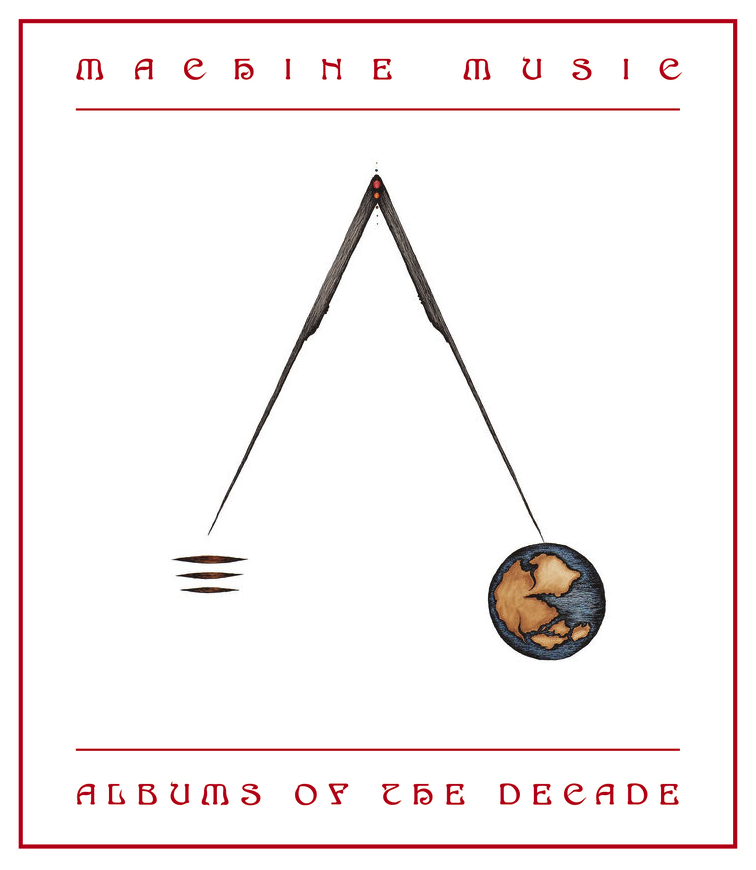
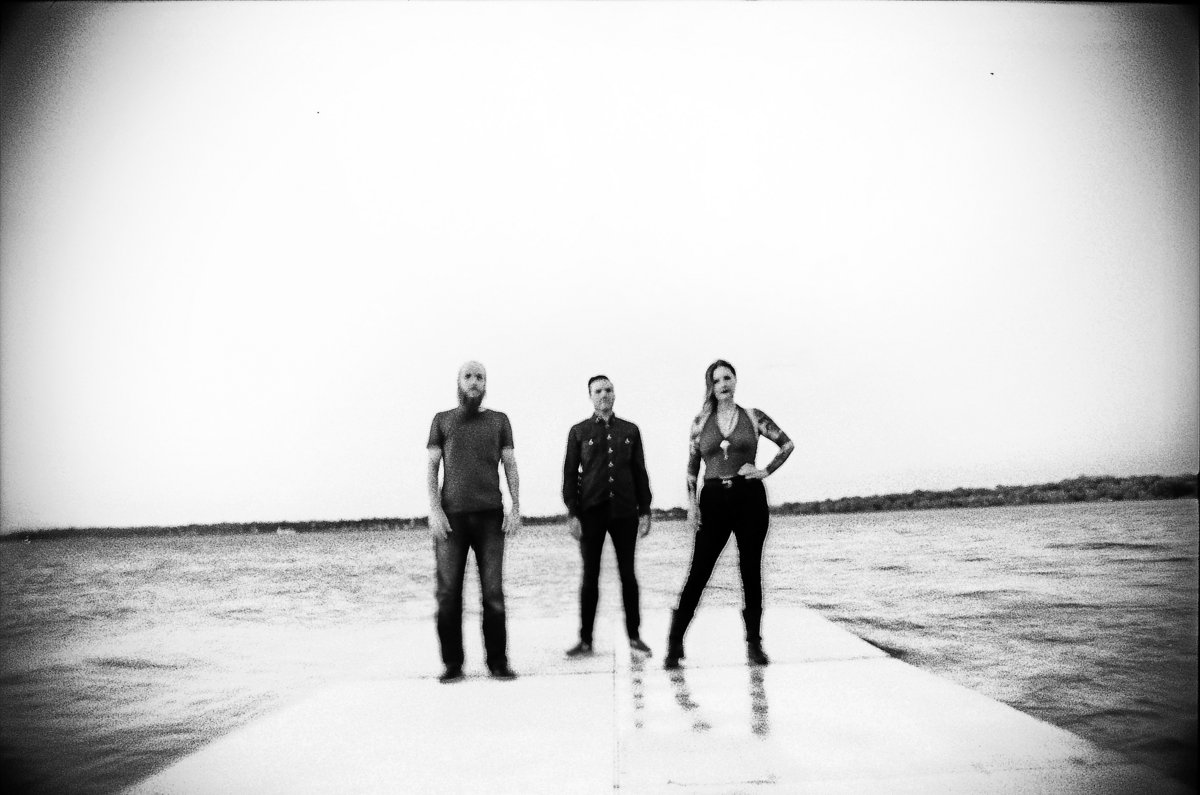
The Bare Bones: As High as the Highest Heavens and from the Center to the Circumference of the Earth is the second full-length from American doom/shoegaze trio True Widow, comprised of Dan Phillips (guitar and vocals), Nicole Estill (bass and vocals), and Timothy "Slim" Starks (drums).
The Beating Heart: As this series begins to fade slowly into what may well be its end there comes that sense one has when the work has been done – well, most of it – and you look at the scattered objects on your desk and begin to make sense of it all. I'll write more when I'm "done" done, but this series began as a weird experiment and morphed into a life-altering experience, one focused not on me being a fan but, slowly and surely, on thinking hard on the experience of making art. I've been trying to include True Widow into that framework for the longest time, literal years, to the point of nearly giving up. It was important for me that they were in some way included for the simple fact that few, very few bands have had real-life impact on me and my life as True Widow has since I first listened to – and was blown away by – As High as the Highest Heavens. Which also means that it, along with a very select group of albums, some of which are included in this project, such as Wavering Radiant, Gin, Vertikal, and others, had a crucial role in not just being beautiful to me but in shaping the form and character of this website. Don't believe me? Here's me freaking all kinds of ways about High as the Highest in April of 2012. I don't often agree with 2012 Ron, but he's right on the money.
So, the opportunity to chat with Dan about the process behind that album and in general behind the work of the band meant a great deal to me. It meant even more given where the conversation went, and in a way it became as a compact symbol of all the things that have become important to me as a fan, writer, author, and person since beginning this interview series – of the craft of making life-shaking art. I know Dan doesn't do a ton of these, though I suspect with the a new album looming – yes, a new album looming (!!) – he might do more, but I nevertheless dearly appreciate his time and candor. Meet your heroes. Sometimes they rule.
HEAD'S UP: Our new compilation benefitting World Central Kitchen is out now. As always, you check out my various interview projects and other cool shit. And if you'd like to keep abreast of the latest, most pressing developments follow us wherever I may roam (FALSE!) (Twitter, Facebook, Instagram, Spotify and now also a tape-per-day series on TIK TOK!), and listen to my, I guess, active (?) podcast (YouTube, Spotify, Apple), and to check out our amazing compilation albums. You can support my unholy work here (Patreon), if you feel like it. Early access to our bigger projects, weekly exclusive recommendations and playlists, and that wonderful feeling that you're encouraging a life-consuming habit. On to my chat with Dan.
I began this project seven years ago and there's really no good reason for me to keep doing it because who cares at this point. It was kind of cool when I was doing it and you know, when everyone was talking about the decade that was, no one really cares about that now. But I say this with all seriousness I would not let go of it until I got you guys.
Dan: [Laughs] So we’re the final one.
You might be. I've done good stuff and there are 58 interviews published for this project, so I could have quit at any given time. But True Widow meant so much to me for so much of that period that I felt like I would have been betraying the very idea of doing this if I didn't talk to you.
Dan: Yeah.
So, that's the wider context. And the narrower context is that because I'm always talking about albums that are kind of in the past, this is not like a PR-cycle interview.
Dan: Right.
I'm a writer myself, not a musician. And so I'm very much interested in how stuff gets created, why, what makes it feel good, what makes it change. And so that's kind of the stuff I'm into. So that's a broad overview.
Dan: Yeah. That might be why it works for me now because it's not in the middle of a cycle. I’m not gonna say we're not doing anything, but it's not coming at a time where we're doing a bunch of interviews or anything like that. So I think for me it's unrelated to anything going on.
Best-case scenario, you might even find it productive, you know, for your own thing.
Dan: Right, sure.
So that's what we're aiming for. I told you in advance that it's technically going to be about As High as the Highest, but really I could have chosen any one of your albums. I'm being a cliché right now, but I could have chosen any one of your albums. I just chose it because it was the one that got me into you guys.
Dan: Well, that's my favorite one.
So there you go. A good reason.
Dan: Good choice.
So the conversation might kind of veer toward it, away from it whatever we want to talk about whatever when you say "Ron get the fuck out of my face," I will.
Dan: [Laughs].
The first question is always a set question, and the set question is this: Do you remember a time, preferably as a younger person, when you heard an album of a song, saw a live show, saw an album art that kind of went, kind of rewired your brain? It was like: “Oh, we can do this also? This is an option?” And because a lot of the people I interview are into heavier music then sometimes it can be a scary moment because that's often a theme. But it doesn't have to be that. So just that. Do you have anything like that kind of comes to mind?
Dan: Well, I will say that before starting True Widow, there were a couple of bands that I liked that I knew used different tunings for the guitars. And I went to see Gossip, pre-disco Gossip, back when they were just like a three-piece garage band, with guitar, drums, and vocals. And watching the guitar player do all this stuff and get low notes and bass lines and all that I was like: "Okay.” I like [The Jon Spencer] Blues Explosion and, you know, Sonic Youth, of course, and Morphine, again, they're a trio with a saxophone, bass, and drums. Just being able to do kind of more than the normal with the guitar.
Anyway, after seeing the Gossip that night, I think maybe the next day, I just started tuning…. I was kind of “bored” with the guitar, so I just went home and started turning the tuners and then just came up with this open tuning, and then it was like playing guitar was fresh and fun again, just getting more out of the guitar. I was aware that you could do that, but I think after seeing the Gossip that night, seeing it in action, hearing it coming out of the amps live, it really did something for me. I didn't go home and start True Widow. I had another band at the time. Maybe three or four of the songs on that last record that we had done had a handful of songs that had that tuning on them.
This is with Slowride?
Dan: Yeah. It was a long, long, long, long time. I mean, up until maybe a couple of years ago where I wrote anything on a regular tuned guitar again.
So, that tuning you kind of struck on, you kept it that way all that time.
Dan: Yeah. Well, True Widow, I think there are five tunings, at this point. But initially it was just that one alternate tuning. On that Slowride record it's all that that one tuning. But then by the time we made a True Widow record there were three or maybe four, but it all started with that very first one. And I still use that. That's the one I would think of as the primary tuning, but I'd have to make a list and it may be an equal number as any of the other ones. But in my head, and probably because it's the first one I ever did, it feels like the main tuning. So maybe not the main one but the root, the one that started it.
And so, on any given album you might have more than one?
Dan: Yeah, for sure. There are two of them that are kind of similar, one of them is drastically different, and then two of them are alterations of the other two that are kind of similar. But, yeah.
Okay, I have a couple of things in mind. Because, again, I'm not a musician. I can play the intro to “Through the Eyes of Ruby” by the Smashing Pumpkins, basically. But that seems to me like a complicating factor in a band, no? I mean, because the bass is affected by how you tune your guitar, right? Doesn't that require a kind of consensus about where things are going?
Dan: Right. It made me appreciate Nicole because she is not changing the tuning of the bass. I don't even what the chords are, so I can't be like: “It's B, C, D,” so she just has to figure it out. Sometimes I'm looking over at what she's doing and it's like she's in between frets….. She's just got to figure it out without me being able to give her really any information on what's happening.
That's pretty amazing.
Dan: I think there might be one or two songs where she tunes a low string down just so she can hit a really low note, but for 98% of the time she's just tuned regularly and has to learn where to play. The nice thing about it is that they sound like complicated songs but really they're just kind of simple songs, but since the chords are crazy it sounds more complicated than it is.
Yeah, I listen to complicated bands, I never got the sense that True Widow was going for that.
Dan: No, I like to keep things really simple, I’m not looking at my hands necessarily or thinking about: “Here comes this part”….. Sometimes. if I forget how to play one of our songs and I'm trying to figure it out, like a song that we haven't played in a long time or something, and I'm like “What was I doing?” and I've got my hands all contorted and I'm like: “I would never have done this to myself" [laughs].
[Laughs]
Dan: So I just keep figuring out and then it clicks in and it's like: “Oh, it's two fingers right here and I don't have to move at all” [laughs].
[Laughs] I actually wanted to ask about that because, and here I'll share my anxiety with you. My anxiety at this moment of our conversation is double, right? The first is I overcomplicate everything in my life.
Dan: [Laughs], yeah.
There's nothing simple in my life, nothing. I overcomplicate anything, even my relationship with my children, I write really weird novels about that. So nothing to me seems simple. And all the stuff that looks simple to other people seems to be very complicated and ambiguous and kind of multi-layered. And that's how I write, that's how I think. And an outcrop of that is that I am immensely jealous of people who manage to not only aspire to, but also kind of achieve simple things.
Dan: Yeah.
And so I guess my first question is something that's always attracted you? Are you a closet prog guy, but you're just playing three chords when you're playing? Or is it something about this simplicity, the kind of the bare-bones aspect of it that has always been attractive for you?
Dan: I don't like complicated stuff. Listening to things that sound complicated doesn't do anything for me, generally. I mean, of course, I like some things that are crazy complicated, but, in songwriting, I think simple melodies and chord changes and harmonies and drum patterns and all that, just a big pile of simple things can end up sounding complicated. And like even in woodworking, each step…. I can make some crazy cabinet that has a thousand things going on, but each layer of that, each step, each task is like cutting to a line, and then trapping out the waste. Each aspect is really simple, but then it becomes a big pile of simple things and looks or sounds complicated, but if you break it down, it's just really, really simple.
But we're talking about two kinds of "complicated" here. Not to complicate the matter [fake laughs], but we're talking about two kinds of complicated, right? One would be like…. I know you make furniture. I'm glad you kind of got on that. I don't make furniture, but I'm the biggest Antiques Roadshow fan in the world.
Dan: Yeah, me too.
So I'm very much an appreciator, as I said, of crafted things. And so I checked out your furniture. And the first thing that comes to mind is: “Of course this is the furniture the True Widow guy makes.”
Dan: [Laughs]
It fits perfectly.
Dan: Yeah.
But what I wanted to say about that is that on the one hand, it's complicated because…. So, my favorite was that high chair you made for your daughter. Also because I have kids and I love that, that you made something so beautiful for your kids. And so, you look at that and you say: “Well, on the one hand, this is very complicated, in that it is very technically proficient. This is very well done. The proportions are very well done. This is a beautiful object.” But on the other hand, it's a chair.
Dan: Ah ha.
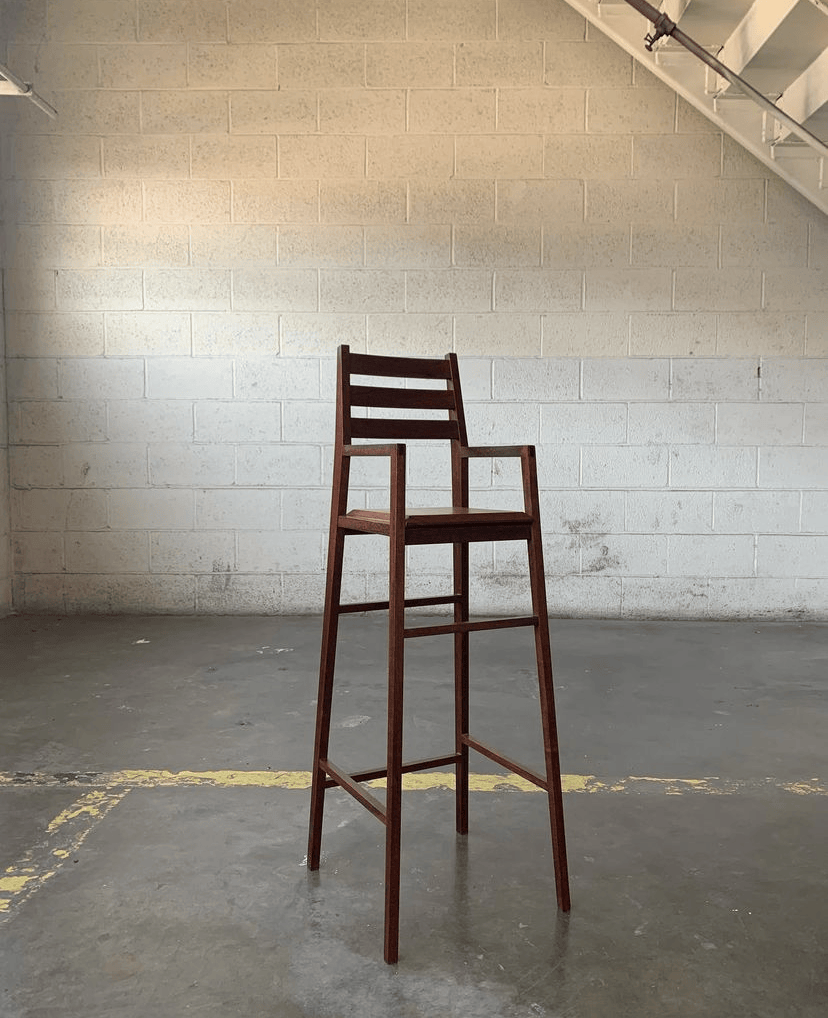
This is not some Louis XIV, Baroque, Rococo something or rather.
Dan: Right, right.
It's a chair. It's a regular chair that got stretched into being a high chair, right? And so I realize that the craft can be complicated, making the proportions right can be complicated. But on the other hand, the end result, and again, maybe some people listen to True Widow and say: "Oh, crazy progressions," whatever, I don't. The end result is a very simple, efficient thing. You know what I'm saying?
Dan: Yeah, yeah.
So, that's the part I'm jealous of. I'm not jealous of all the sanding…
Dan: [Laughs]
I'm jealous of the fact that all of that time and creativity produces this sleek, catchy – in terms of music – thing.
Dan: Yeah. I guess it's just that my brain does "simple" and doesn't do "complex." I don't know. As far as music goes, I might like it complex the way Chopin is complex, but it also doesn’t sound complex….. I don’t know.
I get that. I don't know how much you're into…. Do you know Krallice?
Dan: No.
Okay. So Krallice are a kind of a modern American crazy black metal band. And when I say “crazy black metal band” don't think about people in the woods sacrificing animals, think of a bunch of dorks from Brooklyn playing black metal, right? That's kind of the angle. And so, you can listen to that and say: “Holy shit, I’m a bit overwhelmed. There's so many notes and so many transitions and so much is going on." And you can listen to that and say: "That's complicated." But on the other hand, if you kind of look at it like you would a kind of an expressionist painting from afar, it's just waves, coming up and down, coming up and down. Right. So on the one hand, in that way, it's kind of simple. It sounds crazy to say it because it's complicated, again, Chopin – no one listens to Chopin and says "I can do that."
Dan: Right.
It sounds hard to do. And the reason I'm kind of jabbering about this is because of the example you gave at first of going to the Gossip show…. Even that is a very interesting choice, because all you did the next day…. You didn't wake up the next day and buy a whole new instrument or get a personality transplant, you fiddled with the tuners, and you're good to go.
Dan: Yeah.
So, it’s a revolution, a very important moment, artistically, but it doesn't take a lot.
Dan: Right, Yeah.
It feels like you kept on that kind of wave.
Dan: Yeah, it was fun. And then and then you're like writing songs again, and it feels like you're doing something completely different. But, there are only, whatever, 12 chords, whatever it is, I can't remember, there's only so many notes and so many chord changes out there and it's, you know, it's 2026 and people have been writing music with these same choices or available chords for thousands of years. So, you change the tuning of the guitar and it changes how the chords sound, it changes all kinds of stuff, but it is still the same chords and melodies, but it felt brand new and it was interesting and exploratory.
I had to make up all new chords and where your fingers go can be upside down from what you're used to. I started playing guitar when I was ten, and I'm turning 50 in a couple of months.
Congratulations
Dan: Thank you. Anyway, and this was like this was like a long time ago now, but it made something I've been doing my whole life brand new again, and in turn like when when I started making music for Bad Stuff, that's all regular-tuned guitar, so like that became fun again, to go from crazy tunings to regular tunings. So, I don't know, switching it up rejuvenated writing music again and playing the guitar again. I always liked writing music.
Yeah, actually, because I know nothing about these things like tunings or whatever, it kind of maybe half explains or a quarter explains some of the True Widow magic for me, right? Because the songs, it's a verse chorus, verse chorus kind of world.
Dan: Right.
And it's going to be a catchy chorus, often.
Dan: Yeah.
But there's something weird about it, or weird enough, I guess, for it to be a bit more than that, just enough more than that.
Dan: Yeah. Like you said, it is…. We'll call them standard formulas, verse- chorus, all that stuff. But it's slowed down a little bit, or it sounds slowed down, and the way the chords are resonating, because the strings are looser they’re vibrating in different ways. And in a lot of the tunings, if you just put no fingers on the fretboard and you just hit the strings, all of them, it makes an open chord, so you get to have all of these kinds of drone notes going off underneath there. And then you add a couple of different echoes going on and they'll pick up overtones.
There's an undeniable effect in the way the notes are resonating and ringing and, tonally, if you play an A on a regular-tune guitar and then you play an A on my guitar, they hit differently, the way the notes are stacked. I don't know, it's deeper. And then you sing on top of that and like it's in my range, and then if me and Nicole can harmonize over the top of it, it's like this really huge thing that's affecting, definitely affecting the ears and the brain.
I mean, the only kind of comparison my limited brain could think of, not in terms of the variously vibrating strings, but for music that is as emotionally intense and beautiful and kind of simple in the same way as you guys, and the harmonizing voices, is Low.
Dan: Oh yeah.
And also something about the rhythms. That's like an all-time comparison for me, there's no one like Low.
Dan: When I went to college I had in my dorm room this guy that lived down the hall who turned me on to Low, this was when I Could Live in Hope had come out, and I listened to that record, or CD, I would say every night to go to bed for like a year straight. And then we went to see them – he was like “They're coming!” They were opening up for this band called Soul Coughing…
Oh my god [laughs].
Dan: I don't know why they would ever have Low as their opening band.
I'm not sure I heard that name in like 20 years.
Dan: Right, yeah. This was 1995. They were touring on that album. It was fucking awesome. Everybody, the whole crowd, just sat down. Some people were laying down. And then they ended, and then it was like, all right: "Soul Coughing! Coming out now!" [laughs].
[Laughs]
Dan: Everyone was like: "Whoa, what?" Anyway, all that to say that I absolutely love Low. I've seen him a few times. Huge, huge influence on me. That’s certainly where True Widow came from.
So, a kind of random fact: When my daughter was born, my eldest daughter…. So, like anyone who just had his first child, I was in a dark cave. Like, I didn't know what was going on, I was delirious with anxiety and all that stuff. And then Low came to play, I don't know how old she was, a few months old, and it was my first night out alone. And I was like: "I have to go. I have to go." And as with every time you want to step out of the house when you have kids, it's always rushed, it's always stressful. It's never just going out. And so I got there at the last minute, and I kind of weasled my way into the crowd. And then they played, and it was like they changed the chemistry of the air in a second [I wrote about that show, here].
Dan: Yeah, it's amazing. I just got goosebumps from that story. Because it’s true.
I was like the White Rabbit in Alice [making weird rushing noises) and then I got there and the music hit me…. And I already loved them. I mean, my entry was Things You Lost in the Fire, which is one of the greatest albums ever made, but the moment, and I know it's weird to say it because they're a band and Alan is great and they're all great, but Mimi is the anchor. She holds the rhythm there and her voice is unmatched.
Dan: Yeah, it’s beautiful
And so when she gets to that moment where she sings and you're like: “I don't, where am I? I don't know where I am.”
Dan: [Laughs]. Yeah.
And so, to me, True Widow and Low are kind of like in conversation, and they're both actually bands I don't care about the genre of.
Dan: Yeah.
Like, I don't care what the genre of Low is and I don't care what your genre is [laughs]. I just want to think for a second and feel.
Okay, I wanted to get to As High as the Highest, but I'll ask kind of a rudimentary question about that. And then I'll get to another thing, which I hope I don't forget. So to me, that album stands out, quite interestingly. You guys have been you guys from the second you put in an album. So there hasn't been a gargantuan, tectonic shift. There is no “blue period” in True Widow, right? It's basically you guys.
Dan: Yeah.
But in that world of kind of staying at the same frequency, As High as the Highest feels like a leap. It’s two steps forward instead of a half a step.
Dan: Right.
Which made me wonder what it was about making that album that might have been different for you guys? Was the tuning thing more polished for you? Were you kind of braver with those kinds of choices? Because it feels like you figured something that still stays with you.
Dan: Something that's probably exactly the thing is that I had written most of those songs for the first album before even thinking I would have a band. And we, long story short, ended up making a band, and recording some demos and never intending…. The whole MO of the band was to never be a band, because I didn't really want to do that anymore. So I just wanted to have the music and hear it. Slim was not a drummer he had never played in a band, blah, blah, blah.
When you say he was not a drummer, did he not know how to play the drums?
Dan: He had never played drums in a band. But I had a drum set. I was like: “You can keep time, I just want to hear this.” So we did that. And then anyway, it was sounding cool, got Nicole in there, recorded some demos. I sent them to my band member from my previous band, he was roommates with this guy, Jonathan. He played them for them. Jonathan was like” Do you want to put this out? You want to go to the real studio and put this out?” And we were like: “Okay.” Anyway, so we did that, and that album came out in, I think, ‘08.
And then we did relatively nothing for a really long time, which was fine, because I've never wanted to do anything with it, period. So, it came out, it was just out there.Meanwhile, we're still making up songs.
Where I'm going with all this is that by the time an opportunity had been made for us to record our second album, it'd been a couple of years. So, we had a shitload of songs, more songs than you could put on a record, and had been playing…. When we recorded the first one, we hadn't been playing together that long, but by the time we recorded the second one, we had been playing together a long time, and had amassed this huge pile of songs.
So when it was time to go to the studio, we had recorded demos of all of them, and we just had so many to choose from. So, the band had evolved and developed in this sort of inbetween period, which we didn't even realize was an inbetween period, and I think that has everything to do with what you're talking about: We had been a band longer and had been allowed the freedom and room to just develop and keep evolving what we were doing, even though I would say not that evolved [laughs], but enough so. And then when we went to the studio…. On the first record, we had the drums and this isolation booth, and the guitars and basses out in the big room. This time we were like: “Let's put the drums in the big room and the guitars and amps in the isolation room,” so there was a huger sound. We also had way more time to record. I think we did the first one probably in a week. But this one we had two weeks to do the recording, just more time to explore and more time to make up more music, I guess. I don't know.
So you might not have known that was an in-between time, and you probably didn't know that was evolution time, that you guys were getting better at something. But once the album is out, or once a certain process is something that you've established, how do you maintain all of that stuff? So how do you maintain the band not being “a band”? How do you maintain what you called “freedom,” right? Freedom to kind of look out for what you want? Doesn’t that become more difficult to do when the band kind of gets established? To stay free?
Dan: No, no. I say “no” because it was very important to us to maintain that MO, and we still have it to this day, where we only do things that sound cool and fun to do. We don't have any pressure from the record label. I mean, obviously, our last record came out like 10 years ago, we're still on the label. I wouldn’t say they “don't care,” but when I say we want to do another one, they're like: “Sick.”
[Laughs]
Dan: Or if I said we're not going to do another one, they'd be like: “Okay.” So, we're existing in this world where we do this because we like it, we're not going to just put out a record because we should, we're not going to put out a record because it's been ten years. We're going to put out a record because everything's in alignment and everything is sounding cool and that's when we want to do it, that's when we want to go on tour yeah like we don't. We don't do things that don't feel right, and we don't have to do them. You know, none of us are like: “This band, we need to be doing this band,” you know, we just do it because we like doing it and that’s the only reason we like doing it, you know?
You might not be surprised how often I hear that, especially from bands who maintain a certain level of, I guess, integrity in their music. There's no drop off, right? And so when you talk to those bands, like Neurosis is a great example. When you talk to those bands, nine times out of ten, they'll say: “Because it isn’t my day job.”
Dan: Right. Right.
And “Had it been my day job, I would have ruined this a while ago.”
Dan: Yeah, that I couldn't do it as a day job. It changes what it is. It's fun, and we're really lucky to have this outlet – we can put out records, we got a label, we got people that will support it. We don't take that for granted, you know. But if we had no label or anything like that, we would still get together and make demos and make stuff. I'm never not going to be writing songs. But if I had to, I don't know. I think that would totally flip what the whole thing was. And I think it would not be as good.
Yeah, I just interviewed a band you probably don't know called Cleric, and they operate.
Dan: Yeah, I've heard of them.
Not the Texas death metal Band.
Dan: Okay, That's the one I have heard of.
They're a New York avant-garde band and they work with John Zorn, so they do kind of weird shit And I had a conversation with them about improvisation, this was recently, a couple of weeks ago. And so we caught on to this idea that improvisation works because you really don't have an idea what you're doing. And it's only in retrospect that you go: “Oh, I kind of like that part.” But it's only when you have complete freedom to do whatever the fuck you want. that you can accidentally get at something that's really cool. And so, at one point, the guy I was talking to, Matt, said, I don't remember the wording, he said something like: “If you force it, won't happen.” And I said, and I said something like: “Well, actually, maybe there's a better way of saying that. Maybe you learn that it's just more productive to not take ownership of any of this shit.
Dan: Yeah.
That shit just happens. And if you accept that shit just happens, cooler shit will come. And if you obsess over it and you say, no, it has to be cool now, the cool thing will never happen.” And so it's not like we are egoless floating consciousness who don't care about whether or not we make good art. It's just that we know that if we care too much about it, the art will suck.
Dan: [Laughs] I can't go in to sit to write a song. I will go down. I will go sit and play my guitar. That doesn't mean the song is going to come out. But you know, when it does, and it's like turning me on, I'm like: “I'm going to make a little voice memo on my phone of this and re revisit this.” And I'm going to make a voice memo because I will forget it. I cannot sit down with the purpose of writing a song. I just have to wait for ‘em. And that's kind of like why it's been so long for a True Widow record, because that hadn't happened. I wrote a bunch of songs, but none of them were really True Widow songs. And then, I don't know, maybe about a year or so ago, they just started pouring out. And I was like: “Okay, it's time, here come all the True Widow songs.” Slim, our drummer moved away a few years ago, but when he comes back to town, we'll get together just to play. And the last couple of times he's been here I was like: “I've got some new songs,” and I've sent them demos, my home demos. So, we've played some new songs and it's flowing. It sounds right and it sounds fucking cool. And so we were all like: “Alright, let's do another one.”
That's awesome. I mean, I'm currently slightly obsessed with this topic because I just published a novel. It's my third novel.
Dan: Cool.
And there is really nothing I like less than the actual publishing and then waiting around to see if people will read it…
Dan: [Laughs] Right
…. or if they like it, or if they're forced to read it, that whole bit. There's nothing I like less. And it really makes me kind of question why I do it.
Dan: Totally.
Because I'm obviously having a great time doing it. My version of band practice, or, for that matter, my improvisation, is just me chilling with my computer, thinking of really weird shit and the one that sticks is the one that stays, right? And so that's fun. And it's a protection for me. I feel like it's really like armor-building for me. Like, when I do that, then I am more able to function as a human being. So I know the benefits. I don't need to be told the benefits.
But when you're kind of vulnerable and it's out there, it feels like: “Why am I doing this?” And so in a way I have to kind of, I think it's a weird sort of comfort to tell yourself repeatedly, this really isn't about you.
Dan: [Laughs] Right.
This isn't about you at all. Your name's on the cover, that's true. And if they want to write a review, it will be about you. And if they ever want to interview anyone, like we're doing right now, it will be kind of like about Dan, but it really isn't about Dan. And it isn't about me. It's about stuff that is beautiful that has something to do with our lives, right?
Dan: Yeah.
And we also know that sometimes in fiction writing, this is more apparent, but sometimes I would imagine with music as well, especially with the lyrics part, sometimes people say: “Well, that thing you wrote about, did that happen to you?” And you can genuinely say: “I don't know. It might have.”
Dan: [Laughs] Yeah.
Sometimes it's very particular, but sometimes it's just like a vibe, it's a feeling and it doesn't necessarily it's not you. So, I'm trying to exorcise the demon of ego. Sorry about that.
Dan: No, no. It's exactly the same.
How is it exactly the same?
Dan: That question: "Why am I doing this?" Like, what is the fucking point of this? Or l have it with painting, or any kind of artistic output. It's like “What is the purpose of this?” But I think with writing, or with painting, or making music, it feels good to get it out, it feels good to see your idea or hear your idea. And it's not for critical acclaim. Of course I like it if someone likes the painting or likes the music, or the piece of furniture, or whatever, or the lyrics, or the writing, but if I never knew if anybody liked it or not, it doesn’t change the art.
I have something that helps, because I think a lot of people don't believe that, that you don't care.
Dan: I know, yeah.
But I think what helps people believe it is that if someone came up to me and told me they liked my book – that feeling, albeit a good feeling, and one that I wish for, lasts five minutes.
Dan: Right.
It doesn't matter how powerful the compliment or who it's coming from, it will last five minutes, unless it's some kind of meaningful engagement. Like I hope sometimes I create with these conversations, unless it's some kind of meaningful engagement with your work, then the thing you're waiting for isn't really that hot. It's not that great. So you can't be doing it for that because it's not a lot.
Dan: [Laughs] Yeah. I've got some new songs that I've written that will go somewhere, even two little ones where I'm like: “Will anybody like this song?” But I think it's cool, and I think it fits in this group of songs. And maybe it doesn't sound like a True Widow song has ever sounded, but I am not going to not include it because I think people will think it's weird or like: “What is this!?” I'm putting it in there because it’s part of this and I like it. So, OK [laughs]. I don't need you to like it, I like it, and I want to document it and I want to include it in this project. You can skip over it if you don't like it.
So, I had a question that had to do with this idea of “it belongs in this group of songs.” And I'm going to open this question with a very strange reference. So there's an English, very dark, very strange death metal band or black metal band, whatever the fuck they are, called Abyssal. And they have an 11-minute song that if I were, again, as a non-musician, I would say 10 minutes of that song is asking a question. A lot of open ends that don't really get resolved. And the last minute of the song is the question being answered. So that's a very extreme version of that.
And I get the sense that a lot of True Widow songs, like if I had to kind of put my finger on what makes a True Widow song, along with what you just already said, which really contributes a lot – the vibrations, the overtones, the weird tunings, you and Nicole harmonizing over it, the kind of simple song structures that feel eerie – that a lot of them are kind of unresolved tension. A lot of them are…. It’s not angst or anything like that, but it's “What happening?” But it's so pleasant and so pretty that you kind of go along for the ride, but there's still this undercurrent of not having a resolution to this idea.
Dan: Yeah.
Now the reason I say this, whether or not you agree with it, is that there are two songs, one in As from High as the Highest, which is “Jackyl” And the other is from Avvolgere, which is “OOTPV” that I single out, as a True Widow listener because they have this bridge part ,or the C part or the chorus that is a complete and definite resolution. Like a punch in the face in a beautiful way.
Dan: Yeah.
So, in “Jackyl” it’s in “this will come.” That's not a question. It's cathartic. It's pretty.
Dan: Yeah.
Beautiful.
Dan: And the song is built up to that moment.
Exactly. And then there's a moment similar in “OOTPV,” right? “There's something in the way,” just that repeating refrain, which is also beautiful. And so it kind of makes me wonder at one point or I, know this is part of a process that you're not always kind of in control of, or not in control of at all, we just talked about it, but do you know that sometimes it's cool to stop asking questions and start kind of putting a nice flower on top of all the dark stuff. Do you feel when that's happening?
Dan: I don't know.
Or am I talking out of my ass, which I might be.
Dan: No, you're not. I'm just thinking if I might be doing it intentionally, but coming from a different language but it's doing the same thing. I don't know. I like a resolve, I know we have songs that have no resolve, but the resolve might be a bigger picture. And I definitely like to have bright spots sprinkled in. From a songwriting standpoint, there might be a couple of songs here and there where I want it to not resolve, or if it does, has this really unsatisfactory resolve [laughs]. But I don't know. I don't know whether it's intentional…
I'm sure it's unintentional, that's not that's not my thing. My thing is that, you know, do you notice the fact that you sometimes “go for pretty”? Even when you listen back to it, that sprinkling of bright spots, as you, that there's value to that, that it’s not just overcast.
Dan: Right, yeah, I definitely do that. And there'll be songs…. I'm writing all the songs and there's songs I'll be singing and I’ll go: “I think Nicole should sing this one.” Because it will do something, sonically different than if I'm singing it. And we'll do the “pretty thing,” or, I don't know, like even with “Jackal. That song is slow and nasty, but Nicole's vocals are really clean and pretty. So, if I'm singing that it's maybe more sinister-sounding than if Nicole's singing it. And so that is an intentional decision. I don't know.
That's a good answer. I mean, that's like it's more of an orchestra, right?
Dan: It should be the flute not the cello.
Yeah, as in the higher notes and the lower notes. Yeah: “I feel like something needs to come here and this feels like the right thing.”
Dan: Yeah. There's one we're doing right now that, I mean, I really want to sing it, but in my gut, I know it will hit in a different way if Nicole does the main vocal. And so I'm having to really convince myself, because I want to sing it. But I'm: “But I know I know that it will do the thing if Nicole sings it. And it'll sound really cool.”
I like that story because you're a human being who wants things for himself. But you have to fight that urge in order to get the best result, right?
Dan: Yeah. I know it will be ultimately the thing that I want, if she sings it. And it'll have a different sound if I sing it.
Man, I wish you could write a book as a band.
Dan: [Laughs] Yeah, somebody could do it.
Sounds like a fucking nightmare. So I want to ask just one last question because I don't want to take up too much of your time. And the last question is a set question too, just to keep us in check and recognize our limits as humans. And I know we didn't talk a lot specifically about As High as the Highest, but when you think about that album, you've already mentioned that it might be your favorite, but is there anything specific to that you are still very kind of proud of? It might be a decision, a specific track, a specific moment in the track, the cover art, whatever. Is there something you think about that album and you're like “I have a positive feeling about this.”
Dan: I like that album as a whole, front to back. I was cleaning out these boxes and I found a CD of it, and I hadn't had a CD player in a long time and my car has a CD player in it. So I put it on and listened to it like three times in a row. The other other albums I will skip over songs that I don't like, but that one I can't. Every song I love, the way it flows, all the little noises in front of them behind things. It has something that…. So, the very last song called “Doomseer,” there's this break before it gets heavy and I do this feedback thing on my steel guitar where it just sounds like these shrieking shit coming, just annihilating, and it's like it gives me chills, but I can't do that live. I guess I could find like a sampler pedal and do it, but that moment is so fucking dark and scary sounding and I just wait for it and I'm always trying to count time and it doesn't really line up.
Which is great.
Dan: I love that. We need to figure out how to add that sound for live shows because, God, it's just so scary-sounding. But, my point is that when it's not there, then it’s: “Hey, that got heavy right there,” but, man, it's not fucking terrifying-sounding as it is on the record [laughs]. And then there are steel guitar parts on that…. There's so much I love about that record, the way we recorded it. I love all the lyrics. If you ask me what my favorite True Widow song is, I would say “Blooden Horse” and that's on that album. Just the whole vibe. We really sound together. My amps are in perfect condition on that recording [laughs] – on records after that they've started degrading or needed a new tube or something. So, sonically, I love it. I love that the cover art is white [laughs] instead of like black doom and gloom. I don't know. There's so much I love about it. I love the way it starts with the drums coming in. I really, really like that one, and there's a lot of things about it that we try to…. When we got back to record – I was happy you wanted to focus on this record, because when we go back to record, I want to…. Not recreate that but just put the drums back out in the big room, do some things in the recording sessions that we did on that one, just the way the room sounds, and get my amps repaired [laughs]. Sonically, I love that one and I would like for this next one to be more like that one than any of the other ones.

